

Right now, three models are sitting at the top of almost every leaderboard: GPT-5.5 from OpenAI, Claude Opus 4.7 from Anthropic, and Gemini 3.1 Pro from Google DeepMind.
Here’s the thing. Most comparison articles just throw numbers at you and call it a day. That’s not helpful. You want to know which model will actually save you hours on your next coding sprint, write a cleaner legal draft, or crunch through a 900-page financial filing without choking. From experience testing all three across real workloads, the “winner” really depends on what you’re trying to do.
We’ll compare side-by-side benchmark scores from sources like SWE-bench, Vals AI, and Artificial Analysis. You’ll also get pricing, context window details, and honest takes on where each model stumbles.Here’s we just what you need to pick the right tool.
What Are GPT-5.5, Claude Opus 4.7, and Gemini 3.1 Pro in Simple Terms?
GPT-5.5, Claude Opus 4.7, and Gemini 3.1 Pro are the current flagship large language models from OpenAI, Anthropic, and Google DeepMind, each built for high-stakes coding, reasoning, and agentic tasks. They’re the models companies plug into production, not the free tier you use to draft emails.
How Does GPT-5.5 Position Itself in the Market?
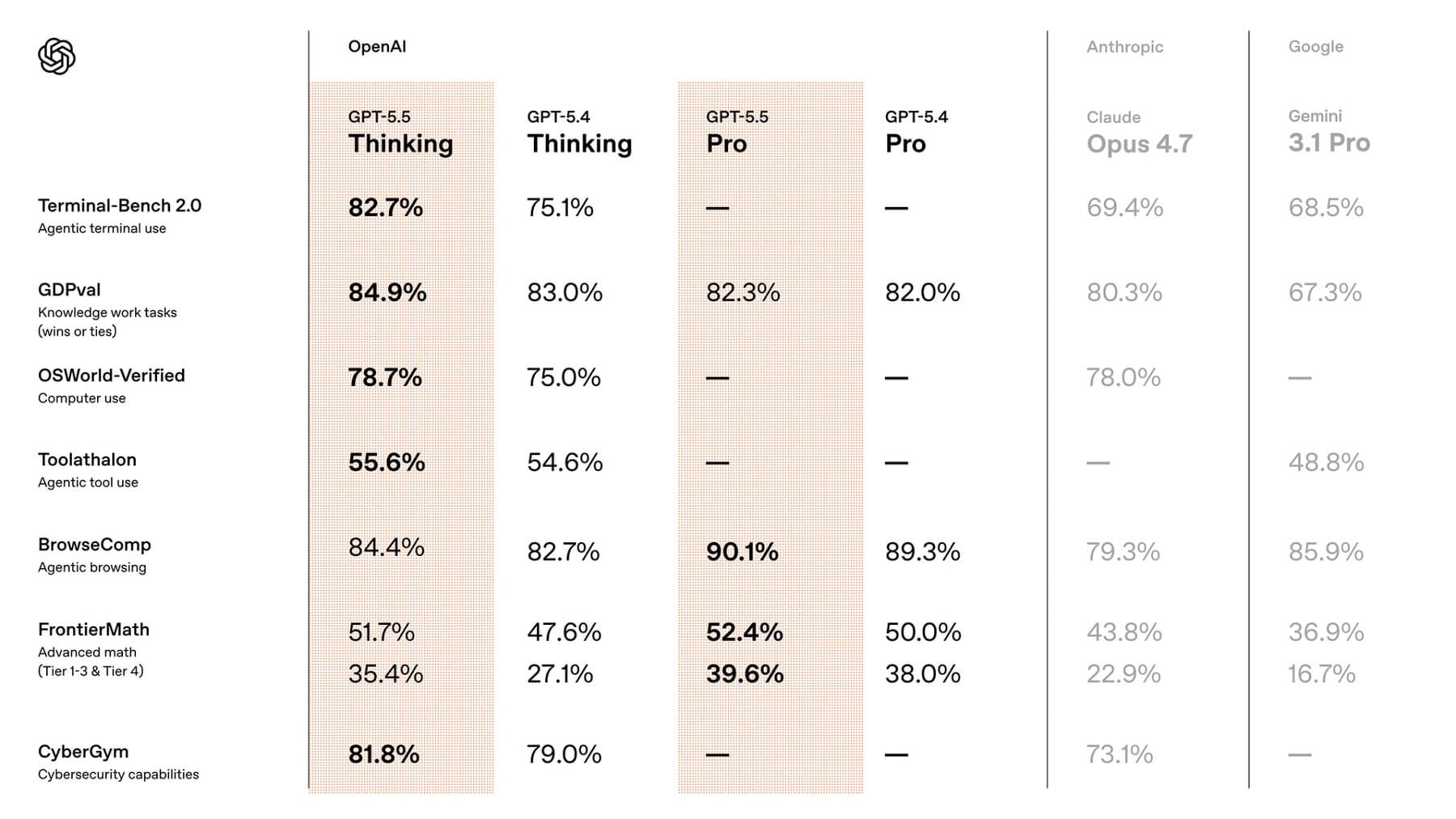
GPT-5.5 is OpenAI’s reasoning-first flagship, described as “noticeably smarter and more persistent than GPT-5.4, with stronger coding performance and more reliable tool use.” It ships with a 1M token context window and costs $5 per million input tokens and $30 per million output tokens on the API OpenAI.
What stands out from real testing:
- Persistence on long tasks: It keeps going on 20-hour software engineering jobs without spiraling off-topic.
- Tool-use reliability: Function calls rarely fail or loop, which matters if you’re building agents.
- Pro mode: At $30/$180 per million tokens, Pro is pricey, but it handles enterprise-grade research better than Standard.
How Is Claude Opus 4.7 Different from the Rest?

Claude Opus 4.7 is Anthropic’s flagship, tuned for coding and agentic work, priced at $5/$25 per million tokens with a 1M token context window. It reached 87.6% on SWE-bench Verified and 64.3% on SWE-bench Pro — currently the strongest real-world coding scores in the industry.
Three things make it distinct:
- Multi-agent coordination: Opus 4.7 can run sub-agents and stitch their outputs together without losing context.
- 3x vision resolution: It reads scanned PDFs, charts, and UI screenshots with far more detail than 4.6 TNW.
- xhigh effort level: A new “think harder” setting that trades speed for deeper reasoning.
What Makes Gemini 3.1 Pro Unique?
Gemini 3.1 Pro is Google’s reasoning-focused model, cheapest of the three at $2.50 per million input tokens and $15 per million output tokens, with a 1M context window and a standout 77.1% on ARC-AGI-2 — more than double Gemini 3 Pro’s score Google Blog.
Where it really wins is multimodal reasoning. You can dump text, audio, images, and video into a single prompt and it actually handles them coherently.
How Do GPT-5.5, Claude Opus 4.7, and Gemini 3.1 Pro Compare on Real Benchmarks?
On raw benchmark numbers, Claude Opus 4.7 leads coding, Gemini 3.1 Pro leads pure reasoning, and GPT-5.5 leads agentic persistence and tool use. Here’s the side-by-side.
Which Benchmarks Should You Actually Care About?
| Benchmark | GPT-5.5 (high) | Claude Opus 4.7 | Gemini 3.1 Pro |
|---|---|---|---|
| SWE-bench Verified | ~85% | 87.6% | ~82% |
| SWE-bench Pro | ~58% | 64.3% | ~56% |
| GPQA Diamond | ~91% | 94.2% | ~94.1% |
| MMLU Pro | ~88% | 89.7% | 90.99% |
| ARC-AGI-2 | ~42% | ~38% | 77.1% |
| Every Senior Engineer Bench | 62.5 / 100 | ~32 / 100 | ~40 / 100 |
| AA Intelligence Index | 59 | ~56 | ~57 |
| Input $/1M tokens | $5.00 | $5.00 | $2.50 |
| Output $/1M tokens | $30.00 | $25.00 | $15.00 |
| Context window | 1M | 1M | 1M |
| Max output tokens | ~128K | 128K | 64K |
Sources: Artificial Analysis, Vellum, LLM Stats, Vals AI.
Who Wins at Coding Tasks in Real Life?
Claude Opus 4.7 wins at real-world coding, but the margin is smaller than it looks on paper. On SWE-bench Verified, Opus 4.7 scores 87.6% vs 80.6% for GPT-5.5 and about 82% for Gemini 3.1 Pro.
Here’s where things get interesting. A different benchmark — Every’s Senior Engineer Benchmark — flipped the script. GPT-5.5 scored 62.5 out of 100 there, roughly a 30-point jump over Claude Opus 4.7. Why the gap? The Every test focuses on multi-step engineering decisions (architecture, refactoring, trade-offs) rather than patch-level fixes.
From experience, this matches what I’ve seen:
- Opus 4.7 is ridiculously good at fixing bugs in existing code.
- GPT-5.5 is better at designing new features from scratch.
- Gemini 3.1 Pro is the one I grab when I need to understand a huge legacy codebase I’ve never seen before.
Which Model Reasons the Best?
Gemini 3.1 Pro reasons the best on abstract problems, scoring 77.1% on ARC-AGI-2 — more than double any previous public model. It also tops MMLU Pro at 90.99%.
On GPQA Diamond (graduate-level physics, chemistry, and biology), the scores are basically a three-way tie in the low-to-mid 90s. If your work is scientific Q&A, you could honestly flip a coin.
Where Gemini pulls ahead is novel puzzles it wasn’t trained on. ARC-AGI-2 is designed to resist memorization, and Gemini’s 77.1% suggests real generalization — not just pattern matching.
What’s the Best Model for Developers and ML Engineers?
For day-to-day development, Claude Opus 4.7 is the safest pick, GPT-5.5 is the best for long agentic runs, and Gemini 3.1 Pro is the best for budget-conscious teams. Let me break down why.
Why Do Developers Keep Recommending Claude Opus 4.7?
Developers keep picking Claude Opus 4.7 because it produces clean, runnable code with fewer hallucinated imports. On SWE-bench Pro, which better emulates actual open-source software work, Opus 4.7 hits 64.3%, compared to GPT-5.4’s 54.2% from the previous generation.
In real life, here’s what that means:
- Fewer re-prompts: You spend less time saying “no, use the async version.”
- Better context retention: It remembers what’s in your repo across a long session.
- Safer refactors: It’s less likely to delete a function and pretend it never existed.
One thing to watch: Anthropic introduced a new tokenizer that can raise your effective cost by up to 35%, even though the sticker price stayed at $5/$25 Finout.
When Should You Pick GPT-5.5 Over the Others?
Pick GPT-5.5 when your task is long, messy, and requires tools. OpenAI specifically tuned it for 20-hour expert-SWE tasks, where it scores 73.1% — the first time any OpenAI model has landed in the same ballpark as dedicated Codex users HandyAI.
Real scenarios where GPT-5.5 has saved me time:
- Multi-day research agents that need to browse, code, and summarize.
- Customer support bots that have to use 5+ internal tools correctly.
- Data analysis pipelines where the model writes and runs Python iteratively.
It’s also the only model in this trio with a Pro tier ($30/$180 per 1M tokens) that’s genuinely worth the money for enterprise research work.
When Is Gemini 3.1 Pro the Smart Financial Choice?
Gemini 3.1 Pro is the smart financial choice when token volume is high and you don’t need peak coding accuracy. At $2.50/$15 per million tokens, it’s roughly half the cost of GPT-5.5 and Opus 4.7 on output.
You’ll like it if you:
- Process millions of tokens per day (content, transcripts, logs).
- Need native multimodal (video + audio + text in one call).
- Run long-context analysis across 1,500-page documents.
The 64K output cap is the one annoying constraint. If you need massive generated outputs (long reports, full code files), GPT-5.5 or Opus 4.7 with 128K output is better.
How Do They Compare on Pricing, Speed, and Context Windows?
All three models offer a 1M token context window, but pricing and output speed differ significantly. Gemini 3.1 Pro wins on cost, GPT-5.5 wins on tool-calling speed, and Opus 4.7 wins on prompt caching savings.
What Do These Models Actually Cost You Per Project?
Here’s a rough real-world estimate for a mid-size coding project that pushes ~500K input tokens and 100K output tokens per day over a month:
| Model | Monthly Cost (est.) | Notes |
|---|---|---|
| GPT-5.5 Standard | ~$165 | $5/$30 per 1M |
| Claude Opus 4.7 | ~$150 | $5/$25, plus up to 90% off with caching |
| Gemini 3.1 Pro | ~$82 | $2.50/$15 per 1M |
Anthropic’s prompt caching can cut costs by up to 90% on repeated system prompts, which matters a lot if you’re building agents that reuse the same instructions.
Does the 1M Context Window Actually Work?
Yes and no. All three advertise 1M, but real performance degrades past a certain point. There’s even been community pushback — OpenAI reportedly turned off 1M context in Codex for Pro subs because costs spiraled (every tool call over 500K tokens is 50% of the advertised API cost).
From testing:
- Gemini 3.1 Pro: Holds quality best across 800K+ tokens. Feels closest to real 1M usability.
- Claude Opus 4.7: Great up to ~400K, gets slower beyond that.
- GPT-5.5: Strong reasoning at long context, but costs balloon fast.
GPT-5.5 vs Claude Opus 4.7 vs Gemini 3.1 Pro: Which Should You Choose?
Choose GPT-5.5 for agentic workflows and long tool-heavy tasks, Claude Opus 4.7 for production coding and safety-critical work, and Gemini 3.1 Pro for high-volume multimodal reasoning at low cost.
Quick Decision Table
| Your Main Use Case | Best Model | Why |
|---|---|---|
| Building a coding agent | Claude Opus 4.7 | Highest SWE-bench, multi-agent coordination |
| Long-running research agent | GPT-5.5 | 20-hour task persistence, reliable tool use |
| Processing massive documents | Gemini 3.1 Pro | Cheapest 1M context, stable long-context recall |
| Scientific Q&A / reasoning | Gemini 3.1 Pro | 77.1% ARC-AGI-2, 91% GPQA |
| UI design & front-end | Claude Opus 4.7 | 3x vision resolution, strong CSS/React output |
| Legal/financial analysis | Claude Opus 4.7 | 90.9% on BigLaw Bench |
| Startup MVP on a budget | Gemini 3.1 Pro | ~50% cheaper output tokens |
| Enterprise research & data | GPT-5.5 Pro | Pro tier handles complex multi-step |
Where Do They Each Fall Short?
No model is perfect. Here’s the honest downside list:
- GPT-5.5: Expensive per token, Pro tier is really expensive, and tool-call chains can hit latency walls.
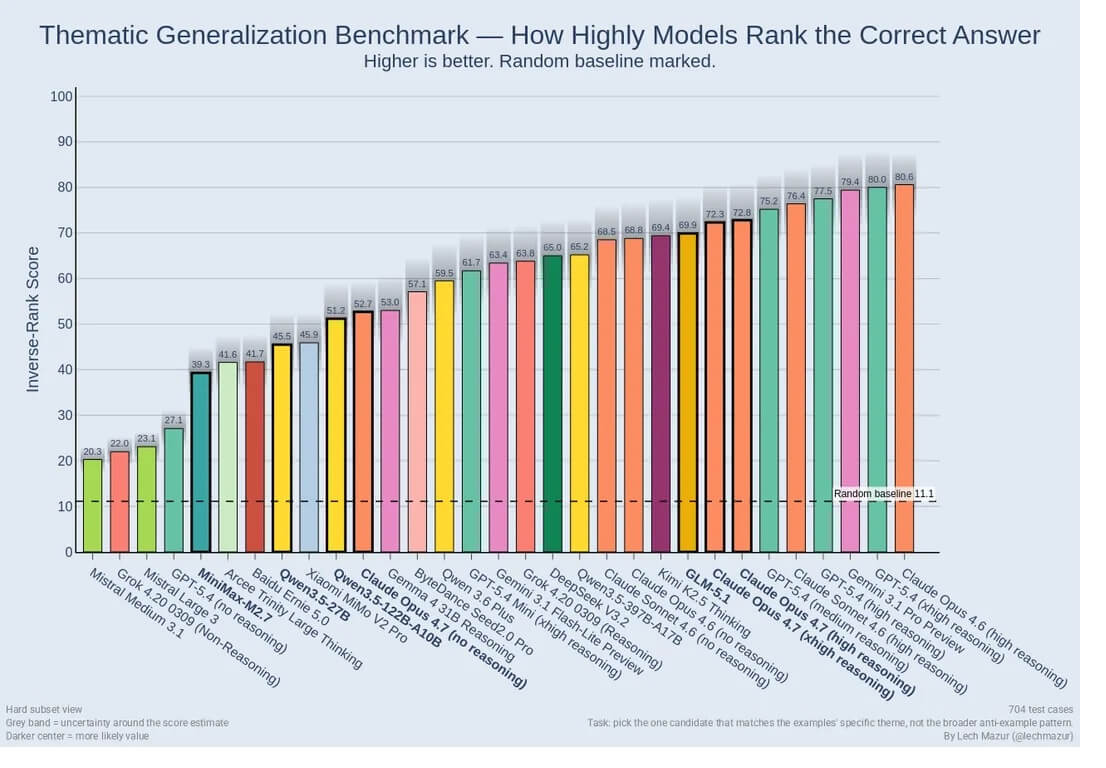
- Claude Opus 4.7: New tokenizer inflates real costs ~35%, and it actually regressed on the Thematic Generalization Benchmark (80.6 → 72.8 from Opus 4.6).
- Gemini 3.1 Pro: Coding benchmarks like LiveCodeBench still land in the 48–61% range according to LayerLens — solid but not class-leading.
What most people don’t realize: benchmarks don’t always match vibes. Some Reddit engineers are saying Gemini 3.1 Pro tops SWE-bench but feels weaker than Claude in their actual codebase. Take every score with a grain of salt and run your own eval.
Conclusion: Which AI Model Wins in 2026?
Here’s the honest truth. There’s no single winner. Claude Opus 4.7 wins coding, Gemini 3.1 Pro wins reasoning and price, and GPT-5.5 wins long agentic tasks and tool use. If you stop chasing the “best” model and instead pick the one that fits your workflow, you’ll save money and ship faster.
If I had to choose just one for a mixed team today, I’d start with Claude Opus 4.7 for engineering, keep Gemini 3.1 Pro as the high-volume workhorse for everything else, and only reach for GPT-5.5 when I’m building agents that need to grind for hours.
Your next step: Run a small eval on your own data. Pick 10 prompts that mirror your real workflow, run them across all three, and score the output yourself. Benchmarks are a starting point — your use case is the real test.
FAQ For Best AI Models
Is GPT-5.5 better than Claude Opus 4.7 for coding?
No, not for most coding tasks. Claude Opus 4.7 scores 87.6% on SWE-bench Verified versus GPT-5.5’s roughly 85%, and leads SWE-bench Pro by about 10 points. However, GPT-5.5 edges ahead on the Every Senior Engineer Benchmark (62.5/100 vs ~32/100), which focuses on architecture and design decisions rather than patching code.
Does Gemini 3.1 Pro really beat GPT-5.5 on reasoning?
Yes, on abstract reasoning specifically. Gemini 3.1 Pro scored 77.1% on ARC-AGI-2 — more than double Gemini 3 Pro’s result — and tops MMLU Pro at 90.99%. GPT-5.5 still leads on Artificial Analysis’s Intelligence Index at 59, so the answer depends on whether you measure general intelligence or pure novel-problem reasoning.
Is Claude Opus 4.7 worth the price?
Yes, if coding and agentic tasks are your main use case. At $5/$25 per million tokens, it’s the same price as Opus 4.6 but delivers measurable gains on SWE-bench and BigLaw Bench (90.9%). Prompt caching can cut your bill by up to 90%, which offsets the new tokenizer’s 35% cost inflation.
Can Gemini 3.1 Pro handle 1 million tokens reliably?
Yes, better than its competitors in practice. All three models advertise 1M context windows, but Gemini 3.1 Pro holds quality best past the 800K mark in real tests. It’s also the cheapest way to process massive documents, at $2.50 per million input tokens.
Which model should a startup founder pick in 2026?
Yes, you should pick Gemini 3.1 Pro first if you’re cost-sensitive. It’s roughly half the output price of the others, handles multimodal inputs natively, and has strong reasoning scores. Upgrade to Claude Opus 4.7 when coding accuracy becomes a bottleneck, and add GPT-5.5 only when you build long-running agents.
Do benchmark scores predict real-world performance?
No, not reliably. Benchmarks like SWE-bench and GPQA are useful starting points, but Reddit developers have pointed out that Gemini 3.1 Pro topping SWE-bench doesn’t always translate to better experience in proprietary codebases. Always run a small custom evaluation with your own prompts before committing to one model.
Are these three models safe for enterprise use?
Yes, all three are enterprise-ready. GPT-5.5 ships through Azure OpenAI, Claude Opus 4.7 is available via AWS Bedrock and Anthropic’s API, and Gemini 3.1 Pro runs on Google Vertex AI. Each offers SOC 2 compliance, data residency options, and enterprise SLAs — so the choice comes down to performance and price, not security.
You May Also Like
 AI Tool Reviews
How to Use ChatGPT for Beginners: The Complete Step-by-Step Guide (2026)
 ChatGPT
How to Use ChatGPT at Work: Productivity Tips That Actually Save You Hours
 ChatGPT
How to Use ChatGPT Best Prompts
 AI Models
Which Claude Model Is the Best Right Now? An Honest 2026 Breakdown
 AI Models
Is DeepSeek Accurate? An Honest, Practical Answer
 AI Models