
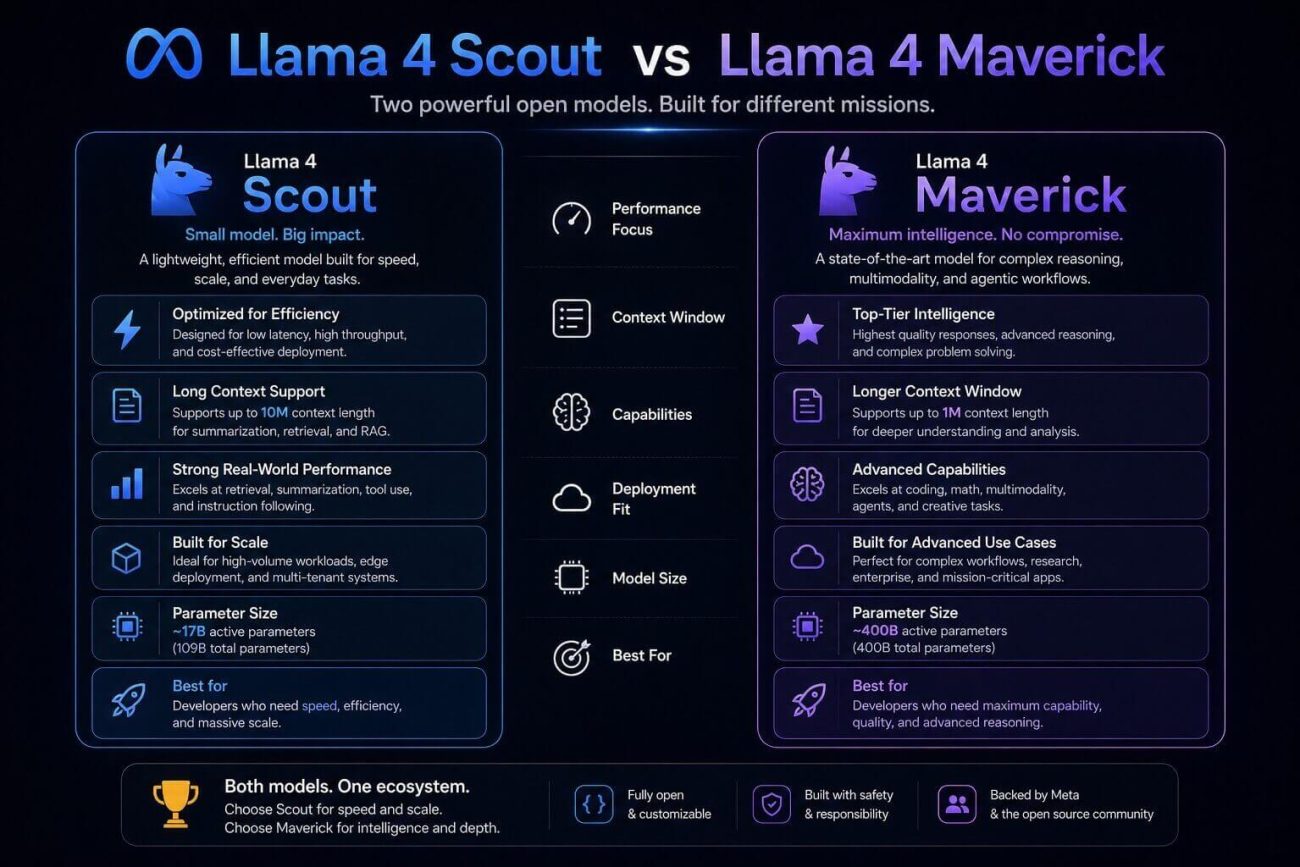
Meta dropped Llama 4 and the AI community lost its mind for about 72 hours. Then the dust settled, the benchmarks rolled in, and a lot of people realized they had no idea which version they should actually be using. Scout? Maverick? Both? Neither?
Here’s the thing, these two models share the Llama 4 last name, but they’re built for very different jobs. Picking the wrong one means you’re either burning money on overkill or hitting a performance wall you didn’t see coming. So let’s break it down properly — what each model is, how they actually compare, and which one deserves a spot in your stack.
If you came here looking for a clean, no-fluff comparison of Llama 4 Scout vs Llama 4 Maverick, you’re in the right place. I’ve pulled together specs, benchmarks, real-world feedback, and the stuff that vendors quietly leave off their pitch decks.
The Quick Version (For People Who Just Want the Answer)
If you’re skimming, here’s the TL;DR:
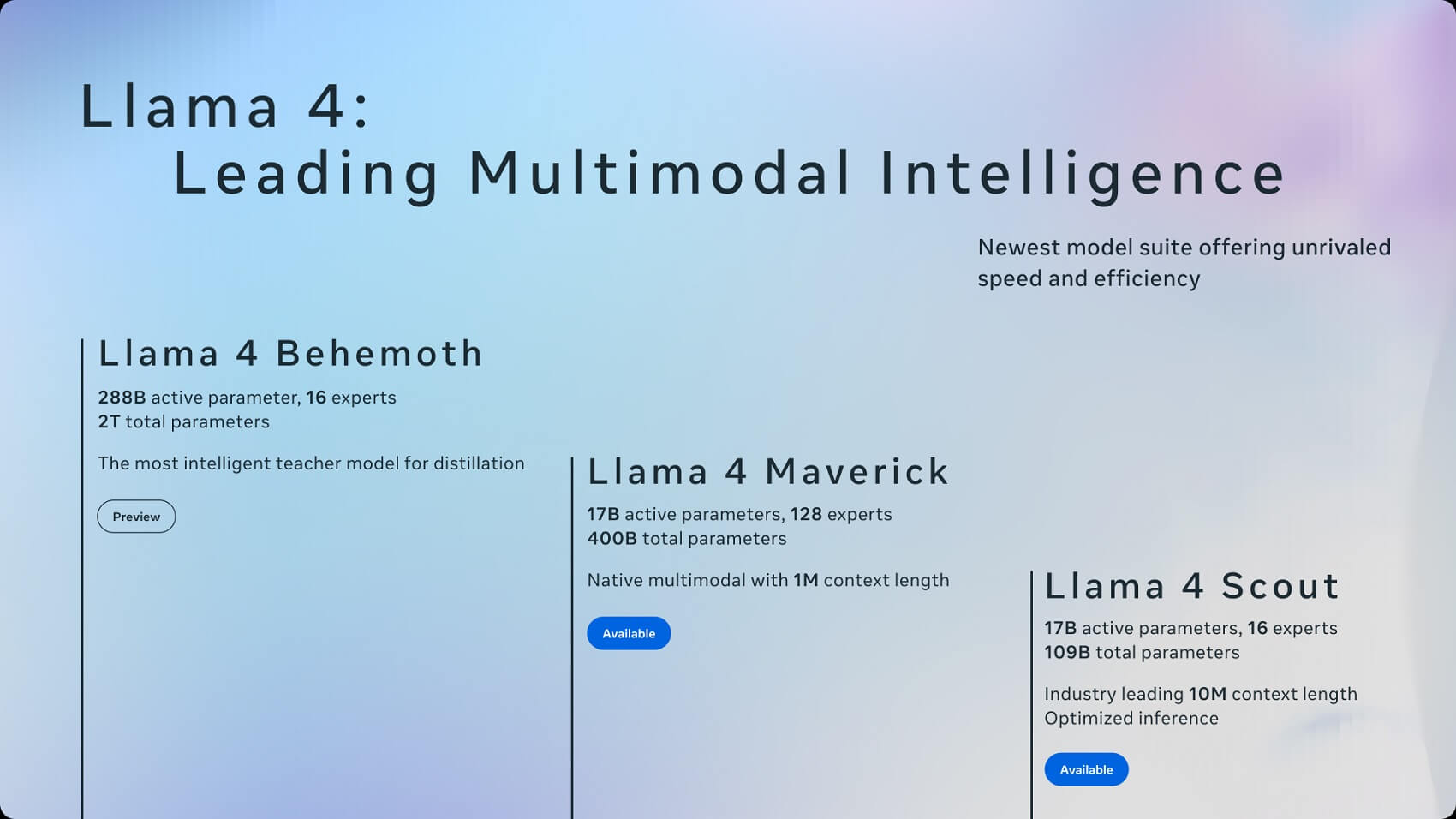
- Llama 4 Scout is the lean, fast, long-context workhorse. 109B total parameters, 17B active, 16 experts, and that wild 10M token context window everyone keeps talking about. Cheap, efficient, runs on a single H100.
- Llama 4 Maverick is the heavier, smarter, more expensive sibling. 400B+ total parameters, 17B active, 128 experts, 1M context window, and significantly stronger reasoning and coding chops. Needs 8x H100s to self-host.
Same architecture family. Different weight classes. That’s the whole comparison in two bullet points, but the why matters way more than the specs.
What Llama 4 Even Is (Quick Refresher)
Before we get into the head-to-head, a quick reset. Llama 4 is Meta’s first generation of natively multimodal, mixture-of-experts (MoE) open-weight models. “Natively multimodal” means images and text were baked into training from day one — not bolted on later. “MoE” means the model has a huge pool of parameters, but only activates a small slice for any given query.
That’s why both Scout and Maverick have 17B active parameters despite their wildly different total sizes. The MoE setup is what makes Llama 4 cheap to run for what it delivers (Meta AI).
There’s also a third model — Llama 4 Behemoth — but it’s not publicly released yet, so we’ll set that one aside.
Llama 4 Scout: The Long-Context Specialist
Scout is the model Meta clearly designed for accessibility. It’s small enough to run on consumer-friendly enterprise hardware, but it punches well above its weight thanks to that ridiculous context window.
Scout at a Glance
- Total parameters: 109B
- Active parameters: 17B
- Experts: 16
- Context window: 10,000,000 tokens (yes, 10 million)
- Multimodal: Yes, native
- Hardware: Single H100 GPU is enough for inference
- Pricing (Groq): $0.11/M input, $0.34/M output.
That 10M context window is the headline feature, and it’s genuinely industry-leading. For perspective, GPT-4 Turbo capped out at 128K. Claude maxed at 200K. Scout is doing 10 million. That’s roughly 7,500 pages of text in a single prompt.
Where Scout Actually Shines
From what I’ve seen in real testing, Scout is the move when:
- You need to feed entire codebases, contracts, or research libraries into a single prompt
- You’re building lightweight agents or retrieval workflows on a budget
- You want to self-host without buying a server farm
- You’re processing high volumes where cost per token actually matters
It also outperforms Gemma 3, Gemini 2.0 Flash-Lite, and Mistral 3.1 in its weight class on most standard benchmarks.
The Honest Catch
Here’s where things get interesting that 10M context window comes with an asterisk. Real-world testing shows Scout’s recall starts degrading well before you hit even 32K tokens (Reddit). So while you can technically dump a novel into the prompt, you shouldn’t expect surgical precision when you ask it about page 847.
What most people don’t realize is that “context window” and “effective context window” are two different things. Scout has the technical capacity, but if you’re doing needle-in-a-haystack retrieval, you’ll still want a proper RAG pipeline.
Independent reviewers have also pointed out that Scout’s general intelligence feels closer to Llama 3.1 8B than to a flagship model — capable, but not a reasoning genius.
Llama 4 Maverick: The Heavyweight Reasoner
Maverick is where Meta flexes. It’s bigger, more expensive, and substantially smarter — especially in coding, math, and complex reasoning.
Maverick at a Glance
- Total parameters: ~400B (some sources cite 402B)
- Active parameters: 17B
- Experts: 128
- Context window: 1,000,000 tokens
- Multimodal: Yes, native
- Hardware: 8x H100 GPUs for self-hosting
- Pricing (Groq): $0.50/M input, $0.77/M output.
The big number here isn’t the parameter count — it’s the 128 experts. That’s 8x more specialized expert networks than Scout, which is why Maverick handles nuanced, domain-specific reasoning so much better.
Where Maverick Actually Shines
This is the model you reach for when:
- You need GPT-4-class reasoning at open-weight pricing
- You’re building production-grade chatbots or copilots
- Multimodal understanding (text + images) needs to be sharp, not just functional
- You’re running enterprise RAG, complex agents, or tool-use chains
The experimental chat version of Maverick scored an ELO of 1417 on LMArena at launch — competitive with Claude 3.7 Sonnet and trailing only DeepSeek V3 in its tier. For an open-weight model that costs a fraction of GPT-4o, that’s genuinely impressive.
The Honest Catch
Let’s be honest — Maverick isn’t perfect. On coding-specific benchmarks, it’s been outpaced by smaller specialists like Qwen2.5-Coder-32B, hitting only around 70% accuracy on some coding evals. For pure code generation, you might want a coding-specialized model instead.
Also, the hardware requirements are serious. 8x H100s isn’t a casual setup — that’s roughly $20,000/month on-demand if you’re renting cloud GPUs. Most teams will end up using API providers rather than self-hosting.
Side-by-Side Comparison Table
Here’s the cleanest way to see the differences:
| Feature | Llama 4 Scout | Llama 4 Maverick |
|---|---|---|
| Total Parameters | 109B | ~400B |
| Active Parameters | 17B | 17B |
| Number of Experts | 16 | 128 |
| Context Window | 10M tokens | 1M tokens |
| Multimodal | Yes (native) | Yes (native) |
| Self-Host Hardware | 1x H100 | 8x H100 |
| Self-Host Cost (est.) | ~$2,500/month | ~$20,000/month |
| Input Pricing (Groq) | $0.11/M | $0.50/M |
| Output Pricing (Groq) | $0.34/M | $0.77/M |
| LMArena ELO (chat) | Mid-tier | 1417 |
| Best For | Long context, low cost | Reasoning, multimodal depth |
| Safety (lower ASR is better) | 56.7% ASR | 49% ASR |
That last row matters too — according to Protect AI’s vulnerability assessment, Maverick is meaningfully harder to jailbreak than Scout, which is worth considering for production deployments where safety actually matters.
How They Actually Compare in Practice
Specs are one thing. Real workflows are another.
For Document Processing and Long Context
Scout wins, but with a catch. Yes, it has the bigger window. Yes, it’s cheaper per token. But effective recall starts degrading past 32K-ish tokens, so you’re not really getting “10M tokens of useful memory.” You’re getting “10M tokens of capacity, with diminishing returns.”
If your use case is really about deep reasoning over a 500K-token document, Maverick’s 1M window combined with stronger overall reasoning might give you better results, even though the technical ceiling is lower.
For Coding
Honestly? Neither is the best in class. Maverick is decent but trails behind specialized coders like Qwen2.5-Coder. Scout is fine for autocomplete-style tasks but struggles with complex refactors. If coding is your main use case, look elsewhere or pair Llama 4 with a coding-specialized model.
For Multimodal Tasks (Text + Images)
Maverick is the clear winner here. The 128-expert architecture lets it handle nuanced visual reasoning much better than Scout. If your product involves analyzing charts, diagrams, screenshots, or product photos, Maverick’s the call.
For Cost-Sensitive Production
Scout, all day. The cost difference is roughly 4-5x for input and ~2.3x for output. If you’re running millions of queries, that adds up fast — and Scout’s quality is “good enough” for most B2C and content-heavy use cases.
For Agents and Tool Use
Maverick. The deeper reasoning makes a real difference when the model has to chain tools, evaluate intermediate results, and self-correct. Scout will work for simple agents, but it’s noticeably less reliable when workflows get complex.
Common Mistakes People Make
From experience watching teams adopt Llama 4, these are the traps people fall into:
1. Picking Scout just because it’s cheaper. If your task needs serious reasoning, Scout will save you 70% on tokens and cost you 200% in failed outputs and rework. That’s not a win.
2. Believing the 10M context window is “free.” Latency, cost, and recall all degrade as your context grows. Don’t treat it as unlimited.
3. Self-hosting Maverick without budget for 8x H100s. I’ve watched teams discover this after they committed to Maverick. Use a hosted provider unless you genuinely need the control.
4. Using Llama 4 for pure coding work. It’s not the best at this. Pair it with a coding-specialized model or use a different stack entirely.
5. Skipping evaluation on your own data. Benchmarks are aggregate. Your specific use case might love one model and hate the other. Always run a small eval set before committing.
6. Assuming bigger = better. Maverick isn’t always the right answer. For high-volume, low-complexity tasks, Scout will outperform it on cost-per-correct-answer.
What Actually Works: Practical Tips
Here’s how I’d approach the choice if I were starting from scratch:
- Start with Scout for prototypes. It’s cheap, it’s fast, and it’ll tell you whether your idea works at all. Upgrade to Maverick only when you hit a quality ceiling.
- Use API providers, not self-hosting. Groq, OpenRouter, Together, and others offer both models at predictable pricing. Self-hosting only makes sense at very high volumes.
- Pair models intentionally. Use Scout for retrieval and summarization, then hand off to Maverick for the final reasoning step. Best of both worlds.
- Build a real eval set. 50-100 representative prompts with expected outputs. Run both models. Compare. Don’t trust generic benchmarks.
- Don’t push the context window unless you have to. Keep prompts focused. RAG beats raw long-context recall in almost every real-world case.
- Treat safety differently for each model. Maverick has a meaningfully lower attack success rate, so if you’re deploying to end users, that gap matters.
- Watch the licensing. Both models use the Llama 4 Community License, which has some restrictions for very large companies. Read it before you commit at scale.
What Most People Get Wrong
Here’s where things get a little uncomfortable.
The narrative around Llama 4 went from “GPT-4 killer” to “disappointing release” within about a week, and both takes are oversimplified. Llama 4 isn’t going to dethrone the closed-source frontier — but it’s also not a flop. It’s a cost-efficient, open-weight, natively multimodal family that gives you 80-90% of frontier quality at a fraction of the price, with full ownership of your weights.
That’s a genuinely useful tradeoff for the right team. It’s just not the magic everyone wanted at launch.
The other thing people miss: Scout and Maverick aren’t competitors — they’re a stack. Meta clearly designed them to complement each other. Use Scout where its strengths fit. Use Maverick where reasoning depth matters. Stop thinking of it as “which one wins” and start thinking of it as “which one for which job.”
Final Thoughts: Which Should You Actually Pick?
If I had to give you a one-sentence answer for each common scenario, here’s how I’d cut it:
- Building a chatbot for users? Maverick.
- Processing tons of documents on a budget? Scout.
- Need multimodal vision-language understanding? Maverick.
- Building lightweight agents or RAG pipelines? Scout.
- Doing serious code generation? Honestly, look beyond Llama 4.
- Not sure? Start with Scout, scale up to Maverick if quality demands it.
The biggest mistake I see teams make is treating model selection like a tribal allegiance — “we’re a Maverick shop” or “we only use Scout.” That’s silly. These are tools. Pick the one that fits the job in front of you.
Llama 4 Scout vs Llama 4 Maverick isn’t really a fight. It’s a menu. And once you know what you’re actually ordering, the decision gets a whole lot easier.
You May Also Like
 AI Models
Which Claude Model Is the Best Right Now? An Honest 2026 Breakdown
 AI Models
Is DeepSeek Accurate? An Honest, Practical Answer
 AI for Coding
The Best AI Models for Developers in 2026: An Honest, Hands-On Look at What Actually Works
 AI Models
GPT-5.5 vs Claude Opus 4.7 vs Gemini 3.1 Pro: Real Benchmark Results Compared
 AI Models
Claude Mythos Preview: What It Is, Who It’s For, and Whether It Actually Matters
 AI Models