
OpenAI officially released GPT-5.5 on April 23, 2026, less than two months after GPT-5.4. The model delivers major gains in agentic coding, computer use, and scientific research, scoring 82.7% on Terminal-Bench 2.0 (narrowly beating Anthropic’s Claude Mythos Preview at 82.0%) and 84.9% on GDPval. It’s available now to ChatGPT Plus, Pro, Business, and Enterprise subscribers, with API pricing at $5 per 1M input tokens and $30 per 1M output tokens. A higher-accuracy variant, GPT-5.5 Pro, is also rolling out for Pro, Business, and Enterprise users.
So after months of leaks, Polymarket bets, and endless “Spud” speculation — it’s finally here. And based on a full day of actually using it, running it against real workloads, and comparing it to both GPT-5.4 and Claude Mythos Preview, this isn’t just another incremental point release.
Let’s break down what you actually need to know.
What Is GPT-5.5?
GPT-5.5 is OpenAI’s latest flagship AI model, released on April 23, 2026. OpenAI describes it as their “smartest and most intuitive to use model yet” and the foundation for a new way of doing computer work specifically, agentic work where the model plans, uses tools, verifies its own output, and keeps going through messy, multi-part tasks without constant human supervision.
The internal codename during development was “Spud” — a name that leaked extensively in the months leading up to release and generated significant anticipation in the AI community. And despite the silly codename, the actual product delivers on the pre-release hype in most of the ways that matter.
Three things make GPT-5.5 genuinely different from what came before:
- It’s built specifically for agentic work. Not just smarter chat, but actual autonomous task completion across tools, apps, and environments.
- It matches GPT-5.4’s latency despite being more capable, and uses significantly fewer tokens per task.
- It sets new state-of-the-art benchmarks in 14 categories, including coding, computer use, and scientific reasoning.
Release Date and Availability
GPT-5.5 launched on April 23, 2026, roughly seven weeks after GPT-5.4, a release cadence that reflects just how fast the competitive landscape is moving right now.
Here’s the rollout breakdown:
| Tier | GPT-5.5 Access | GPT-5.5 Pro Access |
|---|---|---|
| ChatGPT Free | ❌ Not available | ❌ Not available |
| ChatGPT Plus | ✅ Available now | ❌ Not available |
| ChatGPT Pro | ✅ Available now | ✅ Available now |
| ChatGPT Business | ✅ Available now | ✅ Available now |
| ChatGPT Enterprise | ✅ Available now | ✅ Available now |
| Codex (all paid tiers) | ✅ Available now | ✅ Pro/Business/Enterprise |
| API | 🔜 Coming “very soon” | 🔜 Coming “very soon” |
Notable: Free-tier users don’t get access to GPT-5.5 at launch. If you want to try it, you’ll need at least a Plus subscription.
What’s New in GPT-5.5
Based on OpenAI’s official documentation and the first 24 hours of public testing, here are the specific improvements that actually matter.
1. Serious Agentic Capabilities
This is the headline. GPT-5.5 is built to handle “messy, multi-part tasks” where you can trust it to plan, use tools, check its work, navigate ambiguity, and keep going until the task is done.
In practical terms:
- It stays on task significantly longer than GPT-5.4 without stopping early
- It handles ambiguous failures without giving up
- It can move across documents, spreadsheets, browsers, and terminals in a single workflow
- It predicts what testing or verification a task needs before you have to ask
Greg Brockman, OpenAI’s president, put it this way in the launch briefing: “It can look at an unclear problem and figure out just what needs to happen next. It really feels like it’s setting the foundation for how we’re going to do computer work going forward.”
2. Major Coding Improvements
GPT-5.5 posts substantially better coding numbers than GPT-5.4, with particular strength in long-horizon engineering tasks:
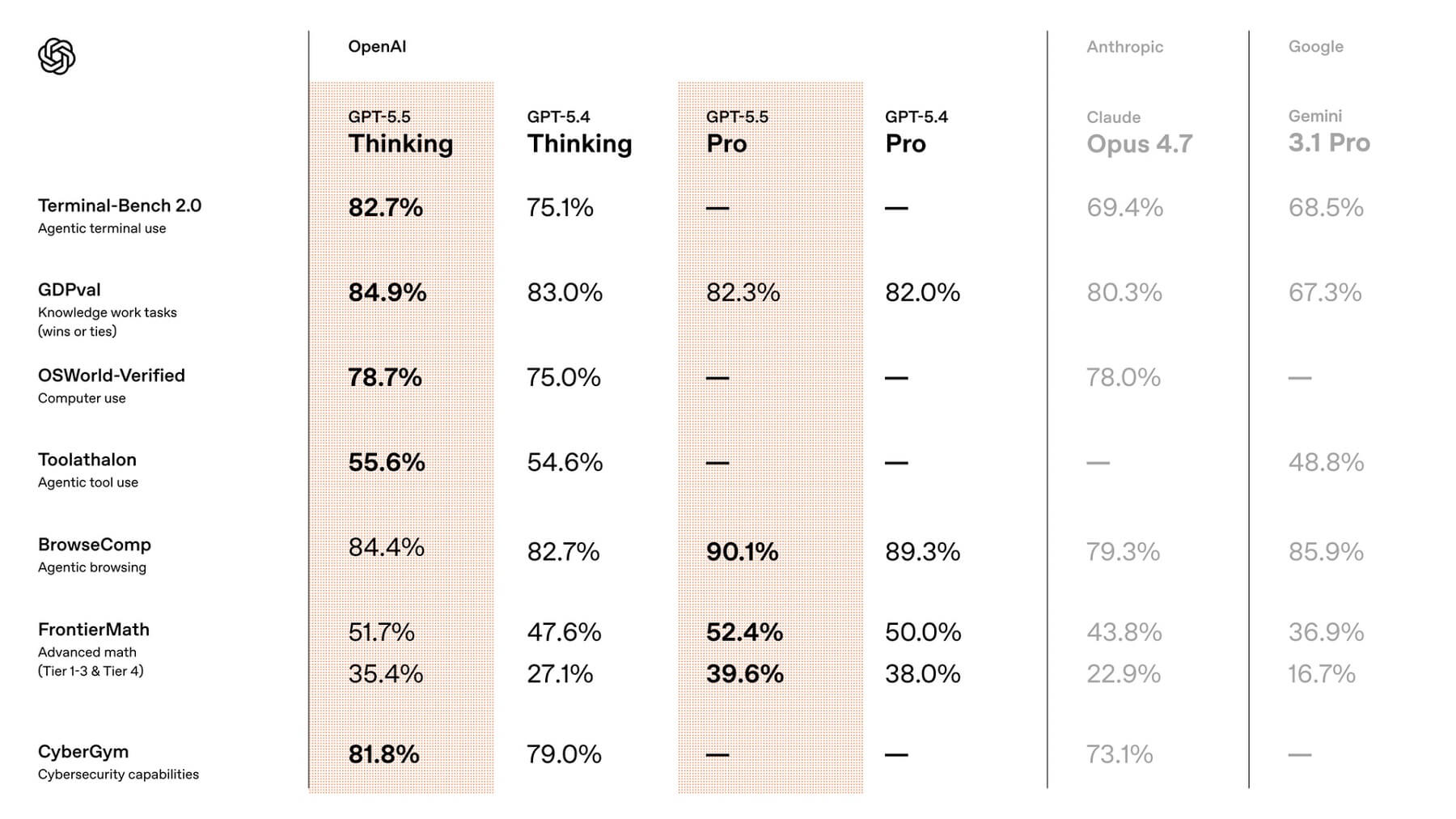
- Terminal-Bench 2.0: 82.7% (vs ~60% for GPT-5.4)
- Expert-SWE (Internal): 73.1%
- SWE-bench Pro (Public): 58.6%
OpenAI specifically notes improvements in implementation, refactoring, debugging, and validation — with stronger performance on large codebases where the model needs to maintain context across many files.
3. Native Computer Use, Upgraded
GPT-5.5 pushes computer use well past what GPT-5.4 could do:
- OSWorld-Verified: 78.7%
- BrowseComp: 84.4%
- Toolathlon: 55.6%
- MCP Atlas: 75.3%
What this means practically: the model can see your screen, click, type, navigate software interfaces, and move between tools reliably enough to actually get work done — not just demo well.
4. Scientific Research Support
This one’s getting less press but matters a lot for researchers and analysts. GPT-5.5 was specifically tuned for scientific workflows:
- FrontierMath Tier 1–3: 51.7%
- FrontierMath Tier 4: 35.4%
- GPQA Diamond: 93.6%
- BixBench (bioinformatics): 80.5%
- Humanity’s Last Exam (with tools): 52.2%
OpenAI’s chief scientist, Jakub Pachocki noted that the team used GPT-5.5 itself to help build GPT-5.5 during development — a useful signal that it’s actually good enough for research work, not just marketing copy.
5. Efficiency Wins That Actually Matter
Here’s the quietly impressive part: GPT-5.5 matches GPT-5.4’s per-token latency while being more intelligent, and uses significantly fewer tokens to complete the same task.
That’s a double win. You get smarter output, faster, at lower effective cost per completed task — even though the raw token price is higher than GPT-5.4.
6. Stronger Cybersecurity Safeguards
GPT-5.5 scores 81.8% on CyberGym and 88.1% on internal Capture-the-Flag challenges — meaning it’s very capable at finding security vulnerabilities. OpenAI acknowledges the model meets their “High” risk classification for cybersecurity (but not “Critical”), which is why they’ve deployed stricter classifiers and more conservative filtering for cyber-related requests at launch.
This context matters: Anthropic took the opposite approach and heavily restricted access to Claude Mythos Preview specifically because of its cybersecurity capabilities. OpenAI is betting they can ship a powerful model responsibly instead of locking it down entirely.
The Benchmarks: How GPT-5.5 Actually Performs
Here’s the complete benchmark picture from OpenAI’s official release, organized by category.
Coding and Software Engineering
| Benchmark | GPT-5.5 Score |
|---|---|
| Terminal-Bench 2.0 | 82.7% |
| Expert-SWE (Internal) | 73.1% |
| SWE-bench Pro (Public) | 58.6% |
Agentic and Tool Use
| Benchmark | GPT-5.5 Score |
|---|---|
| OSWorld-Verified (computer use) | 78.7% |
| BrowseComp (web browsing) | 84.4% |
| Toolathlon | 55.6% |
| MCP Atlas | 75.3% |
| Tau2-bench Telecom | 98.0% |
Knowledge Work and Business
| Benchmark | GPT-5.5 Score |
|---|---|
| GDPval (knowledge work) | 84.9% |
| Investment Banking Modeling (Internal) | 88.5% |
| FinanceAgent v1.1 | 60.0% |
| OfficeQA Pro | 54.1% |
Math and Science
| Benchmark | GPT-5.5 Score |
|---|---|
| FrontierMath Tier 1–3 | 51.7% |
| FrontierMath Tier 4 | 35.4% |
| GPQA Diamond | 93.6% |
| BixBench (bioinformatics) | 80.5% |
| GeneBench | 25.0% |
General Reasoning
| Benchmark | GPT-5.5 Score |
|---|---|
| MMMU Pro (no tools) | 81.2% |
| MMMU Pro (with tools) | 83.2% |
| Humanity’s Last Exam (no tools) | 41.4% |
| Humanity’s Last Exam (with tools) | 52.2% |
| ARC-AGI-2 (Verified) | 85.0% |
Cybersecurity
| Benchmark | GPT-5.5 Score |
|---|---|
| CyberGym | 81.8% |
| CTF Challenges (Internal) | 88.1% |
The pattern here is clear: GPT-5.5 isn’t just marginally better — it’s posting new state-of-the-art numbers in 14 categories, with particular dominance in agentic workflows and coding.
GPT-5.5 vs GPT-5.4: What Actually Changed
If you’re currently on GPT-5.4 and trying to decide whether to switch, here’s the honest breakdown.
| Category | GPT-5.4 | GPT-5.5 | Improvement |
|---|---|---|---|
| Terminal-Bench 2.0 | ~60% | 82.7% | Massive |
| OSWorld-Verified | 75% | 78.7% | Meaningful |
| GDPval | 83% | 84.9% | Incremental |
| GPQA Diamond | 92.8% | 93.6% | Incremental |
| Per-token latency | Baseline | Matches GPT-5.4 | Equal |
| Tokens per task | Baseline | Significantly fewer | Better |
Where GPT-5.5 feels dramatically different:
- Long-running coding tasks — it keeps working through complex problems instead of declaring premature victory
- Computer use reliability — fewer weird off-script moments during automation
- Ambiguous prompts — it figures out intent better, so you spend less time prompt-crafting
Where the upgrade is more modest:
- Pure knowledge work (writing, summarizing, research) — still improved, but not dramatically
- Quick one-shot tasks — you’ll barely notice
Honest take: if you’re primarily using ChatGPT for writing or everyday Q&A, the upgrade from 5.4 to 5.5 is nice but not life-changing. If you’re doing agentic workflows, coding, or complex research — it’s genuinely a different model.
GPT-5.5 vs Claude Mythos Preview
This is the matchup everyone’s been waiting for. Anthropic’s Claude Mythos Preview has dominated competitive chatter for weeks, and GPT-5.5 is the first model released specifically to contend with it.
The verdict? Mixed and that’s actually interesting.
| Benchmark | GPT-5.5 | Claude Mythos Preview | Winner |
|---|---|---|---|
| Terminal-Bench 2.0 | 82.7% | 82.0% | GPT-5.5 |
| OSWorld-Verified | 78.7% | 79.6% | Mythos |
| Humanity’s Last Exam (no tools) | 41.4% (Pro: 43.1%) | 56.8% | Mythos |
| Availability | Public (paid tiers) | Heavily restricted | GPT-5.5 |
The key takeaways:
GPT-5.5 narrowly wins on Terminal-Bench 2.0 — the big agentic coding benchmark everyone watches — by a margin of 0.7 percentage points. It’s close, but it’s a win.
Claude Mythos Preview leads on pure reasoning benchmarks like Humanity’s Last Exam, where it outperforms even GPT-5.5 Pro by a meaningful margin.
Accessibility matters. Mythos Preview remains heavily restricted to a small group of developers and researchers due to cybersecurity concerns. GPT-5.5 is available today to anyone with a ChatGPT Plus subscription. For most people, that practical difference outweighs the benchmark gap.
GPT-5.5 Pro: The Higher-Accuracy Variant
OpenAI also released GPT-5.5 Pro, a more powerful variant designed for high-stakes work where accuracy matters more than speed or cost.
GPT-5.5 Pro is specifically tuned for:
- Legal research — where precision on case law and citations is non-negotiable
- Data science and statistical analysis — where numerical accuracy is critical
- Business analytics and financial modeling — where errors compound
- Scientific research — where mistakes can set projects back weeks
The Pro variant features a “Thinking” mode that allocates additional internal compute time for verifying its own assumptions before responding. In practice, it’s slower but significantly more reliable on complex multi-step reasoning.
On benchmarks, Pro generally edges out the standard version — for example, scoring 43.1% on Humanity’s Last Exam (no tools) compared to 41.4% for base GPT-5.5.
Who should use Pro? If you’re a lawyer, researcher, financial analyst, or anyone where a confidently wrong answer is worse than a slow correct one, Pro is worth the switch. For general coding, writing, and research? Standard GPT-5.5 is plenty.
Pricing and How to Access It
API Pricing
| Token Type | GPT-5.5 | GPT-5.5 Pro |
|---|---|---|
| Input (per 1M tokens) | $5.00 | $30.00 |
| Output (per 1M tokens) | $30.00 | $180.00 |
| Batch API (input) | $2.50 | $15.00 |
| Batch API (output) | $15.00 | $90.00 |
| Flex processing | 50% of standard | 50% of standard |
| Priority processing | 2.5x standard | 2.5x standard |
Worth noting: these prices are substantially higher than GPT-5 ($1.25 input / $10 output) or GPT-5.4. OpenAI is positioning GPT-5.5 as a premium tier for work where the capability gain is worth the cost premium.
The Pro pricing in particular — $30/$180 per million tokens — is aggressive. A long conversation can easily cost several dollars. This is a model you deploy surgically for tasks that need it, not one you run at scale.
ChatGPT Pricing (Unchanged)
| Plan | Price | GPT-5.5 Access |
|---|---|---|
| Free | $0 | ❌ |
| Plus | $20/month | ✅ GPT-5.5 |
| Pro | $200/month | ✅ GPT-5.5 + Pro |
| Team | $25–30/user/month | ✅ GPT-5.5 |
| Business | Custom | ✅ GPT-5.5 + Pro |
| Enterprise | Custom | ✅ GPT-5.5 + Pro |
Real-World Use Cases
Based on the launch materials and early testing, these are the use cases where GPT-5.5 delivers the clearest upside.
1. Autonomous Coding Workflows
If you’re using Codex, Cursor, or similar coding tools, GPT-5.5 is a genuinely different experience. It handles long-horizon refactors, debugs across multiple files, writes tests proactively, and stays focused on the actual goal instead of declaring premature completion. The Terminal-Bench 2.0 jump from ~60% to 82.7% isn’t just a number — you feel it in daily use.
2. Research and Scientific Workflows
Literature review, hypothesis generation, data analysis, and experimental design — GPT-5.5 handles all of these noticeably better than 5.4. The bioinformatics and math benchmarks in particular suggest this is a serious research assistant, not just a chatbot with extra steps.
3. Document and Spreadsheet Automation
Generating professional documents, populating complex spreadsheets, building presentations from research inputs — GPT-5.5 is strong here thanks to its 84.9% GDPval score. This is the “agent that does knowledge work” pitch, actually working.
4. Multi-Tool Business Workflows
Running tasks that span a browser, email, spreadsheets, and internal tools is where GPT-5.5’s computer use capabilities really pay off. Think: “Research these five vendors, compare pricing across their sites, log it in this sheet, and flag anomalies.” This kind of workflow was unreliable with earlier models; with 5.5, it starts actually working.
5. Legal and Financial Analysis (Pro Variant)
The Pro variant’s accuracy improvements make it useful for work where you genuinely can’t afford hallucinations — contract review, financial modeling, case law research. The 88.5% score on internal Investment Banking Modeling Tasks is a signal that this is production-grade for that work.
Limitations and Safety Considerations
Being honest about what GPT-5.5 doesn’t do well:
Pure reasoning benchmarks still favor Mythos. If you’re doing work where deep reasoning matters more than agentic execution, Claude Mythos Preview (when accessible) may give better results — though it’s heavily restricted.
Cybersecurity requests are locked down. OpenAI deliberately implemented stricter filtering on security-related prompts because of the model’s capability in this area. If you’re a legitimate security researcher, expect more refusals than with previous models.
Cost scales fast. Input at $5/M tokens and output at $30/M tokens means careless use gets expensive quickly. Pro at $30/$180 is another tier entirely. Monitor your spending.
API availability is delayed. As of launch, the API is “coming very soon” but not live yet. If you’re a developer waiting to build on it, you’ll need to wait a bit longer.
Free tier users are locked out. No free access at launch — a meaningful change from previous releases where at least limited free access was standard.
Still hallucinates. Reduced compared to GPT-5.4, but not eliminated. For any high-stakes output, verification is still your job.
Common Mistakes People Are Already Making
It’s been less than 48 hours and these patterns are already showing up on social media and in forums:
Mistake #1: Assuming it’s just “GPT-5.4 but slightly better.” The benchmark improvements in agentic coding and computer use are substantial — this isn’t a typical point release. If you write it off based on a quick test, you’ll miss what it’s actually good at.
Mistake #2: Testing it with prompts optimized for older models. GPT-5.5 responds differently to prompting. It wants goals and constraints, not step-by-step instructions. If you’re still writing GPT-4-era mega-prompts, you’re leaving performance on the table.
Mistake #3: Using the Pro variant for everything. Pro is 6x the input cost and 6x the output cost of standard. For most tasks, standard GPT-5.5 is more than enough. Reserve Pro for legal, financial, or research work where accuracy genuinely matters.
Mistake #4: Ignoring the token efficiency gains. People keep comparing GPT-5.5’s raw token price to GPT-5.4 and calling it a price hike. But GPT-5.5 uses significantly fewer tokens per completed task. The effective cost per deliverable is often comparable or lower.
Mistake #5: Canceling Claude or Gemini subscriptions. Different models still excel at different things. Mythos leads on reasoning benchmarks. Gemini is still excellent for certain multimodal tasks. Running two or three tools is still the power user move.
Mistake #6: Expecting human-free automation. GPT-5.5 is dramatically more reliable than previous models, but “agentic” doesn’t mean “never check the work.” Always build verification steps into critical workflows.
Best Practices: What Actually Works
From the first wave of real-world use, here’s what’s delivering results:
Think in deliverables, not prompts. Instead of “help me analyze this data,” try: “Analyze this dataset, identify the three strongest patterns, output a markdown report with a summary table, and flag any data quality issues you notice.” GPT-5.5 rewards clear goals with specific artifacts.
Let it plan first. For complex tasks, ask it to outline its approach before executing. This catches misunderstandings early and gives you a chance to steer before it commits to the wrong path.
Use Codex for anything coding-related. The Codex integration feels meaningfully tighter than before. If you’re coding through a chat interface, you’re using it wrong.
Leverage the efficiency gains. Because GPT-5.5 uses fewer tokens per task, you can afford to give it more context upfront. Include full documentation, full requirements, full background — it handles long context well and produces cleaner output.
Build verification steps in. Add “At the end, list any assumptions you made and any claims you couldn’t verify” to your prompts. Best single instruction for catching hallucinations.
Reserve Pro for high-stakes work. Don’t use the $30/$180 Pro tier for casual work. Route only tasks where accuracy justifies the cost premium.
Test the Thinking mode. The “GPT-5.5 Thinking” option in ChatGPT gives noticeably better answers on hard problems at the cost of speed. Worth the trade-off for anything non-trivial.
Is GPT-5.5 Worth the Hype?
Honest answer: yes, but it depends on what you do.
Use GPT-5.5 if you:
- Write code for a living — especially anything involving long files, refactors, or multi-file reasoning
- Do agentic work across tools (browsers, spreadsheets, terminals, APIs)
- Conduct research where the model needs to persist through complex reasoning
- Run a business workflow that automates knowledge work
- Want the most reliable tool-using model available today
Stick with GPT-5.4 or another model if you:
- Primarily use ChatGPT for writing, brainstorming, or casual Q&A (5.4 is plenty)
- Are on the free tier (you don’t have access anyway)
- Care mostly about pure reasoning benchmarks where Mythos leads
- Are building a high-volume API app where $5/$30 per million tokens breaks your budget
- Don’t need the agentic features at all
The Honest Take
GPT-5.5 isn’t the “AGI moment” some of the pre-release hype suggested. It’s not going to replace your senior engineers or your research team. Anyone selling you that narrative is selling something.
But it is the first model that genuinely feels like a capable digital worker rather than an impressive chatbot. The agentic improvements are real. The coding gains are substantial. The computer use reliability is finally good enough to deploy in production without constant babysitting.
In practice, tasks that would have taken 30 minutes of back-and-forth with GPT-5.4 are finishing in one well-crafted prompt with 5.5. That’s the actual value proposition — not benchmarks, but wall-clock time saved on real work.
Is it worth the hype? Close enough to say yes.
Frequently Asked Questions
When was GPT-5.5 released?
GPT-5.5 was officially released on April 23, 2026, approximately seven weeks after GPT-5.4.
Is GPT-5.5 free?
No. At launch, GPT-5.5 is only available to paying ChatGPT subscribers (Plus, Pro, Team, Business, and Enterprise) and Codex users. Free-tier users don’t have access.
What was the “Spud” codename?
“Spud” was OpenAI’s internal codename for GPT-5.5 during development. The name leaked publicly in March 2026 and became a shorthand for the model in the AI community leading up to launch.
How much does the GPT-5.5 API cost?
Standard GPT-5.5 costs $5 per 1M input tokens and $30 per 1M output tokens. GPT-5.5 Pro costs $30 per 1M input tokens and $180 per 1M output tokens. Batch API pricing is 50% of standard rates.
What’s the difference between GPT-5.5 and GPT-5.5 Pro?
GPT-5.5 Pro is a higher-accuracy variant designed for high-stakes tasks like legal research, financial modeling, and scientific analysis. It uses a “Thinking” mode that allocates additional compute time for verifying its own reasoning, producing more reliable but slower outputs than standard GPT-5.5.
Is GPT-5.5 better than Claude Mythos Preview?
It depends on the benchmark. GPT-5.5 narrowly beats Mythos on Terminal-Bench 2.0 (82.7% vs 82.0%). Mythos leads on pure reasoning benchmarks like Humanity’s Last Exam (56.8% vs 43.1% for GPT-5.5 Pro). Practically, GPT-5.5 is available to paying subscribers today, while Mythos remains heavily restricted.
Will GPT-5.5 replace GPT-5.4?
Not immediately. GPT-5.4 remains available for users who prefer its lower cost or who have workflows already optimized for it. Over time, most users will likely migrate to 5.5 for its improved capabilities.
When will GPT-5.5 be available in the API?
OpenAI says API access is coming “very soon” after the April 23 launch, but hasn’t committed to a specific date.
Is GPT-5.5 safe?
OpenAI rates GPT-5.5 at the “High” risk classification for cybersecurity capabilities but not “Critical.” The model underwent extensive third-party safeguard testing and red-teaming before release, and stricter classifiers have been deployed for cyber-related requests.
Does GPT-5.5 handle images and voice?
Yes. GPT-5.5 is multimodal and handles text, images, and voice input. It’s particularly strong on visual reasoning benchmarks like MMMU Pro (81.2% without tools, 83.2% with tools).
Final Takeaway
After months of speculation, leaked benchmarks, and endless “Spud” memes, GPT-5.5 is here — and it mostly lives up to the hype. The agentic capabilities are real, the coding gains are substantial, and the efficiency improvements mean you get smarter output at comparable effective cost.
It’s not perfect. Pure reasoning benchmarks still favor Claude Mythos Preview. API pricing is aggressive. Free users are locked out at launch. But for anyone doing real work with AI — coding, research, multi-step workflows, business automation — GPT-5.5 is the new default.
If you’re on the fence, the honest recommendation: spend a few hours actually using it on your real work. Benchmarks only tell you so much. The feel of a model doing your job well or poorly is the only test that matters, and for most professional use cases right now, GPT-5.5 passes that test comfortably.
Keep an eye on the API rollout in the coming weeks, watch how Anthropic responds, and don’t delete your Claude subscription yet. The AI race isn’t slowing down — but for today, GPT-5.5 is leading it.
You May Also Like
 AI Tool Reviews
How to Use ChatGPT for Beginners: The Complete Step-by-Step Guide (2026)
 ChatGPT
How to Use ChatGPT at Work: Productivity Tips That Actually Save You Hours
 ChatGPT
How to Use ChatGPT Best Prompts
 AI Models
Which Claude Model Is the Best Right Now? An Honest 2026 Breakdown
 AI Models
Is DeepSeek Accurate? An Honest, Practical Answer
 AI Models
