

Moonshot AI just dropped Kimi K2.6, and honestly, it’s the kind of release that makes you sit up and pay attention. It’s open-weight, it’s cheap, and it can code for 13 hours straight without falling apart. That last part alone is a big deal.
Here’s the thing — most AI models can write a slick function or fix a bug. But ask them to stick with a real engineering project for hours, making thousands of decisions along the way? That’s where they usually crumble. K2.6 was built specifically to solve that problem.
Let’s break down what actually changed and why you might care.
What Is Kimi K2.6?
Kimi K2.6 is the newest model from Moonshot AI, the Beijing-based lab that’s been quietly building a reputation for shipping serious open-source tools. It landed on April 20, 2026, and it’s a direct upgrade to K2.5.
Under the hood, it’s a Mixture-of-Experts (MoE) model. In plain English: instead of running one giant brain for every task, it has 384 smaller “experts” and picks the right ones for the job. Total size is 1 trillion parameters, but only about 32 billion are active at any moment. That’s how you get big-model intelligence without the big-model price tag.
A few specs worth knowing:
- Context window: 256,000 tokens (plenty for massive codebases)
- Input: Text, images, and now video
- Training data: 15.5 trillion tokens
- Knowledge cutoff: April 2025
- License: Modified MIT (free for commercial use, with a credit requirement if you’re a huge company)
The Long-Horizon Coding Thing, Why It Matters
“Long-horizon coding” is the phrase Moonshot keeps using, and it’s not just marketing fluff.
What most people don’t realize is that coding agents usually fail the same way: they start strong, lose context after a few hours, start forgetting what they were doing, and eventually spiral into repeating themselves or making dumb mistakes. It’s the AI equivalent of getting tired.
K2.6 is built to keep going. To prove it, Moonshot ran two wild demos:
The 13-hour financial engine rewrite. They pointed K2.6 at exchange-core, an 8-year-old open-source trading engine that was already pretty optimized. Thirteen hours later, with zero human help, the model had made over 1,000 tool calls, modified 4,000+ lines of code, and pushed throughput up by 185% (from 0.43 to 1.24 MT/s).
The 12-hour Zig port. It rewrote Qwen 0.8B inference in Zig on a Mac, bumping speeds from ~15 tokens/sec to ~193 tokens/sec — about 20% faster than LM Studio.
In practice, that means you can hand K2.6 a real engineering task, walk away, grab dinner, sleep, come back, and find actual work done. Not a toy demo — real refactors on real codebases.
Agent Swarms, Now With 300 Workers
Here’s where K2.6 gets really interesting. If you’re running multi-agent systems, you know the pain: one “manager” agent tries to coordinate a handful of specialists, and things get messy fast.
K2.6 triples the ceiling. It can now orchestrate 300 concurrent sub-agents across 4,000 coordinated steps — up from 100 agents and 1,500 steps in K2.5.
Think of it like this: K2.6 acts as the project manager. It takes a giant goal, chops it into smaller tasks, and hands them out to specialist agents — maybe one focused on security, another on refactoring, another on writing tests. Then it pulls all the results back together into a working codebase.
The real advantage is speed. Instead of doing everything in a line, you’re parallelizing the work across hundreds of agents at once.
The Benchmark Numbers
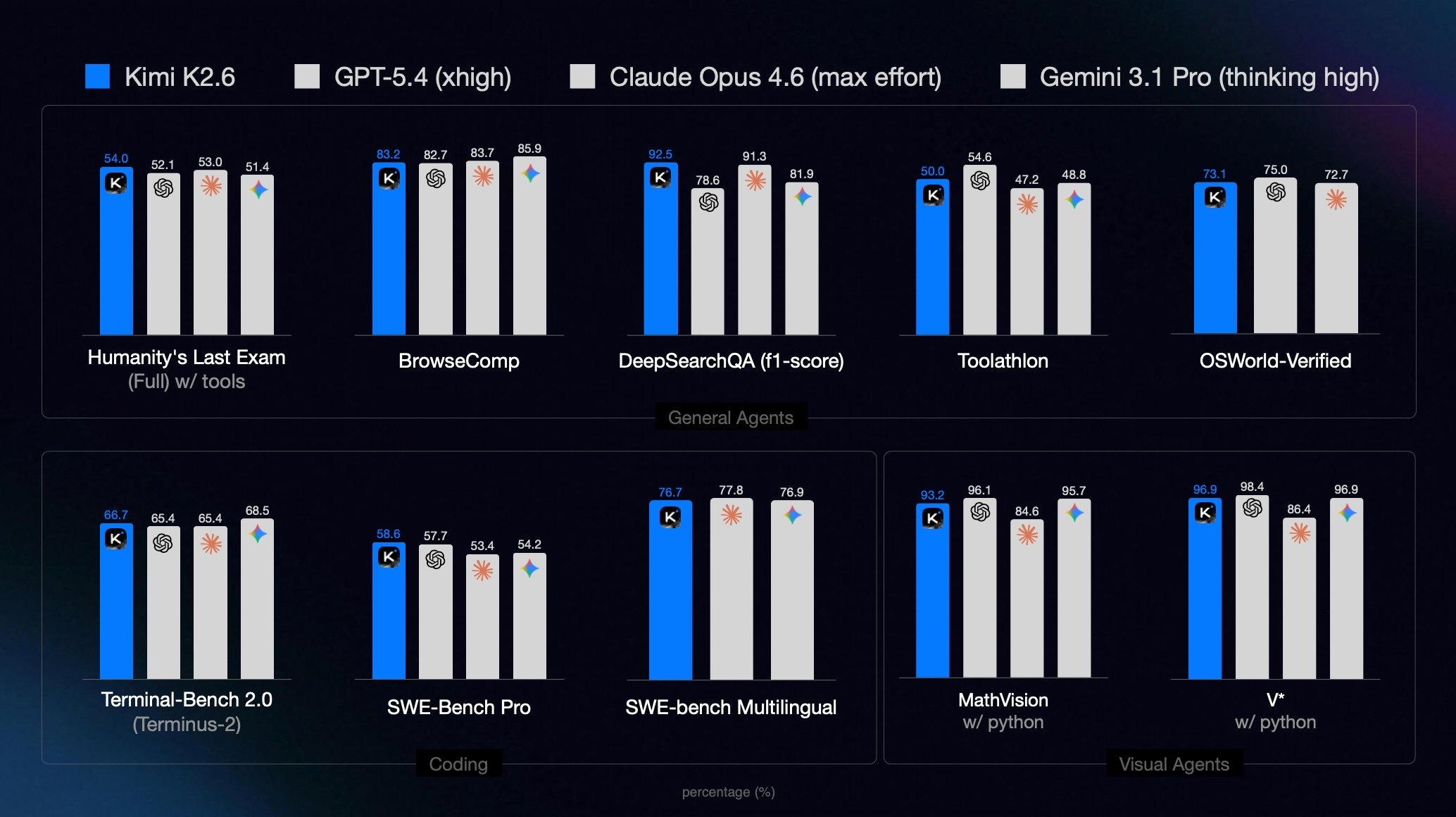
Benchmarks aren’t everything, but K2.6’s scores are hard to ignore:
- SWE-Bench Verified: 80.2%
- SWE-Bench Pro: 58.6% (beats GPT-5.4 at 57.7% and Claude Opus 4.6 at 53.4%)
- Humanity’s Last Exam (with tools): 54.0% — the highest score Moonshot tested against any frontier model
- DeepSearchQA F1: 92.5%
- Terminal-Bench 2.0: 66.7%
- BrowseComp: 83.2% (jumps to 86.3% with Agent Swarm)
Real-world wins are just as telling. Vercel reported over 50% improvement on their Next.js benchmark versus K2.5. Factory.ai saw a 15% gain in their internal tests.
The Price Tag -This Is Where It Gets Spicy
Okay, let’s talk money, because this is arguably the most disruptive part.
- Moonshot API: $0.60 per million input tokens / $2.50 per million output tokens
- OpenRouter: $0.60 / $2.80
- Claude Opus 4.7 (for comparison): $5.00 / $25.00
Do the math. K2.6 is roughly 8× cheaper than Claude Opus on inputs — about 88% less for similar workloads.
And because the API is OpenAI-SDK compatible, switching is literally a one-line change to your base URL. If you’re burning five figures a month on Opus for code generation, running an A/B test is basically free. That’s the kind of math that makes procurement teams twitchy.
A Few New Tricks Worth Mentioning
Skills from documents. You can upload a PDF, spreadsheet, or slide deck, and K2.6 will extract the structure and style as a reusable “Skill.” The obvious demo is reproducing a McKinsey-style consulting deck. The less obvious — but maybe more valuable — use is cloning a regulator’s filing format or your company’s brand deck.
Claw Groups (research preview). This is a new orchestration layer where humans and agents running on different devices and different model stacks share one workspace. K2.6 plays coordinator, matches tasks to agents based on their skills, and reassigns when someone stalls out.
Native video input. K2 Thinking was text-only. K2.5 added images. K2.6 now takes video — same parameter budget, more eyes.
Where to Run It
K2.6 is available pretty much anywhere you’d want it:
- Kimi.com and the Kimi App for chat
- Kimi Code for terminal and IDE coding
- Moonshot API (OpenAI-compatible)
- Hugging Face for open weights (run it yourself via vLLM or SGLang)
- OpenRouter and Vercel AI Gateway for multi-provider routing
- Kilo Gateway (Kilo CLI, VS Code, JetBrains extensions)
- Qubrid AI for an interactive playground
Where K2.6 Shines — And Where It Doesn’t
It’s genuinely great at:
- Long-horizon coding across Rust, Go, Python, and front-end
- Multi-file refactors on large codebases
- Agent orchestration when you actually need 100+ parallel workers
- Tool-heavy browsing and deep research
- Any workload where cost-per-token is a deciding factor
You’ll regret reaching for it when:
- Mathematical correctness is mission-critical (it trails the closed frontier by 3–6 points on AIME and HMMT)
- You need complex tool scheduling
- Vision-heavy workloads are central to the job
- You’re in a regulated industry where a Beijing-based model is a non-starter regardless of capability
- You need ironclad safety guarantees — K2.5 had documented issues with CBRNE-adjacent prompts and hallucinations, and Moonshot hasn’t published a K2.6 system card yet.
The Honest Take
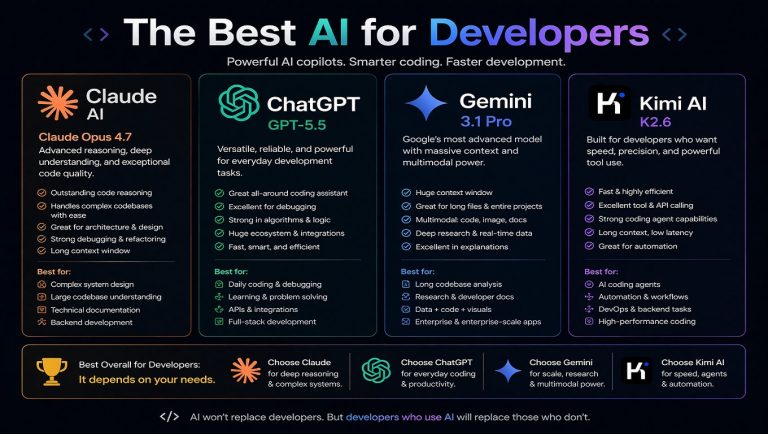
Hacker News user nikcub summed it up well: K2.6 is “below Sonnet and Opus 4.0 on capability… better than Gemini 2.5 Pro on tool calling.” That’s probably the fairest mental model. K2.6 isn’t the smartest model on the planet. But for specific workloads — long-horizon coding, agent swarms, tool-heavy tasks — it hits a price-to-performance ratio that the closed frontier can’t touch.
The real advantage is this: for the first time, an open-weight model is making the closed frontier’s pricing look genuinely uncomfortable. If you’re running serious coding workloads, K2.6 deserves a spot in your rotation — or at least a weekend of A/B testing.
Just go in with clear eyes. It’s creative, which is a feature until it isn’t. Give it detailed instructions, and it’ll reward you with remarkably steady, hands-off work. Get sloppy with your prompts, and it’ll happily wander somewhere you didn’t ask it to go.
You May Also Like
 AI Tool Reviews
How to Use ChatGPT for Beginners: The Complete Step-by-Step Guide (2026)
 AI Models
Which Claude Model Is the Best Right Now? An Honest 2026 Breakdown
 AI Models
Is DeepSeek Accurate? An Honest, Practical Answer
 AI Tool Reviews
GPTZero vs ZeroGPT: Which AI Detector Actually Holds Up in the Real World?
 AI Models
Llama 4 Scout vs Llama 4 Maverick: Which One Actually Fits Your Workflow?
 AI for Coding