
DeepSeek officially released DeepSeek-V4-Pro and DeepSeek-V4-Flash as preview versions on April 24, 2026, exactly one year and three months after the R1 shock that wiped $600 billion off Nvidia’s market cap. V4-Pro is a 1.6-trillion parameter Mixture-of-Experts model with 49B active parameters; V4-Flash is a leaner 284B/13B active variant. Both are open-source, both support a 1 million token context window, and both were optimized for Huawei’s Ascend chips rather than Nvidia. DeepSeek claims V4-Pro beats every open-source model on coding and math, and trails GPT-5.4 and Gemini 3.1-Pro by “approximately 3 to 6 months.”
Here’s the thing: the timing is wild. DeepSeek dropped V4 on the same day OpenAI launched GPT-5.5. That’s not a coincidence. That’s a statement.
Let’s break down what you actually need to know about V4, its three variants, and whether it lives up to the hype.
What Is DeepSeek V4?
DeepSeek V4 is the latest flagship large language model series from the Hangzhou-based AI startup DeepSeek, released in preview form on April 24, 2026. It represents a generational leap over V3.2, new architecture, new modalities, a much bigger context window, and a completely different hardware story.
Let’s be honest: this release matters beyond just the technical specs. DeepSeek is the lab that single-handedly broke Silicon Valley’s confidence with R1 in January 2025. That model was built for under $6 million in compute costs (allegedly) and performed roughly on par with OpenAI’s best reasoning model. It wiped out roughly $600 billion in Nvidia’s market cap in a single day.
V4 is the second act. And the question everyone’s asking is: can DeepSeek do it twice?
The early answer: it’s close, but the dynamics have changed.
The Three DeepSeek V4 Variants Explained: Preview, Pro, and Flash
Here’s where things get slightly confusing, so let me break it down clearly.
DeepSeek-V4 Preview refers to the release format — this is a preview version of the V4 series, not the final production release. Both models that shipped on April 24 are officially “preview” builds. Independent benchmarking is still ongoing as of this writing.
DeepSeek-V4-Pro is the flagship variant. 1.6 trillion total parameters with 49 billion active per token. This is the one that competes directly with GPT-5.4, GPT-5.5, Gemini 3.1-Pro, and Claude Opus 4.7.
DeepSeek-V4-Flash is the efficiency-focused variant. 284 billion total parameters with just 13 billion active per token. It’s positioned as a lighter, faster, cheaper option that still maintains most of Pro’s reasoning capabilities — particularly when given a larger “thinking budget.”
Here’s a quick comparison:
| Specification | V4-Pro | V4-Flash |
|---|---|---|
| Total parameters | 1.6 trillion | 284 billion |
| Active parameters | 49 billion | 13 billion |
| Context window | 1M tokens | 1M tokens |
| Release format | Preview | Preview |
| Optimized for | Peak capability | Speed & cost |
| License | Open-source | Open-source |
| Hardware target | Huawei Ascend | Huawei Ascend |
From experience with DeepSeek’s previous model family, the “Flash” variant is usually the one most developers actually deploy. Pro is the benchmark hero; Flash is the workhorse.
Release Date and Availability
DeepSeek-V4-Pro and V4-Flash launched as preview versions on Friday, April 24, 2026, published directly to Hugging Face. Both models are open-source, meaning developers can download the weights, modify the code, and run the models on their own infrastructure.
That open-source commitment is a major differentiator. OpenAI’s GPT-5.5 launched the day before, but it’s completely locked behind paid ChatGPT subscriptions and a (soon-to-launch) API. V4 is free to download, free to inspect, and free to self-host.
The catch? Running these models requires serious hardware. V4-Flash alone won’t fit on a 128GB setup — you’ll need at least 256GB of VRAM for the smaller variant, and the Pro version demands significantly more. Most people will access V4 through hosted API providers rather than running it locally.
What’s New in DeepSeek V4
Based on DeepSeek’s technical report and early testing, here’s what actually changed in V4.
1. Hybrid Attention Architecture
The headline technical advance. DeepSeek’s Hybrid Attention Architecture is designed to preserve context quality across long conversations — solving the well-known problem where language models get “dumber” as their context fills up. Combined with the 1M token window, this is what makes V4 genuinely useful for agentic workflows that span many steps.
2. Native Multimodality
V3.2 was text-only. V4 is natively multimodal from the ground up, handling text, image, video, and audio inputs in a single unified model. This isn’t a “bolt-on” vision adapter like some earlier multimodal approaches — the model was trained on all four modalities from scratch.
For teams running DeepSeek infrastructure, this is a big deal. V4 replaces both V3.2 and DeepSeek-VL in a single model, which cuts deployment complexity substantially.
3. 1 Million Token Context Window
V3.2 capped out at 128K tokens. V4 jumps to 1 million tokens — an 8x expansion that puts it in the same class as Gemini 3.1-Pro and GPT-5.
This isn’t about stuffing bigger PDFs. It’s about enabling workflows that span entire codebases, multi-document research tasks, and long-horizon agent execution without the model losing the plot.
4. More Expert Routing, Smarter Activation
V3.2 used a top-2/top-4 expert selection pattern with 671 billion total parameters and 37 billion active per token. V4-Pro scales up to 1.6 trillion parameters but reduces active parameters to 49B (vs expected ratio scaling), while activating 16 expert pathways per token from hundreds available.
The practical impact: more specialized expertise accessible per query, better reasoning on complex problems, and actually improved efficiency despite the parameter growth.
5. Manifold-Constrained Hyper-Connections (mHC)
Getting into the technical weeds here, but this one matters: mHC is DeepSeek’s innovation for stabilizing training at trillion-parameter scale. Training instability has historically been the wall that stops open-source labs from scaling up. DeepSeek appears to have solved this, which has implications well beyond V4 itself.
6. Engram Conditional Memory
Works alongside the attention architecture to provide efficient long-range retrieval across the 1M context. Think of it as the model’s ability to remember what matters from earlier in the context rather than just re-reading everything.
7. DeepSeek Sparse Attention with Lightning Indexer
An upgrade over V3.2’s DSA (DeepSeek Sparse Attention), specifically tuned for processing million-token sequences efficiently. This is what makes the big context window commercially viable rather than just a marketing bullet point.
The Benchmarks: How DeepSeek V4 Actually Performs
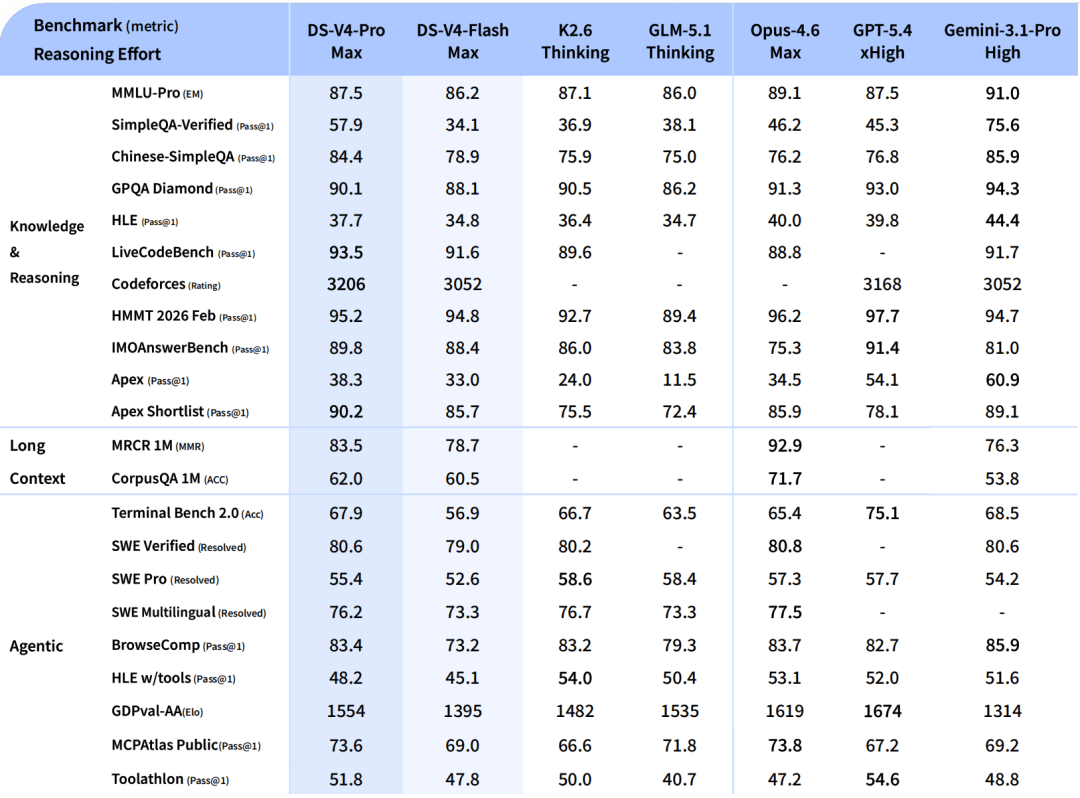
Let’s be upfront: DeepSeek’s official benchmarks are self-reported for preview models, and independent evaluation is still ongoing. That said, here’s where V4 currently stands based on DeepSeek’s reported numbers.
World Knowledge
V4-Pro trails only Gemini 3.1-Pro on world knowledge benchmarks (MMLU, MMLU-Pro, SuperGPQA, C-Eval, CMMLU, TriviaQA). Among open-source models, it’s the new leader.
Coding and Math
DeepSeek’s biggest claim: V4-Pro beats every rival open-source model on coding and mathematics. Leaked pre-release benchmarks suggested SWE-bench Verified scores above 80% — up from V3.2’s 73.1%. Math benchmarks (GSM8K, MATH, MGSM, CMath) show similarly strong performance.
Language & Reasoning
Competitive scores across BBH, DROP, HellaSwag, WinoGrande, and CLUEWSC. Not class-leading against the closed-source frontier, but strong among open models.
Long Context
Strong performance on LongBench-V2, which tests genuine long-context comprehension rather than just passing the “needle in a haystack” test.
V4-Pro vs V4-Flash on Reasoning
Here’s an interesting finding: V4-Flash-Max (Flash with an expanded thinking budget) achieves comparable reasoning performance to V4-Pro. It only falls behind meaningfully on pure knowledge-intensive tasks and the most complex agentic workflows. For most real-world reasoning tasks, Flash with extended thinking is a legitimate substitute for Pro at roughly 1/6 the active parameter cost.
The Self-Assessment That Caught Everyone Off Guard
Here’s what’s genuinely unusual: DeepSeek publicly stated that V4-Pro falls “marginally short” of GPT-5.4 and Gemini 3.1-Pro, and that their developmental trajectory trails the frontier by “approximately 3 to 6 months.”
That kind of honest self-assessment is basically unheard of in AI model launches. Companies usually cherry-pick benchmarks where their model wins and quietly ignore the ones where it loses. DeepSeek publishing a candid gap estimate is either unusually transparent or a deliberate expectations-setting move before third-party benchmarks land. Probably both.
DeepSeek V4 vs V3.2: What Actually Changed
If you’re on V3.2 and wondering whether to upgrade, here’s the side-by-side:
| Feature | V3.2 | V4-Pro | Change |
|---|---|---|---|
| Total parameters | 671B | 1.6T | 2.4x larger |
| Active parameters | 37B | 49B | Modest increase |
| Context window | 128K | 1M | 8x larger |
| Modalities | Text only | Text, image, video, audio | Massive upgrade |
| SWE-bench Verified | 73.1% | 80%+ | Major improvement |
| Expert routing | top-2/top-4 | 16 experts | More specialization |
| Hardware target | Primarily Nvidia | Huawei Ascend | Strategic shift |
| Input pricing (est.) | $0.28/M | ~$0.14/M | 50% cheaper |
| Output pricing (est.) | $0.42/M | ~$0.28/M | 33% cheaper |
The short version: V4 is simultaneously more capable and cheaper per token than V3.2. That’s the kind of curve that’s hard to argue with if you’re building on DeepSeek.
DeepSeek V4 vs GPT-5.5 and Gemini 3.1-Pro
This is the comparison everyone actually wants. Let me be direct:
GPT-5.5 wins on:
- Agentic coding (Terminal-Bench 2.0: 82.7% for GPT-5.5 vs unverified for V4)
- Computer use reliability
- Tool integration (MCP, Codex, native desktop agents)
- Enterprise support and SLA guarantees
Gemini 3.1-Pro wins on:
- World knowledge (GPQA Diamond: 94.3%)
- Pure reasoning benchmarks
- Multimodal video understanding
- Massive context integration
DeepSeek V4 wins on:
- Cost by an enormous margin (20–50x cheaper than OpenAI, per various estimates)
- Open-source availability (inspect, modify, self-host)
- Coding and math among open models
- Flexibility for air-gapped or regulated deployments
- Customization via fine-tuning
The honest framing: if you need best-in-class performance and have a budget for it, GPT-5.5 or Gemini 3.1-Pro is still the better pick. If you need very good performance at a tiny fraction of the cost, or you need to own your deployment — V4 is genuinely compelling.
Pricing: The Open-Source Cost Advantage
This is where DeepSeek dominates. V4’s pricing through hosted API providers is expected to land around:
| Tier | Input (per 1M tokens) | Output (per 1M tokens) |
|---|---|---|
| V4-Pro (standard) | ~$0.14 | ~$0.28 |
| V4-Pro (cache hit) | ~$0.014 | N/A |
| V4-Flash | Lower than Pro | Lower than Pro |
Compare that to:
| Model | Input (per 1M) | Output (per 1M) |
|---|---|---|
| GPT-5.5 | $5.00 | $30.00 |
| GPT-5.5 Pro | $30.00 | $180.00 |
| GPT-5 | $1.25 | $10.00 |
| Claude Opus 4.7 | ~$15 | ~$75 |
That’s not a minor discount. V4-Pro is approximately 35x cheaper on input and 107x cheaper on output than GPT-5.5. And if you’re willing to self-host with your own hardware, the marginal cost per query drops even further — essentially to electricity and amortized GPU costs.
For high-volume applications, this changes the math entirely. A use case that would cost $10,000/month on GPT-5.5 might run for $200/month on V4.
The Huawei Chip Story Nobody’s Talking About Enough
Here’s where things get geopolitically interesting. DeepSeek worked with Chinese chipmakers Huawei and Cambricon to optimize V4 for their latest hardware. DeepSeek did not give Nvidia or AMD early access for performance tuning — reversing standard industry practice where Western chipmakers typically get first access to new model weights.
Why this matters:
- It’s a proof point for China’s domestic AI chip supply chain. Running a frontier-class 1.6T parameter model on Huawei Ascend chips (instead of Nvidia H100s or H200s) is a significant capability demonstration, especially given US export restrictions that have been in place since October 2022.
- It decouples Chinese AI development from US hardware. If V4 runs as well as DeepSeek claims on Ascend, it means future Chinese models don’t need access to restricted Nvidia chips to stay competitive.
- It sets up long-term market segmentation. DeepSeek V4 may end up being the default frontier model inside China and adjacent markets, while OpenAI/Anthropic/Google dominate Western enterprise.
This isn’t just a product launch — it’s a statement about where the AI infrastructure competition is heading.
Real-World Use Cases
Based on V4’s architecture and early testing, here are the applications where it genuinely shines.
1. High-Volume Coding Assistance
If you’re building a coding product with tens of thousands of daily queries, V4’s cost advantage over GPT-5.5 is transformative. You can offer capabilities that would be economically impossible on closed-source models.
2. Long-Document Analysis
Contract review, legal research, technical documentation analysis, and academic literature review all benefit from the 1M token context window. Drop in an entire document set and ask questions across all of it.
3. Agentic Workflows at Scale
Multi-step agent workflows that would rack up hundreds of dollars per task on frontier closed models become economically viable at V4’s pricing.
4. Fine-Tuning and Custom Deployments
Open weights mean you can fine-tune V4 for your specific domain, inspect its behavior, and deploy in air-gapped environments. Critical for regulated industries (finance, healthcare, defense) where data can’t leave your infrastructure.
5. Multimodal Applications
Video understanding, image analysis, audio processing — all in one model, at a price point where you can experiment freely without blowing your budget.
6. Research and Academic Use
Free access to frontier-class capabilities for researchers, students, and academic institutions that can’t justify OpenAI’s enterprise pricing.
Limitations You Should Know
Time for honesty — V4 isn’t a silver bullet. Here’s what to watch out for.
The 3–6 month gap is real. DeepSeek itself admits V4 trails GPT-5.4 and Gemini 3.1-Pro. Now add GPT-5.5 released the same day, and the gap is more like 6+ months against OpenAI’s current frontier. For applications that need bleeding-edge capability, V4 isn’t it.
Preview means preview. These are not final production builds. Expect issues, iteration, and possible architectural changes before V4 hits stable release.
Hardware requirements are substantial. Even V4-Flash needs 256GB+ of VRAM for local deployment. Most users will rely on hosted API providers, which reintroduces pricing variability.
Independent benchmarks are pending. DeepSeek’s self-reported numbers should be treated as preliminary until third-party labs validate them. This was the case with R1, whose claims did largely hold up — but validation still matters.
Regulatory and privacy concerns. Multiple countries (US states, Australia, Taiwan, South Korea, Denmark, Italy) previously restricted DeepSeek-R1 over data protection and censorship concerns. Expect similar scrutiny on V4 for any enterprise or government deployment.
Censorship behavior. Chinese-trained models historically have specific topic restrictions aligned with PRC content policies. V4 will almost certainly carry these, which affects its usability for certain applications.
Computer use and tool integration lag. Compared to GPT-5.5’s native desktop agent capabilities, V4 is behind on the “use my computer for me” front. DeepSeek is primarily a foundation model; building tool-use integrations is still on you.
Best Practices When Using DeepSeek V4
From early testing, here’s what’s delivering results:
Start with V4-Flash, upgrade to Pro only when needed. Flash handles 80% of use cases and costs a fraction of Pro. Reserve Pro for the hardest workloads.
Use the 1M context window aggressively. Don’t split documents. Don’t summarize-then-query. Dump the whole context in and let V4 reason across it. This is the workflow shift that actually unlocks value.
Lean into caching. V4’s cache-hit pricing is roughly 10% of standard pricing. If you’re running applications with repeated context (RAG systems, consistent system prompts), caching is a massive cost lever.
Fine-tune for your domain. Because V4 is open-source, you can fine-tune it on your data. For specialized applications, a fine-tuned V4 can outperform a general-purpose GPT-5.5 at a fraction of the cost.
Run structured evals against GPT-5.5 and Gemini. Don’t just trust vendor benchmarks. Run your actual workload against all three models before committing. You’ll often be surprised by which one wins on your specific use case.
Host through third-party providers for critical workloads. Providers like Together AI, Fireworks, and others will likely host V4 weights on Western infrastructure. For enterprise use cases with data residency requirements, this is the safer path than DeepSeek’s direct API.
Monitor Chinese regulatory developments. The US-China AI landscape is changing fast. Keep an eye on how both governments respond to V4’s release — it affects what you can legally deploy in different jurisdictions.
Is DeepSeek V4 Worth the Hype?
Here’s an honest take after digging into everything available.
Yes, for specific use cases. No, as a universal replacement.
V4 doesn’t match GPT-5.5 or Gemini 3.1-Pro on the frontier. DeepSeek admits this publicly. But here’s the thing — for 80% of real-world AI use cases, you don’t need frontier capability. You need good enough capability at a price that makes economic sense.
That’s where V4 wins, and wins decisively.
Choose DeepSeek V4 if you:
- Are building a high-volume AI product where unit economics matter
- Need to self-host or deploy in air-gapped environments
- Want to fine-tune on proprietary data
- Are working in regulated industries where open-weight models are required
- Want to hedge against closed-source API pricing or access changes
- Are in markets (especially China) where Western AI APIs are unavailable or restricted
Stick with GPT-5.5 or Gemini 3.1-Pro if you:
- Need absolute best-in-class performance on agentic coding
- Rely on native computer use and tool integration
- Require enterprise-grade SLAs and support
- Process sensitive data that can’t be associated with Chinese infrastructure
- Want the most reliable multimodal video understanding
The Bigger Picture
What’s most significant about V4 isn’t the model itself; it’s what it proves. One year after R1, DeepSeek has scaled to trillion-parameter models, achieved native multimodality, ported frontier training to non-Nvidia hardware, delivered all of this at prices that force Western competitors to justify their pricing, and done it while publicly admitting where they still lag.
That’s not a company that’s slowing down. And the 3-to-6 month gap they quoted? That was the gap last year too, and they closed it in bursts. V5 will likely ship in Q4 2026 or Q1 2027 — and it’ll likely be narrower.
For now, V4 isn’t quite the “Sputnik moment” R1 was. Nvidia’s stock didn’t crater. But it’s a very loud signal that the AI race has become genuinely global, genuinely multi-polar, and genuinely open-source as a viable competitive path.
You May Also Like
 AI Models
Which Claude Model Is the Best Right Now? An Honest 2026 Breakdown
 AI Models
Is DeepSeek Accurate? An Honest, Practical Answer
 AI Models
Llama 4 Scout vs Llama 4 Maverick: Which One Actually Fits Your Workflow?
 AI for Coding
The Best AI Models for Developers in 2026: An Honest, Hands-On Look at What Actually Works
 AI Models
GPT-5.5 vs Claude Opus 4.7 vs Gemini 3.1 Pro: Real Benchmark Results Compared
 AI Models