
GPT-4o (short for “omni“) is OpenAI’s multimodal AI model, released on May 13, 2024. It processes text, audio, and images through a single unified neural network, delivers voice responses in roughly 320 milliseconds, and currently costs $2.50 per million input tokens and $10 per million output tokens via the OpenAI API. Despite newer models like GPT-5 and GPT-5.4, GPT-4o remains widely used for conversational AI, voice applications, and vision-based tasks thanks to its balance of speed, cost, and natural tone.
If you’re researching GPT-4o in 2026, whether as a developer evaluating the API, a business leader weighing AI options, or a ChatGPT user trying to understand what’s under the hood this guide covers everything you need: capabilities, benchmarks, pricing, real-world use cases, limitations, and how it compares to newer models.
I’ve been using GPT-4o daily since it launched, shipping production features on the API, and testing it side-by-side with every major model release since. This article reflects that hands-on experience combined with official OpenAI documentation.
What Is GPT-4o? Definition and Overview
GPT-4o is a multimodal large language model (LLM) developed by OpenAI and released on May 13, 2024. The “o” stands for “omni,” reflecting its ability to accept and generate any combination of text, audio, and image inputs through a single unified neural network.
This was a structural shift from previous models. Before GPT-4o, voice interactions with ChatGPT required a pipeline of three separate models: a speech-to-text transcription model, GPT-4 for reasoning, and a text-to-speech model for the response. This introduced significant latency (averaging 2.8 seconds) and stripped out emotional nuance, tone, and non-speech audio cues.
GPT-4o replaced that pipeline with a single end-to-end model trained jointly across all three modalities. The result is real-time conversation, preserved tonal information, and dramatically improved multimodal reasoning — all for roughly half the cost of GPT-4 Turbo at launch.
Why GPT-4o Mattered at Launch
At release, GPT-4o was positioned as OpenAI’s flagship model, combining GPT-4-level intelligence with improvements across speed, cost, and modality support. Three numbers defined the launch:
- 320 ms — average voice response latency (comparable to human conversation)
- 50% — API cost reduction compared to GPT-4 Turbo
- 50+ — languages with improved speech recognition and translation performance
Key Features and Capabilities
1. Unified Multimodal Architecture
GPT-4o processes text, audio, and images natively within one model. This isn’t a bundle of specialized systems — it’s a single neural network trained to reason across modalities simultaneously OpenAI.
Practical implications:
- Analyze a screenshot and discuss it conversationally
- Have a voice conversation while showing the model live video
- Translate spoken language in real time with tone preserved
- Interpret handwritten notes, whiteboards, charts, and mixed-format documents
2. Real-Time Voice Interaction
GPT-4o’s Advanced Voice Mode responds to speech in approximately 320 milliseconds on average, with a minimum of 232 ms in some cases. This matches the cadence of human conversation and represents roughly a 9x improvement over the previous voice mode’s 2.8-second average latency.
The model preserves paralinguistic information — laughter, singing, emotional tone, multiple speakers — that previous systems discarded during the transcription step.
3. Advanced Vision Capabilities
GPT-4o outperforms GPT-4 Turbo on multiple vision benchmarks, including MMMU (academic multimodal understanding), MathVista (visual math reasoning), and ChartQA (chart interpretation). It handles:
- Screenshots and UI analysis
- Photos of physical objects and documents
- Charts, graphs, and data visualizations
- Handwritten text (including notes and math)
- Live video through the ChatGPT mobile and desktop apps
4. Multilingual Performance
GPT-4o significantly improved speech recognition and translation performance across 50+ languages, with particularly strong gains in underrepresented languages. OpenAI also released a more efficient tokenizer that reduces the number of tokens needed to represent non-English text — directly lowering costs and increasing speed for non-English users.
5. Speed and Throughput
On text generation tasks, GPT-4o runs approximately 2x faster than GPT-4 Turbo, with higher rate limits (5x higher for paying developers at launch) and lower latency per token.
6. Extended Context Window
GPT-4o supports a 128,000-token context window with a maximum output of 16,384 tokens — sufficient for long documents, codebases, and multi-turn conversations without truncation issues in most standard use cases.
GPT-4o Specifications at a Glance
| Specification | Details |
|---|---|
| Developer | OpenAI |
| Release date | May 13, 2024 |
| Model type | Multimodal large language model |
| Modalities (input) | Text, audio, image, video frames |
| Modalities (output) | Text, audio, image |
| Context window | 128,000 tokens |
| Maximum output | 16,384 tokens |
| Knowledge cutoff | October 2023 |
| Voice latency (avg) | ~320 ms |
| API input price (2026) | $2.50 per 1M tokens |
| API output price (2026) | $10.00 per 1M tokens |
| Cached input price | $1.25 per 1M tokens |
| Languages supported | 50+ (with improved performance) |
| Availability | ChatGPT (Free/Plus/Team/Enterprise), API |
Pricing sourced from the OpenAI API pricing page.
How GPT-4o Works: The Technical Breakdown
GPT-4o is built on a transformer architecture, like all modern LLMs, but with a critical difference in how it handles multimodal inputs.
End-to-End Training Across Modalities
Traditional multimodal systems add vision or audio capabilities as separate components that convert inputs into text tokens before feeding them to a language model. This loses information during conversion and introduces latency at each step.
GPT-4o was trained from scratch on interleaved text, audio, and image data. All three modalities share the same neural network, same weights, and same attention mechanism. Audio waveforms and image patches are tokenized directly into the model’s representation space, allowing the model to reason about them in their native form.
What This Enables in Practice
- Preserved emotional context in voice conversations
- Direct image reasoning without a separate captioning step
- Cross-modal understanding — describing an image in response to a voice question, or generating an image based on a conversation
- Lower latency because there’s no pipeline handoff
Safety and Alignment
GPT-4o underwent extensive red-teaming across modalities before launch, with over 70 external experts contributing to safety evaluations across domains like misinformation, bias, and psychosocial risks. Voice capabilities were rolled out gradually (May through September 2024) specifically to allow iterative safety work.
GPT-4o Pricing in 2026
API Pricing (Current)
As of 2026, GPT-4o API pricing via OpenAI is:
| Token Type | Cost per 1M Tokens |
|---|---|
| Input (standard) | $2.50 |
| Input (cached) | $1.25 |
| Output | $10.00 |
| Batch API input | $1.25 |
| Batch API output | $5.00 |
Source: OpenAI API pricing
ChatGPT Plan Pricing
GPT-4o is accessible across OpenAI’s consumer and business tiers:
| Plan | Price | GPT-4o Access |
|---|---|---|
| Free | $0 | Limited daily messages |
| ChatGPT Plus | $20/month | Expanded limits, Advanced Voice Mode |
| ChatGPT Team | $25–30/user/month | Higher limits, admin controls |
| ChatGPT Enterprise | Custom | Unlimited access, enterprise security |
Cheaper Alternative: GPT-4o Mini
For high-volume or cost-sensitive applications, GPT-4o mini is available at significantly lower pricing (roughly $0.15 input / $0.60 output per 1M tokens), while retaining most of GPT-4o’s capabilities at reduced depth.
Pricing Context
It’s worth noting that newer models have shifted the pricing landscape. GPT-5 launched at $1.25 input / $10 output per million tokens — meaning GPT-5 is actually cheaper on input than GPT-4o in 2026 devtk.ai. This affects the cost-benefit calculation for new projects.
GPT-4o vs GPT-4, GPT-5, and Competitors
GPT-4o vs GPT-4 Turbo
| Feature | GPT-4 Turbo | GPT-4o |
|---|---|---|
| Release | November 2023 | May 2024 |
| Multimodal | Limited (added-on) | Native omni |
| Voice latency | ~2.8 seconds | ~320 ms |
| Text generation speed | Baseline | 2x faster |
| API input price | $10/1M | $2.50/1M |
| API output price | $30/1M | $10/1M |
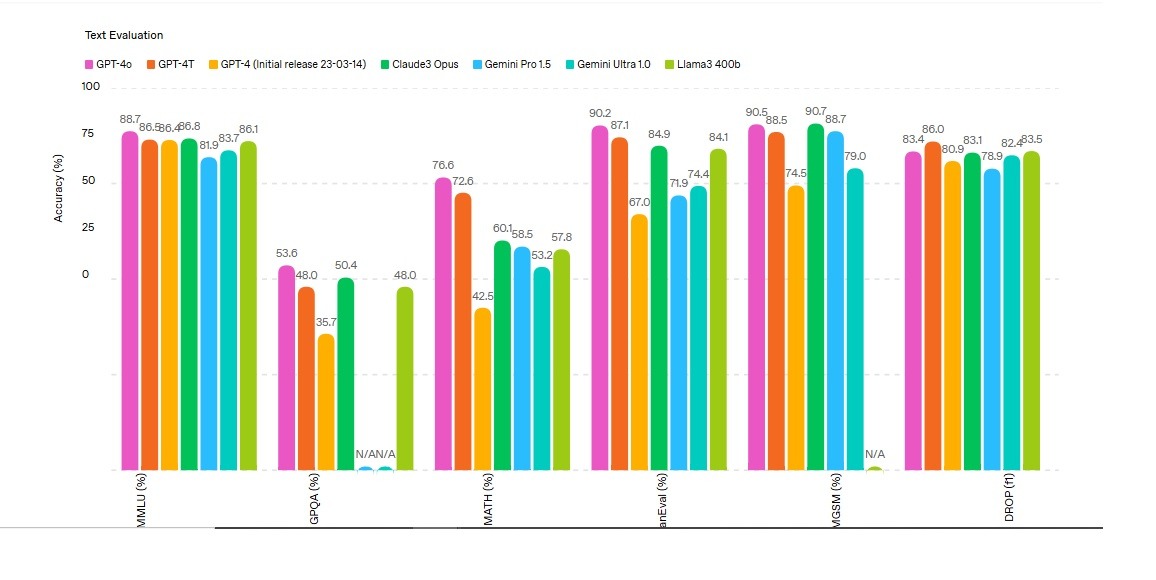
| MMLU benchmark | 86.4% | 88.7% |
Verdict: GPT-4o is a clear upgrade across every dimension that matters — faster, cheaper, more capable, and genuinely multimodal.
GPT-4o vs GPT-5
| Feature | GPT-4o | GPT-5 |
|---|---|---|
| Release | May 2024 | August 2025 |
| Context window | 128K tokens | 400K tokens |
| Reasoning depth | Solid | Significantly better |
| Coding performance | Good | Substantially stronger |
| Personality/warmth | Higher | More clinical |
| API input price | $2.50/1M | $1.25/1M |
| API output price | $10/1M | $10/1M |
Verdict: GPT-5 wins on raw capability, reasoning, and price. GPT-4o wins on tone and conversational feel — which explains why users on communities like r/ChatGPT still advocate for it even after GPT-5’s release.
GPT-4o vs Claude and Gemini
As of 2026, GPT-4o competes with a field that includes:
- Claude Opus 4.7 (Anthropic) — leads on coding benchmarks like SWE-bench Verified (87.6%)
- Gemini 3.1 Pro (Google) — leads on pure reasoning benchmarks like GPQA Diamond (94.3%)
- GPT-5.4 and GPT-5.4 Pro — OpenAI’s current frontier models
GPT-4o no longer leads in any major benchmark category, but it remains highly competitive for its cost class and specific use cases (voice, multimodal chat, rapid iteration).
Real-World Use Cases for GPT-4o
Based on OpenAI’s documentation, published case studies, and my own production deployments, these are the applications where GPT-4o delivers the strongest return on investment.
1. Conversational AI and Customer Support
Low latency and natural tone make GPT-4o well-suited for voice-based support agents, virtual assistants, and conversational interfaces. Companies like Stripe, Canva, and Shopify have built production features on GPT-4o for customer-facing interactions.
2. Real-Time Language Translation and Learning
The voice mode combined with multilingual improvements makes GPT-4o effective for language tutoring, real-time translation in meetings, and practicing pronunciation with conversational feedback.
3. Vision-Based Workflows
- Receipt and invoice processing
- Chart and graph interpretation
- Accessibility (image description for visually impaired users)
- Document OCR and summarization
- Medical image assistance (with appropriate safeguards)
4. Content Creation and Writing
GPT-4o is particularly strong for first drafts, email writing, social media content, and any task where natural tone matters more than deep reasoning.
5. Education and Tutoring
The voice mode enables Socratic dialogue; students can ask questions out loud, receive conversational explanations, and show the model their work via the camera. Khan Academy’s Khanmigo and Duolingo’s AI features both leveraged GPT-4o capabilities.
6. Developer Productivity
Code explanation, quick debugging, regex generation, and documentation writing. For deep refactors or complex engineering tasks, Claude Opus 4.7 or GPT-5.4 are typically stronger — but for everyday developer tasks, GPT-4o remains efficient and cost-effective.
Limitations You Should Know
Transparency matters, so here are the documented limitations of GPT-4o in 2026.
- Reasoning depth. GPT-4o underperforms reasoning-focused models (o3, GPT-5 Thinking, Gemini 3.1 Pro) on complex multi-step problems, advanced mathematics, and long-horizon planning.
- Knowledge cutoff. The October 2023 training cutoff means GPT-4o lacks knowledge of events, products, or developments from late 2023 onward unless paired with web browsing.
- Agentic reliability. GPT-4o predates the “native computer use” era introduced in GPT-5.4. It can call tools and functions, but it’s not optimized for multi-step autonomous workflows.
- Context window. 128K tokens is workable but smaller than GPT-5 (400K) or Claude Opus 4.7, limiting use cases involving very long documents or entire codebases.
- Hallucinations. Like all LLMs, GPT-4o can generate plausible-sounding but factually incorrect information. This is particularly pronounced on niche topics or time-sensitive queries.
- Image generation quality. GPT-4o’s image generation (released in 2025) is strong but typically behind specialist models for professional design work.
Common Mistakes When Using GPT-4o
From two years of watching teams deploy (and misdeploy) this model in production:
1. Using GPT-4o for tasks that need deep reasoning. If your use case involves multi-step logic, complex math, or careful analytical reasoning, route to o3, GPT-5 Thinking, or Claude Opus. GPT-4o will be fast and confident — and wrong more often than you’d like.
2. Paying for GPT-4o when GPT-4o mini is sufficient. A large percentage of API calls don’t actually need full GPT-4o capability. Running high-volume classification or simple generation on full GPT-4o wastes roughly 90% of your budget compared to mini.
3. Ignoring the cached input pricing. The cached input price ($1.25/1M) is half the standard rate. For applications with repetitive system prompts or RAG context, enabling prompt caching can cut API costs significantly.
4. Not using Advanced Voice Mode. Many ChatGPT Plus subscribers have never tried the voice mode. This is the feature that most differentiates GPT-4o from newer, more clinical models.
5. Trusting it for real-time information. The October 2023 knowledge cutoff is now over two years old. Without browsing enabled, GPT-4o will confidently give you outdated information.
6. Deploying without evals. GPT-4o behaves differently from GPT-4 Turbo and from GPT-5 in subtle ways. Teams that migrate without running evaluations against their specific use cases frequently ship regressions.
Best Practices When Using GPT-4o Model
Strategies I’ve seen consistently deliver results in production:
Match the model to the task. Use GPT-4o for conversational interfaces, quick drafts, and vision tasks. Route reasoning-heavy queries to dedicated reasoning models. This hybrid approach typically cuts costs 40–60% while improving output quality.
Lean into multimodality. Instead of describing what you want in long text prompts, show the model a screenshot, sketch, or diagram. GPT-4o’s vision handling is excellent, and it saves tokens on both sides.
Use system prompts effectively. GPT-4o is responsive to well-crafted system prompts. Invest time in writing detailed role and behavior instructions — the ROI is substantial across thousands of calls.
Combine GPT-4o with GPT-4o mini. A common production pattern: use mini for initial classification or filtering, then escalate to full GPT-4o only when complexity warrants it. Cost-effective and scalable.
Leverage structured outputs. GPT-4o supports JSON mode and structured output schemas, which dramatically improve reliability for data extraction and API-facing applications.
Enable prompt caching. For any application with consistent system prompts or repeated context, caching cuts input costs by 50%.
Pair with retrieval for current information. Combine GPT-4o with a RAG pipeline or web browsing to compensate for the knowledge cutoff.
Is GPT-4o Still Worth Using in 2026?
Yes, for specific use cases, but not as a default choice for new projects.
Use GPT-4o When:
- You need natural voice conversation (Advanced Voice Mode remains best-in-class)
- Tone and warmth matter more than reasoning depth (e.g., customer-facing chatbots)
- You have existing infrastructure built on GPT-4o that doesn’t warrant migration
- You’re doing vision-heavy work where image understanding is the primary need
- You want a proven, battle-tested model with extensive ecosystem support
Choose a Newer Model When:
- Your application requires complex reasoning → GPT-5.4 Thinking or o3
- Coding is central to the use case → Claude Opus 4.7 or GPT-5.4
- You need agentic workflows with native computer use → GPT-5.4
- You’re processing very long documents (500K+ tokens) → GPT-5 (400K context)
- You’re starting a new project and want best cost-per-capability → GPT-5 (often cheaper than GPT-4o on the API)
The Honest Assessment
GPT-4o was the model that made AI feel genuinely conversational for mainstream users. In 2026, it’s no longer OpenAI’s most capable model, but it occupies a specific and valuable niche: the most natural-feeling, voice-optimized, tone-rich general-purpose assistant available. For that reason, it retains a devoted user base and continues to power production applications at scale.
Frequently Asked Questions
What does the “o” in GPT-4o stand for?
The “o” stands for “omni,” referring to the model’s ability to handle multiple modalities (text, audio, and images) through a single unified neural network.
When was GPT-4o released?
GPT-4o was announced and released to ChatGPT users on May 13, 2024. Advanced Voice Mode rolled out gradually through September 2024.
Is GPT-4o free to use?
Yes, GPT-4o is available to free ChatGPT users with daily message limits. Paying subscribers (Plus, Team, Enterprise) get higher usage caps and earlier access to new features like Advanced Voice Mode.
Is GPT-4o better than GPT-4?
Yes. GPT-4o matches or exceeds GPT-4 Turbo on benchmarks while being 2x faster, 50% cheaper, and natively multimodal. It’s a strict upgrade for the vast majority of use cases.
Is GPT-4o better than GPT-5?
No, not in overall capability. GPT-5 has stronger reasoning, a larger context window (400K vs 128K), and lower API input costs. However, many users prefer GPT-4o’s more conversational, warmer tone for creative and everyday tasks.
How much does the GPT-4o API cost?
As of 2026, GPT-4o costs $2.50 per million input tokens and $10 per million output tokens. Cached inputs cost $1.25 per million tokens, and Batch API pricing is 50% of standard rates.
Can GPT-4o generate images?
Yes. OpenAI rolled out native image generation through GPT-4o in March 2025, replacing DALL-E 3 as the default image generator in ChatGPT.
What’s the difference between GPT-4o and GPT-4o mini?
GPT-4o mini is a smaller, faster, and significantly cheaper version of GPT-4o (~$0.15 input / $0.60 output per 1M tokens). It retains most capabilities at reduced depth — ideal for high-volume or cost-sensitive applications.
Does GPT-4o have memory?
GPT-4o supports ChatGPT’s memory feature, which lets it remember facts about you across conversations in the ChatGPT interface. API-based deployments need to implement memory management separately.
Is GPT-4o safe for business use?
GPT-4o underwent extensive safety evaluations before release, and ChatGPT Enterprise provides SOC 2 compliance, data privacy guarantees, and admin controls. For regulated industries, review OpenAI’s data usage policies and consider their enterprise offerings.
Final Takeaway
GPT-4o remains one of the most impactful AI model releases of the past decade. It defined what mainstream users expect from conversational AI — fast, natural, multimodal, and genuinely useful — and set the baseline that every subsequent model has had to meet or exceed.
In 2026, it’s no longer the frontier. But for the right applications — voice interfaces, conversational products, vision-heavy workflows, and any use case where tone matters — GPT-4o continues to deliver strong results at a reasonable price point.
If you’re evaluating it for a new project, run your own benchmarks. Compare it against GPT-5 (which is often cheaper now), Claude Opus 4.7, and Gemini 3.1 Pro on your specific use cases. The best model isn’t the newest one — it’s the one that consistently delivers what your users need.
You May Also Like
 AI Tool Reviews
How to Use ChatGPT for Beginners: The Complete Step-by-Step Guide (2026)
 ChatGPT
How to Use ChatGPT at Work: Productivity Tips That Actually Save You Hours
 ChatGPT
How to Use ChatGPT Best Prompts
 AI Models
Which Claude Model Is the Best Right Now? An Honest 2026 Breakdown
 AI Models
Is DeepSeek Accurate? An Honest, Practical Answer
 AI Models