

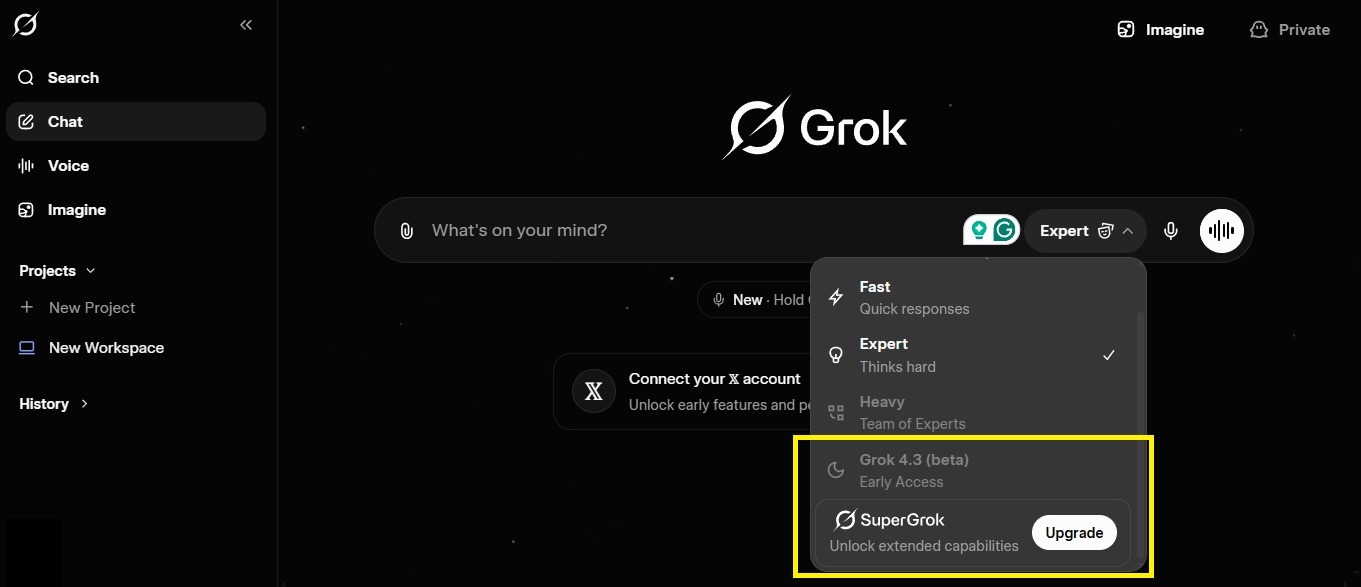
So xAI did the thing again. No fanfare, no launch stream, no polished “hey everyone, here’s our biggest model yet” announcement from Elon. Just a quiet soft-launch on April 17, 2026, and suddenly people on X started noticing a new “Early Access” tag on grok.com. Turns out that was Grok 4.3 beta rolling out — and the AI crowd spent the next 48 hours trying to figure out what it actually is.
If you’ve been keeping up with xAI’s release pattern by now, this is kind of their thing. Ship first, explain later, let people poke at it on Reddit, maybe Elon drops a tweet confirming specs two days in. Honestly, I kind of respect it. It feels more like watching a startup than a trillion-dollar lab.
Anyway, the dust has settled enough that we can actually talk about what Grok 4.3 is, what changed, how it stacks up against the other frontier models that dropped this year, and whether it’s the upgrade people were hoping for. Let’s get into it.
The Quick Rundown (If You Only Have 30 Seconds)
Before we dig in, here’s the cheat sheet version for anyone skimming on their phone between classes.
| Detail | What We Know |
|---|---|
| Release Date | April 17, 2026 (soft-launched) |
| Status | Beta / Early Access |
| Who Gets Access | SuperGrok Heavy subscribers only (for now) |
| Current Model Size | 0.5T parameters |
| Full Version Coming | 1T parameter model in training, ~5 days from April 18 |
| Knowledge Cutoff | December 2025 |
| Official Announcement? | Nope — confirmed via tweets and release notes |
| Price to Access | ~$300/month (SuperGrok Heavy) |
Now, let’s break down what any of that actually means.
What Is Grok 4.3?
Grok 4.3 is xAI’s newest flagship model, currently in beta and only available to SuperGrok Heavy subscribers. It’s a fresh pre-trained model with an updated architecture and a December 2025 knowledge cutoff — which matters more than people realize because it means Grok 4.3 actually knows about stuff that happened in late 2025, not just what Grok 4.20 was trained on.
Here’s where it gets interesting though. There’s been some back-and-forth about the model’s actual size. Initial hype pinned it at 1 trillion parameters — twice the size of Grok 4.20. But then Elon Musk clarified on April 18 that beta users are currently running the 0.5T version, not the full 1T. The 1T model is apparently still training and is expected to wrap up within about five days of that clarification.
Translation: what’s live right now is the “small” 4.3. The actual chonker is coming soon. So if this version already impresses you, hold onto your seat.
Why Is Everyone Asking “Wait, Isn’t This Supposed to Be Grok 5?”
Fair question, and it’s the first thing that popped up on Hacker News when the release hit. Grok 5 was rumored to launch around this time frame, and yet here we are with a “4.3” label instead. So what gives?
The most likely answer is pretty boring: xAI probably didn’t feel this generation was enough of a leap to earn a major version bump. A 0.5T-to-1T jump in size is meaningful, but it’s not a “we completely rethought how this model works” moment. Think of it as the iPhone 15 vs. 15 Pro situation — same era, different flavors.
The other theory floating around is that xAI is stress-testing infrastructure and training pipelines for Grok 5 using 4.3 as a real-world beta. Either way, calling it 4.3 keeps expectations realistic while still shipping improvements.

What’s Actually New in Grok 4.3?
Okay, the fun part. Here’s what people are actually noticing when they use it.
Bigger Brain, Longer Training
The simplest win: it’s just a bigger model. At 0.5T parameters right now (1T on the way), Grok 4.3 has roughly the same or greater scale than 4.20, but was trained significantly longer. In AI terms, “trained longer” often matters more than “trained bigger,” because the extra training time lets the model develop better reasoning patterns instead of just more surface-level knowledge.
Better Document Handling
This one is getting genuinely positive feedback from early users. If you’ve ever tried to feed a 40-page PDF into an older Grok model and watched it miss the middle 20 pages, you’ll appreciate this. Grok 4.3 seems to hold onto context across long documents much more reliably. It’s also better at producing documents — writing reports, long-form drafts, structured content — without the weird “loses the thread at page 3” problem.
Improved Video Understanding
Native multimodal video understanding got a real upgrade. You can hand Grok 4.3 a video and ask it actual nuanced questions — not just “what’s in this clip” but “what’s the tone of this presentation” or “summarize the argument the speaker is making between minute 2 and minute 5.” Claude and Gemini already do this reasonably well, so this is xAI catching up rather than leapfrogging. But it’s a noticeable jump from where Grok was six months ago.
Real-Time X Integration (Still the Sleeper Feature)
This one isn’t new to 4.3 specifically, but it’s gotten sharper. Grok’s ability to pull live X data and synthesize it with its base knowledge is genuinely something no other frontier model does as well. Ask it about public sentiment on a trending topic and you get actual current discussion, not stale training data.
The “Skills” Feature (Coming Soon)
This one’s worth watching. xAI is reportedly developing a Skills feature that lets users create reusable instructions to automate tasks and personalize Grok’s behavior. Think ChatGPT’s custom GPTs, but integrated deeper into the workflow. Not live for everyone yet, but it’s been spotted in iOS testing.
Grok 4.3 vs. Grok 4.20 differences: Side-by-Side
For the people who actually want to see the upgrade in numbers and specs, here’s how the two compare based on what’s been confirmed so far.
| Feature | Grok 4.20 | Grok 4.3 (Beta) |
|---|---|---|
| Parameters | ~0.5T | 0.5T now, 1T coming |
| Knowledge Cutoff | Earlier 2025 | December 2025 |
| Training Duration | Standard | Significantly longer |
| Document Understanding | Good | Noticeably better |
| Video Understanding | Basic multimodal | Native, more nuanced |
| Long-Context Performance | Solid | Improved |
| Real-Time X Integration | Yes | Yes (sharper) |
| Availability | All paid tiers | SuperGrok Heavy only |
| Skills / Automation | No | In development |
If you want the quick side-by-side instead of wading through a wall of text, here’s the honest breakdown based on what xAI has actually confirmed — not the stuff that went viral on X the week 4.3 dropped.
On the raw scale, the two models are closer than you might think. Your current Grok 4.3 checkpoint sits around half a trillion parameters, which is roughly in the same ballpark as 4.20. If you saw those early posts claiming 4.3 was a full trillion and “twice as big,” you can ignore them — Musk himself walked that back the next day. Where you’ll actually feel the upgrade is under the hood: 4.3 is built on a reworked architecture and trained on fresher data, with your knowledge cutoff pushed up to December 2025.
The feature that genuinely changes how you use it, though, is computer access. With Grok 4.20, you get a fast, polished assistant — four-agent swarm, agent library, PDF previews, XLSX viewer, hold-to-dictate voice input, all the quality-of-life stuff you’d expect from a flagship. With Grok 4.3, you can actually hand it real work. It runs code in a live environment, installs what it needs, and hands you back finished files. Ask it for a slide deck, a spreadsheet, or a formatted doc, and you get a working file you can open and edit — not just a description of one.
Availability is the other thing you’ll want to know about. If you’re on any paid tier, you already have full access to Grok 4.20 — it’s been rolled out since March 2026. Grok 4.3 is still in beta, so you’ll need a SuperGrok or Premium+ subscription to get your hands on it right now.
Your biggest real-world takeaway: if you’re doing document-heavy work or you need the model to actually produce files you can use, 4.3 is a meaningful step up for you. But if you’re mostly using it for quick chat, search, and everyday questions, you probably won’t notice a huge day-to-day difference — and plenty of folks on Reddit are saying the same thing.
How Grok 4.3 Stacks Up Against the Competition
Here’s the part everyone actually wants to know. The AI space in April 2026 is absolutely stacked — we’ve got GPT-5.4 from OpenAI (dropped March 5), Claude Opus 4.7 from Anthropic (released April 17, same day as Grok 4.3, which is wild timing), and Gemini 3.1 Pro from Google DeepMind (live since February 19). So Grok 4.3 isn’t launching into an empty arena. It’s stepping into a full-blown cage match with three other frontier models, all fresh, all swinging.
Let me break it down honestly, because each of these players is playing a different game.
The Quick Version: Where Each Model Actually Wins
| Model | Biggest Strength | Biggest Weakness | Best Used For |
|---|---|---|---|
| Grok 4.3 Beta | Real-time X data, unfiltered personality, improved video | Limited availability, no official benchmarks | Live info, trend analysis, conversational work |
| GPT-5.4 | Broadest deployment, reliable all-rounder, huge ecosystem | Nothing truly dominant anymore | Default workhorse, general coding, production apps |
| Claude Opus 4.7 | Best-in-class coding and agentic work, 1M token context | Pricey, slower on simple tasks | Long-running agents, engineering, serious coding |
| Gemini 3.1 Pro | Massive context, multimodal, Google integrations, cost-efficient | Personality feels corporate | Long documents, research, budget-conscious use |
Now let’s actually unpack each one.
Grok 4.3 Beta: The Live-Data Wildcard
Grok’s real superpower has always been — and still is — its live X integration. No other frontier model synthesizes current public sentiment and real-time conversation the way Grok does. If you need to know what people are saying right now about something, Grok is genuinely the best tool for the job. Full stop.
Where it falls short: availability. It’s locked to the $300-a-month Heavy tier, there’s no published model card, and no third-party benchmarks exist yet. We’re basically trusting user reports and Elon tweets. That’s fine for hype, not great for serious evaluation.
GPT-5.4: The Safe Default
OpenAI launched GPT-5.4 on March 5, 2026, with both Pro and Thinking versions, plus a Cyber variant for defensive security work. It’s not the most dominant model in any single category anymore — a year ago that would’ve been unthinkable — but it’s the most reliable generalist. Broadest API availability, largest ecosystem of tools built on top of it, most documentation, most community support.
If you’re building something in production and need the model to just work across a thousand different tasks without surprises, GPT-5.4 is still the safe pick. It’s the Toyota Camry of frontier models. Not the most exciting, but you can count on it.
Claude Opus 4.7: The New Coding King
Anthropic dropped Claude Opus 4.7 on April 17 — the exact same day Grok 4.3 beta went live, which either means they were watching each other or AI release timing has just become chaos. Either way, Opus 4.7 is arguably the biggest news of the week.
On the SWE-bench Pro coding benchmark, Opus 4.7 beat GPT-5.4 by 6.6 points and Gemini 3.1 Pro by 10.1 points. That’s a meaningful gap, not a rounding error. Anthropic also claims a 13% lift in coding task resolution over Opus 4.6, with a 1M token context window, stronger autonomous agent performance, and better vision capabilities.
Short version: if you’re a developer or doing any kind of long-horizon agentic work, Opus 4.7 is probably the best tool on the market right now. The trade-off is cost and speed — it’s not cheap, and for simple questions it can feel like overkill.
Gemini 3.1 Pro: The Long-Context Monster
Google’s Gemini 3.1 Pro has been out the longest of this group, since February 19. And while it doesn’t have the flashiest launch narrative, it’s quietly doing things the others can’t match. A 1M token context window paired with genuinely strong long-context reasoning, native multimodal everything (text, audio, image, video), and deep Google integrations across Workspace, Search, and Cloud.
DeepMind’s own benchmarks highlight 2x improvement in abstract reasoning over Gemini 3 Pro and elite software engineering scores, plus native SVG and 3D code rendering — which is a weirdly specific flex but useful if you’re building visualizations.
Where it loses points: personality. Gemini always feels a little more buttoned-up than the others. If you want a chatbot with vibes, this isn’t it. If you want to stuff an entire codebase or a 500-page PDF into a model and have it actually reason about the whole thing, this is probably your best option.
Head-to-Head: The Specs That Matter
Here’s how the four stack up across the stuff that actually shows up in daily use.
| Capability | Grok 4.3 Beta | GPT-5.4 | Claude Opus 4.7 | Gemini 3.1 Pro |
|---|---|---|---|---|
| Release Date | Apr 17, 2026 | Mar 5, 2026 | Apr 17, 2026 | Feb 19, 2026 |
| Context Window | Large (unconfirmed) | ~400K | 1M tokens | 1M tokens |
| Knowledge Cutoff | Dec 2025 | Late 2025 | Early 2026 | Late 2025 |
| Coding (SWE-bench Pro) | Not benchmarked | Strong | Best in class | Good |
| Real-Time Web Data | Excellent (X native) | Via browsing tool | Limited | Excellent (Google) |
| Multimodal Video | Improved | Strong | Strong | Native, excellent |
| Long-Horizon Agents | Developing | Good | Best in class | Good |
| Personality / Tone | Unfiltered, opinionated | Polished, neutral | Thoughtful, careful | Corporate, balanced |
| Availability | Heavy tier only | Wide (ChatGPT + API) | Wide (Claude + API) | Wide (Gemini + Cloud) |
| Starting Price | $300/mo (Heavy) | $20/mo (Plus) | $20/mo (Pro) | $20/mo (Advanced) |
So Which One Should You Actually Use?
Depends entirely on what you’re doing, and I’ll be blunt about it.
If you want real-time information and a chatbot with personality, Grok 4.3 is genuinely the best at what it does — assuming you can afford Heavy or the feature trickles down to lower tiers soon.
If you’re coding for real work, building agents, or doing anything that involves long reasoning chains, Claude Opus 4.7 is the new standard. The benchmark gap is too big to ignore.
If you’re deploying something in production, shipping features to users, or you just want a model that reliably does the thing across the widest range of tasks, GPT-5.4 is still the default choice for a reason.
If you need massive context, are drowning in long documents, or live inside the Google ecosystem anyway, Gemini 3.1 Pro is probably your move — and it’s often the cheapest of the four at scale.
There’s no single winner anymore, and that’s honestly the most interesting thing about where we are in April 2026. A year ago, GPT was just obviously the best. Now it’s four different models carving out four different kingdoms.
Who Can Actually Use Grok 4.3 Right Now?
This is where some of you are going to get annoyed. Grok 4.3 beta is currently locked behind the SuperGrok Heavy plan, which is the top-tier subscription from xAI. We’re not talking casual-user pricing here.
| Plan | Price | Grok 4.3 Beta Access? |
|---|---|---|
| Free (grok.com) | $0 | ❌ No |
| X Premium | $8/month | ❌ No |
| SuperGrok Lite | ~$10/month | ❌ No |
| SuperGrok | ~$30/month | ❌ No |
| SuperGrok Heavy | ~$300/month | ✅ Yes |
| Student Program (.edu) | Free for 2 months | ❌ Not Heavy tier |
So yeah — for most normal humans, Grok 4.3 isn’t in reach yet. The good news is xAI typically trickles new models down through the tiers pretty fast. Expect it to hit regular SuperGrok within weeks, and eventually reach the free tier in some reduced form (probably with tighter limits) over the next couple months.
If you’re a student, the free two-month SuperGrok program unfortunately doesn’t include Heavy — so no 4.3 for you through that route. Still worth using for 4.20, which is no slouch.
Is Grok 4.3 Actually Good? The Honest Take
I’ve been reading through early user reports and testing notes, and here’s the vibe. People fall into roughly three camps.
The impressed camp is mostly developers and researchers who are using it for document-heavy work, long-context tasks, and video analysis. They’re seeing real improvements over 4.20 and think the 1T version is going to be a genuine leap when it drops.
The “meh” camp is casual users who hopped in expecting some mind-blowing upgrade and got… roughly the same experience as before. One Reddit comment summed it up pretty brutally: “It’s not much different than 4.20. Better document producing and video understanding. Other than that, no difference.” If you’re asking Grok to write you a quick email, you’re not going to feel the difference.
The skeptical camp is pointing out that xAI released this with no official blog post, no published model card, and no third-party benchmarks. Which is a fair critique. It’s hard to fully evaluate a model when the company hasn’t even formally documented it yet — especially when Claude Opus 4.7 dropped on the same day with a detailed model card, benchmark tables, and the works.
My take? All three camps can be right at once. Grok 4.3 is a solid incremental upgrade, the competition is fiercer than ever, and the real headline is the incoming 1T version. If you’re already paying for SuperGrok Heavy, enjoy the early access. If you’re not, you’re not missing much yet — wait a few weeks.
Common Misunderstandings About Grok 4.3
A few things people keep getting wrong in the discourse:
- “It’s Grok 5 in disguise.” Probably not. The parameter counts and architecture are consistent with an incremental 4.x release, not a whole new generation. Grok 5 is still coming.
- “The free version just got better.” Nope. Grok 4.3 is locked to SuperGrok Heavy. The free version is still running older models.
- “It’s worse than GPT-5.4 / Claude Opus 4.7 / Gemini 3.1 Pro.” Depends what you’re measuring. On real-time data and personality, Grok wins. On coding benchmarks, Opus 4.7 dominates. On context length and multimodal, Gemini holds strong. On general reliability, GPT-5.4 still leads. There’s no single winner in frontier AI right now, and anyone telling you otherwise is simplifying.
- “Beta means broken.” Beta here means early access with frequent updates, not buggy. Elon confirmed there’ll be near-daily improvements with meaningful updates roughly twice a week.
What to Watch For Next
A few things I’ll be keeping an eye on over the next few weeks, and you probably should too.
| Thing to Watch | Why It Matters |
|---|---|
| 1T model release | The “real” Grok 4.3 and likely a big performance jump |
| Trickle-down to lower tiers | When SuperGrok and SuperGrok Lite users get access |
| Skills feature rollout | Could be Grok’s answer to custom GPTs |
| Official model card | Will finally give us real benchmark numbers vs. Opus 4.7 and GPT-5.4 |
| Grok 5 timeline | If 4.3 was a stress test, 5 might be closer than we think |
Final Thoughts
Grok 4.3 beta is a weird release, and I mean that in a mostly good way. It dropped without warning, shipped to the smallest user base possible, and is improving daily in public. That’s a really different model of AI development than what OpenAI or Anthropic are doing, and honestly, it’s kind of refreshing.
But here’s the context that matters: it landed in the same week as Claude Opus 4.7, and on the heels of GPT-5.4 and Gemini 3.1 Pro. The bar is higher than it’s ever been. “Incremental improvement” isn’t automatically impressive anymore, because the rest of the field didn’t stand still. Anthropic is eating coding benchmarks, Google is dominating long-context, and OpenAI is everywhere. Grok has to bring more than personality and live X data to keep up — and we’ll see whether the 1T version actually delivers that.
For now, if you’ve got the Heavy tier, Grok 4.3 is a genuine upgrade worth playing with. If you don’t, hang tight. The next few weeks are going to be interesting — not just for Grok, but for the whole AI landscape. We’re in the middle of the most competitive stretch of frontier model releases anyone has ever seen, and you, the user, are the one who actually benefits from that.
Buckle up. It’s a good time to be paying attention.
You May Also Like
 Grok AI
How to Use Grok AI: A Practical Guide for Real People Who Actually Want to Get Things Done
 AI Models
Which Claude Model Is the Best Right Now? An Honest 2026 Breakdown
 Grok AI
Does Grok Only Respond to Verified Accounts?
 AI Models
Is DeepSeek Accurate? An Honest, Practical Answer
 Grok AI
Why Does Grok Know My Location IP Address? What’s Really Going On
 AI Models