

Claude 4.6 Sonnet and Claude 4.6 Opus are two of the best AI models from Anthropic’s Claude 4.6 generation, both released in February 2026. Sonnet 4.6 is the cost-efficient workhorse built for everyday tasks, while Opus 4.6 is the premium powerhouse built for deep reasoning and complex coding. If you need a quick answer, Sonnet 4.6 delivers roughly 97–99% of Opus 4.6’s coding capability at a fraction of the cost, but Opus 4.6 still leads in multi-step reasoning and agentic planning.
Here is the thing most comparison articles skip. You probably do not need to choose only one. Many developers and teams now run both models side by side. They route simple tasks to Sonnet 4.6 and complex tasks to Opus 4.6. This hybrid approach saves money and keeps output quality high across the board. But before you can set up a smart workflow like that, you need to understand where each model shines and where it falls short.
I have spent time testing both models across coding tasks, writing projects, and long-context document analysis since their release. This guide breaks down the 8 key differences between Claude Sonnet 4.6 and Claude Opus 4.6. It covers pricing, benchmarks, speed, coding performance, reasoning depth, context handling, computer use, and real-world use cases. Everything here is based on Anthropic’s published data, third-party benchmarks, and developer community feedback.
What Is Claude Sonnet 4.6?
Claude Sonnet 4.6 is Anthropic’s most capable Sonnet-class model, released on February 17, 2026. It delivers a full upgrade across coding, computer use, long-context reasoning, agent planning, knowledge work, and design compared to its predecessor, Claude Sonnet 4.5.
Sonnet 4.6 is the first Sonnet model to feature a 1 million token context window (currently in beta). This means it can hold entire codebases, lengthy contracts, or dozens of research papers in a single request. The model is accessible through the API with the model string claude-sonnet-4-6, and it costs $3 per million input tokens and $15 per million output tokens.
What makes Sonnet 4.6 stand out is its value proposition. In Anthropic’s own testing, users preferred Sonnet 4.6 over Sonnet 4.5 roughly 70% of the time when using Claude Code. Users even preferred Sonnet 4.6 over Opus 4.5 (the previous frontier model from November 2025) about 59% of the time. That is a remarkable result for a model at this price point.
Sonnet 4.6 supports both adaptive thinking and extended thinking. It also supports context compaction in beta, which automatically summarizes older context as conversations approach limits. This feature increases your effective context length without losing important information.
What Is Claude Opus 4.6?
Claude Opus 4.6 is Anthropic’s most powerful model for complex challenges, released on February 5, 2026. It is designed for tasks that demand the deepest reasoning, like codebase refactoring, coordinating multiple agents in a workflow, and problems where precision is critical.
Opus 4.6 costs $5 per million input tokens and $25 per million output tokens. It also features a 1 million token context window and supports up to 128K max output tokens with extended thinking. The model is accessible through the API with the model string claude-opus-4-6.
According to Anthropic’s system card, Opus 4.6 excels at agentic planning. It breaks complex tasks into independent subtasks, runs tools and subagents in parallel, and identifies when tasks can happen at the same time rather than in sequence. The model achieved 56.8% on SWE-Bench Pro and 77.3% on Terminal-Bench 2.0 in Anthropic’s internal testing. It also scored 78.3% on MRCR v2 for long-context retrieval accuracy and can sustain task completion for up to 14.5 hours.
Claude 4.6 Sonnet Vs Claude 4.6 Opus
How Do the Two Models Compare on Pricing?
Sonnet 4.6 costs 40–67% less than Opus 4.6, depending on whether you measure input or output tokens. Here is a side-by-side pricing breakdown:
| Feature | Claude Sonnet 4.6 | Claude Opus 4.6 |
|---|---|---|
| Input price per 1M tokens | $3.00 | $5.00 |
| Output price per 1M tokens | $15.00 | $25.00 |
| Context window | 1M tokens (beta) | 1M tokens |
| Max output tokens | Standard | 128K (extended thinking) |
| Prompt caching discount | Up to 90% | Up to 90% |
| Batch processing discount | 50% | 50% |
| Release date | February 17, 2026 | February 5, 2026 |
| API model string | claude-sonnet-4-6 | claude-opus-4-6 |
For individual developers or small teams, the price gap might feel manageable. But for enterprise teams processing millions of tokens daily, this difference adds up fast. Running Sonnet 4.6 instead of Opus 4.6 on a high-volume coding assistant could save your team thousands of dollars per month.
How Do the Benchmark Scores Stack Up?
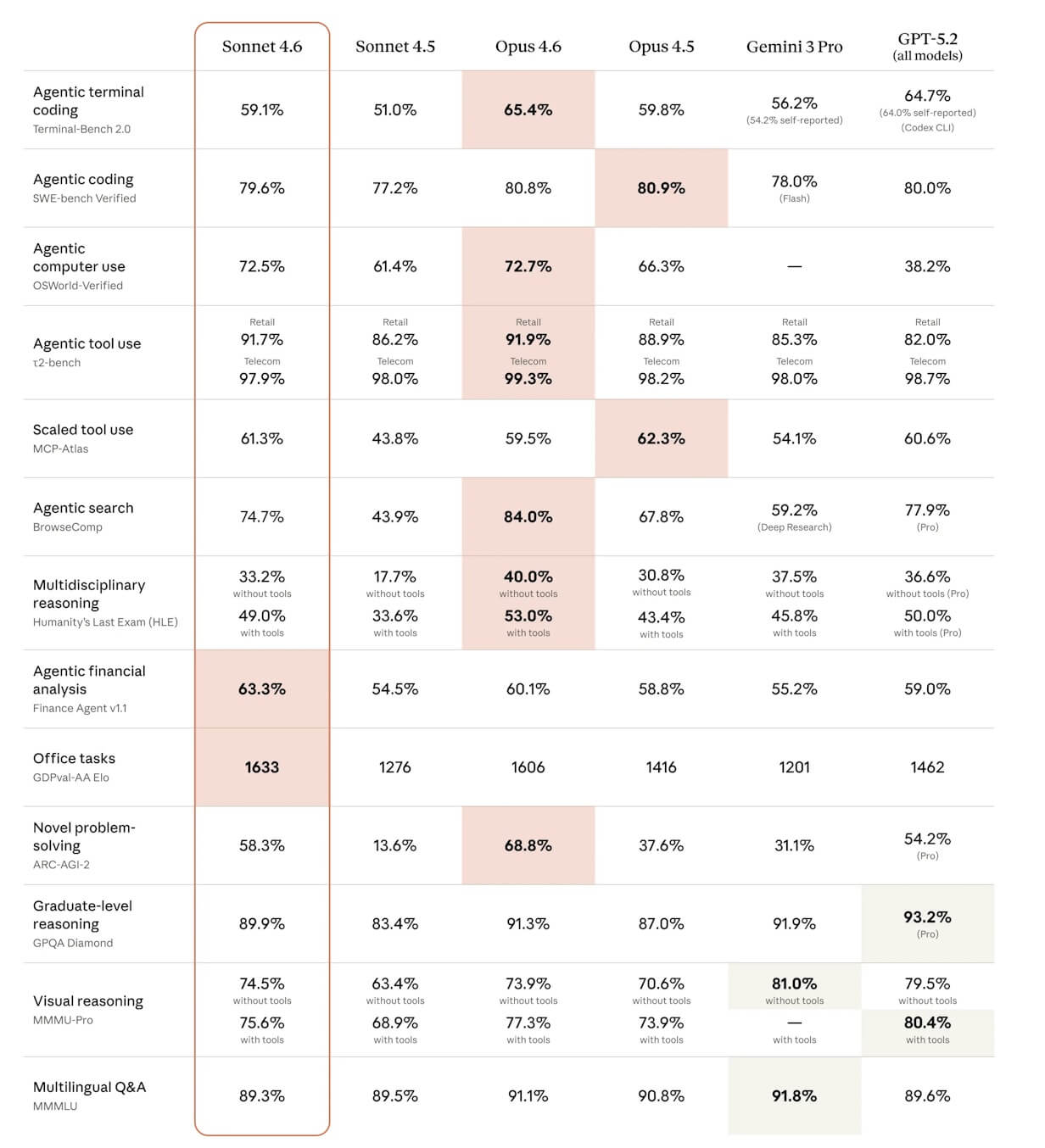
Sonnet 4.6 scores within 1–7 percentage points of Opus 4.6 on most major coding and reasoning benchmarks. Here is a comparison of their publicly reported scores:
| Benchmark | Claude Sonnet 4.6 | Claude Opus 4.6 | Gap |
|---|---|---|---|
| SWE-bench Verified | 79.6% | 80.8% | 1.2 points |
| HumanEval | ~92% | ~95% | ~3 points |
| MBPP (code generation) | ~88% | ~91% | ~3 points |
| GPQA Diamond | ~65% | ~74% | ~9 points |
| ARC AGI 2 | ~58% | ~75% | ~17 points |
The SWE-bench Verified gap of just 1.2 percentage points is the most striking number in this table. SWE-bench simulates fixing real bugs in open-source projects, which is one of the most practical tests of coding ability. For most everyday coding work, Sonnet 4.6 performs nearly as well as Opus 4.6.
The gap widens on abstract reasoning benchmarks like ARC AGI 2, where Opus 4.6 leads by 17 points. This tells you something important. For standard coding tasks, Sonnet is close enough. For deep, abstract, multi-layered problem solving, Opus still has a real edge.
Which Model Is Better for Coding?
Opus 4.6 produces higher quality code on complex, multi-file projects, but Sonnet 4.6 handles most standard coding tasks with near-identical results. The practical difference depends entirely on what you are building.
Where Sonnet 4.6 Matches or Beats Opus 4.6
Sonnet 4.6 performs at the same level as Opus 4.6 on 6 common coding task categories:
- CRUD APIs and boilerplate code where Sonnet produces clean, idiomatic output with no quality loss
- Unit test generation where Sonnet writes accurate and well-structured tests quickly
- Documentation and code comments where the quality gap between the two models is negligible
- Frontend component creation for frameworks like React, Vue, and standard HTML/CSS
- CI/CD scripting including Bash scripts, GitHub Actions workflows, and Dockerfiles
- Iterative pair programming where Sonnet’s faster response time gives it a speed advantage
Where Opus 4.6 Has a Clear Advantage
Opus 4.6 outperforms Sonnet 4.6 in 5 specific coding scenarios:
- Debugging complex multi-layered systems where deep reasoning catches subtle bugs
- Designing architecture for large-scale projects that require careful planning
- Working with legacy codebases that have poor or missing documentation
- Solving difficult algorithmic problems that require abstract thinking
- End-to-end project generation where Opus produces cleaner, more complete output in fewer tokens
A real-world test by Tensorlake demonstrated this gap clearly. Both models were asked to build a complete Python project from scratch. Opus 4.6 finished in 20 minutes with 33,200 output tokens and produced a working product. Sonnet 4.6 took 33 minutes with 52,900 output tokens and still had integration issues it could not fully resolve. Opus was faster, used fewer tokens, and delivered a cleaner result.
How Does Each Model Handle Long Context?
Both models support a 1 million token context window, but Opus 4.6 reasons more effectively across that full context length. Anthropic reported that Opus 4.6 achieves 76% accuracy on needle-in-haystack tasks at 1M tokens, compared to just 18.5% for Sonnet 4.5. Sonnet 4.6 significantly improved on that number, but Opus still holds the advantage for deep retrieval over very long documents.
The 1M context window is a first for the Sonnet line. Previous Sonnet models topped out at 200K tokens. This expansion means you can now feed Sonnet 4.6 an entire codebase, a full book, or dozens of research papers — and it can reason across all of them in a single conversation.
Both models support context compaction, a feature that automatically summarizes older parts of a conversation when it approaches the context limit. This keeps your effective context even larger than 1M tokens for long-running agentic sessions.
For most document analysis and knowledge work, Sonnet 4.6’s long-context ability is strong enough. Box evaluated Sonnet 4.6 on enterprise document tasks and found it outperformed Sonnet 4.5 in heavy reasoning Q&A by 15 percentage points. Hebbia reported a significant jump in answer match rate on their Financial Services Benchmark. These are real enterprise results, not synthetic tests.
Which Model Performs Better at Computer Use?
Sonnet 4.6 reached near human-level capability on computer use tasks, scoring 94% on one insurance industry benchmark for screen-based workflows. This makes it one of the highest-performing models for tasks like navigating spreadsheets, filling out web forms, and clicking through multi-step processes on a virtual screen.
Both models can use a computer the way you do — clicking, typing, reading the screen. Anthropic pioneered this capability back in October 2024, and the progress since then has been rapid. On the OSWorld benchmark, which tests AI performance across real software like Chrome, LibreOffice, and VS Code, Sonnet models have made steady gains over 16 months from Sonnet 3.5 through Sonnet 4.6.
Sonnet 4.6 also improved its resistance to prompt injection attacks during computer use. Prompt injections happen when malicious content on a website tries to hijack the model’s behavior. Anthropic’s safety evaluations confirmed that Sonnet 4.6 performs similarly to Opus 4.6 on prompt injection resistance — a major upgrade over Sonnet 4.5.
If your primary use case involves computer automation, Sonnet 4.6 offers the best cost-to-performance ratio. You get near-Opus quality computer use at 40% less cost per output token.
How Do the Models Differ in Reasoning Depth?
Opus 4.6 thinks more deeply and more carefully revisits its reasoning before settling on an answer. This makes it the stronger choice for tasks that require extended chains of logic, like analyzing complex legal arguments, solving multi-step math problems, or planning agentic workflows with many dependencies.
Both models support extended thinking, which allows the model to “think out loud” before producing its final answer. Opus 4.6 can generate up to 128K tokens of thinking, giving it more room to reason through complicated problems. Both models also support adaptive thinking, which lets you control the balance between speed and depth on each request.
The GPQA Diamond benchmark, which tests graduate-level scientific reasoning, shows the gap clearly. Opus 4.6 scores approximately 74% while Sonnet 4.6 scores approximately 65%. That 9-point gap reflects a real difference in the model’s ability to handle hard, multi-domain reasoning.
However, for most business and coding tasks, Sonnet 4.6’s reasoning is more than sufficient. Zapier tested Sonnet 4.6 and found it especially strong on branched and multi-step tasks like contract routing, conditional template selection, and CRM coordination. Windsurf noted that “for the first time, Sonnet brings frontier-level reasoning in a smaller and more cost-effective form factor.”
What Did Real Companies Say About Each Model?
Real enterprise feedback paints a clear picture. Sonnet 4.6 closes the gap with Opus for most production workflows, but Opus still leads on the hardest tasks. Here is what 5 major companies reported:
Replit said the performance-to-cost ratio of Sonnet 4.6 is “extraordinary” and that it outperforms on their orchestration evaluations while handling their most complex agentic workloads.
GitHub found that Opus 4.6 excels at complex code fixes, especially when searching across large codebases. For agentic coding at scale, they observed strong resolution rates and consistent quality.
Cursor described Sonnet 4.6 as “a notable improvement over Sonnet 4.5 across the board, including long-horizon tasks and more difficult problems.”
Databricks tested Sonnet 4.6 and found it matches Opus 4.6 performance on OfficeQA, which measures document comprehension across charts, PDFs, and tables.
Cognition reported that Sonnet 4.6 “meaningfully closed the gap with Opus on bug detection,” allowing them to run more reviewers in parallel and catch a wider variety of bugs without increasing cost.
When Should You Use Sonnet 4.6 Over Opus 4.6?
Use Sonnet 4.6 when speed and cost matter more than maximum reasoning depth. Sonnet is your best choice for 7 specific scenarios:
- Building or iterating quickly on new features where fast turnaround keeps your team moving
- Running agentic coding pipelines with many sequential API calls where token cost compounds rapidly
- Generating tests, documentation, or boilerplate at scale where output quality is already high enough
- Working within a tight API budget where every dollar of token spend matters
- Building tools for teams that need fast feedback loops rather than maximum precision
- Processing enterprise documents like contracts, financial reports, and research papers
- Automating computer-based workflows like form filling, data entry, and web navigation
When Should You Use Opus 4.6 Over Sonnet 4.6?
Use Opus 4.6 when the task demands deep reasoning, high accuracy, or sustained agentic execution. Opus is your best choice for 6 specific scenarios:
- Debugging complex multi-layered systems where subtle bugs hide across multiple files
- Designing architecture for large or long-lived projects that require careful upfront planning
- Working with legacy codebases that have poor documentation and tangled dependencies
- Solving algorithmic or mathematical problems at high difficulty levels
- Running high-stakes one-shot tasks where you need it right the first time
- Coordinating multiple agents in a workflow that requires sustained 14+ hour execution
The honest truth? Most of us will get excellent results from Sonnet 4.6 for 80–90% of our daily work. Opus 4.6 is the model you reach for on that remaining 10–20% — the tasks where you cannot afford mistakes and need the deepest reasoning the Claude 4 family offers.
How Do You Access Both Models?
Both Sonnet 4.6 and Opus 4.6 are available through 4 main channels: the Claude web and mobile interface at claude.ai, the Anthropic API, Claude Code (a command-line coding tool), and major cloud platforms like AWS Bedrock, Google Vertex AI, and Microsoft Azure.
On the free plan at claude.ai, Sonnet 4.6 is the default model. This means you can try it right now without paying anything. Opus 4.6 requires a paid plan or API access.
For developers building with the API, you use the model strings claude-sonnet-4-6 and claude-opus-4-6. Both models support prompt caching (up to 90% discount), batch processing (50% discount), and all existing Claude API features like tool use, web search, code execution, and memory.
If you use Claude Code, Anthropic’s command-line coding tool, both models are available. Claude Code lets you delegate coding tasks to Claude directly from your terminal. You can find full documentation at https://docs.anthropic.com/en/docs/claude-code.
Should You Use Both Models Together?
Yes. A hybrid Sonnet-plus-Opus workflow is the most cost-effective strategy for teams that need both speed and depth. Here is how to set it up in 3 steps:
Route all standard coding tasks, document processing, and repetitive work to Sonnet 4.6 first. Set up automatic escalation to Opus 4.6 when a task fails or requires deeper reasoning. Review the results monthly and adjust your routing thresholds based on actual quality metrics.
This approach lets you capture the cost savings of Sonnet 4.6 on most tasks while still having Opus 4.6 available when you genuinely need it. Several enterprise teams, including those at Cognition and Windsurf, already use this pattern in production.
The cost math is straightforward. If 80% of your tasks go to Sonnet and 20% go to Opus, your blended cost per output token is roughly $17 per million tokens instead of $25. That is a 32% savings with minimal quality loss on the tasks that matter most.
Frequently Asked Questions
Is Claude Sonnet 4.6 Better Than Claude Opus 4.6?
No. Claude Opus 4.6 remains Anthropic’s most powerful model overall. It scores higher on benchmarks for coding (80.8% vs 79.6% on SWE-bench Verified), abstract reasoning (75% vs 58% on ARC AGI 2), and scientific knowledge (74% vs 65% on GPQA Diamond). However, Sonnet 4.6 delivers 97–99% of Opus 4.6’s performance on standard coding tasks at 40–67% lower cost. The answer depends on your specific use case and budget.
Is Claude Sonnet 4.6 Free to Use?
Yes, on the claude.ai free plan. Anthropic upgraded the free tier to use Sonnet 4.6 as the default model. The free plan includes file creation, connectors, skills, and context compaction. API access requires payment at $3 per million input tokens and $15 per million output tokens.
Can Claude Sonnet 4.6 Replace Opus 4.6 for Coding?
Yes, for most coding tasks. Sonnet 4.6 handles CRUD APIs, test generation, frontend components, CI/CD scripting, and documentation at near-Opus quality. It struggles compared to Opus only on complex multi-file debugging, architectural design, and difficult algorithmic problems. About 80–90% of daily coding tasks fall within Sonnet’s capability range.
Does Claude Sonnet 4.6 Support Extended Thinking?
Yes. Both Sonnet 4.6 and Opus 4.6 support extended thinking and adaptive thinking. Extended thinking lets the model reason step-by-step before producing a final answer. Opus 4.6 supports up to 128K tokens of thinking output, which gives it more room for complex reasoning chains.
Which Model Has Better Computer Use Capabilities?
Both models perform similarly on computer use tasks. Sonnet 4.6 reached 94% on an insurance industry computer use benchmark and showed near human-level capability on spreadsheet navigation and web form completion. Sonnet 4.6 also matches Opus 4.6 on prompt injection resistance during computer use. For computer automation specifically, Sonnet 4.6 offers the best value because it achieves comparable performance at lower cost.
How Much Money Can You Save by Using Sonnet 4.6 Instead of Opus 4.6?
You save 40% on input tokens and 40% on output tokens. Sonnet 4.6 charges $3/$15 per million tokens (input/output), while Opus 4.6 charges $5/$25. For a team processing 10 million output tokens per day, that difference equals $100 per day or roughly $3,000 per month in savings. Both models offer additional savings through prompt caching (up to 90%) and batch processing (50%).
Which Model Is Better for Agentic Workflows?
Opus 4.6 is better for complex agentic workflows that require deep planning and sustained execution. It can break tasks into independent subtasks, run tools in parallel, and sustain agentic execution for up to 14.5 hours. Sonnet 4.6 handles simpler agentic tasks well and excels in agentic pipelines where speed and cost matter more than maximum reasoning depth. For high-volume agentic workflows with many sequential calls, Sonnet 4.6 is often the smarter choice because token costs compound quickly.
Wrapping Up: What This Comparison Tells You
The gap between Claude Sonnet 4.6 and Claude Opus 4.6 is the smallest gap ever between a Sonnet and Opus model in Anthropic’s history. On SWE-bench Verified, just 1.2 percentage points separate them. On everyday coding tasks, the difference is often invisible. On enterprise document comprehension, Databricks found them performing at parity.
But the gap still exists. Opus 4.6 leads on hard reasoning, abstract problem solving, and sustained agentic execution. It produces cleaner code on complex projects, uses fewer tokens, and recovers from errors faster. If you are working on something genuinely hard — refactoring a legacy codebase, building an agent coordinator, solving competitive programming problems — Opus 4.6 is worth the extra cost.
For everyone else, Sonnet 4.6 is a breakthrough. It brings what used to be Opus-level performance into a price bracket that works for startups, individual developers, and high-volume production systems. The smartest approach is to start with Sonnet 4.6 as your default, measure where it falls short for your specific tasks, and route only those tasks to Opus 4.6. That way you get the best of both models without overspending on the vast majority of your workload.
You May Also Like
 AI Models
Which Claude Model Is the Best Right Now? An Honest 2026 Breakdown
 AI Models
Is DeepSeek Accurate? An Honest, Practical Answer
 AI Models
Llama 4 Scout vs Llama 4 Maverick: Which One Actually Fits Your Workflow?
 AI for Coding
The Best AI Models for Developers in 2026: An Honest, Hands-On Look at What Actually Works
 AI Models
GPT-5.5 vs Claude Opus 4.7 vs Gemini 3.1 Pro: Real Benchmark Results Compared
 AI Models