
If you’ve spent any time on dev Twitter, Reddit, or YouTube lately, you’ve seen the “Kimi just destroyed ChatGPT” thumbnails. You’ve also seen the “ChatGPT is still king, don’t fall for the hype” takes. And if you’re like most people, you’ve ended up confused because both camps are saying the opposite thing with equal confidence.
Here’s the truth, and I’ll say it upfront: neither one is universally “better.” What I can tell you is which model wins at which job, when to use which, and where the loud voices online are getting it wrong.
I’ve spent real time with both, using Kimi K2.6 and GPT-5 for coding, writing, research, debugging, summarization, generate images and a bunch of weird edge cases. What follows is the honest breakdown, written the way I’d explain it to a buddy over beers, not the way a marketing team would spin it.
Let’s dig in.
Kimi K2.6 Model VS ChatGPT 5.4: The Quick Answer If You’re in a Hurry
Use ChatGPT (GPT-5) if: you want the polished, everything-works-out-of-the-box experience. Best for general writing, creative work, quick coding help, voice chat, image generation, and if you need one tool that does everything reasonably well.
Use Kimi K2.6 if: you need to process massive documents, run large-scale coding projects, care deeply about cost, want agentic workflows with multi-agent orchestration, or you work heavily in Chinese. It’s cheaper, more technical, and in some specific lanes — it’s actually better.
Use both if: you’re smart. Honestly. A lot of power users are running ChatGPT for daily work and Kimi for bulk or document-heavy jobs. They’re complementary more than they are rivals.
Now, the actual breakdown.
Meet the Contenders
ChatGPT is OpenAI’s flagship chatbot, built on the GPT-5 family of models. It launched in late 2022, and by now basically every person with an internet connection has heard of it. It’s the default, the household name, the one your mom uses to write birthday cards.
Kimi AI is made by Moonshot AI, a Beijing-based startup backed by Alibaba. Their latest model, Kimi K2.6 (dropped April 20, 2026), is the current version turning heads. It’s open-weight, aggressively cheap, and built with a heavy focus on long-context work and agentic tasks.
One’s polished and mainstream. The other’s scrappy and technical. That context matters for everything that follows.
The Spec Sheet Nobody Reads But Should
Here’s what you’re actually comparing if you stripped away all the marketing:
| Feature | ChatGPT (GPT-5) | Kimi K2.6 |
|---|---|---|
| Made by | OpenAI (USA) | Moonshot AI (China) |
| Context Window | 400K tokens (API), 128K (Plus) | 256K tokens |
| Max Output | 128K tokens | ~65K tokens |
| Input Price (API) | $1.25 / 1M tokens | ~$0.56 / 1M tokens |
| Output Price (API) | $10.00 / 1M tokens | ~$3.50 / 1M tokens |
| Consumer Plan | Free / Plus $20/mo / Pro $200/mo | Free web tier + pay-per-use API |
| Open Weights | ❌ Proprietary | ✅ Available on Hugging Face |
| Image Generation | ✅ Yes (GPT-Image-2) | ❌ No |
| Voice Mode | ✅ Yes | ❌ No |
| Web Browsing | ✅ Yes | ✅ Yes |
| Multimodal Input | Text, Image, File | Text, Image |
| Agent Swarm | Limited | ✅ Up to 300 sub-agents |
| Thinking Mode | ✅ Yes | ✅ Yes |
Two things pop out here. First, GPT-5 is roughly 2-3x more expensive than Kimi on API pricing (Galaxy.ai comparison). Second, ChatGPT does way more types of things — voice, image generation, richer multimodal — while Kimi is more of a specialist.
These aren’t the same product. They’re overlapping, but they’re not identical. Treating them as direct one-to-one competitors is where most comparison articles go wrong. Here’s the ChatGPT Images 2.0 update and it was insane! If you’re from USA and worry about privacy you can figue out here; is kimi ai safe to use.
Head-to-Head: Which Is Better for What?
This is the part you’re actually here for. Let me break it down by use case, because “better” depends entirely on what you’re doing.
Coding & Development: Mostly a Tie, Leaning Kimi for Scale
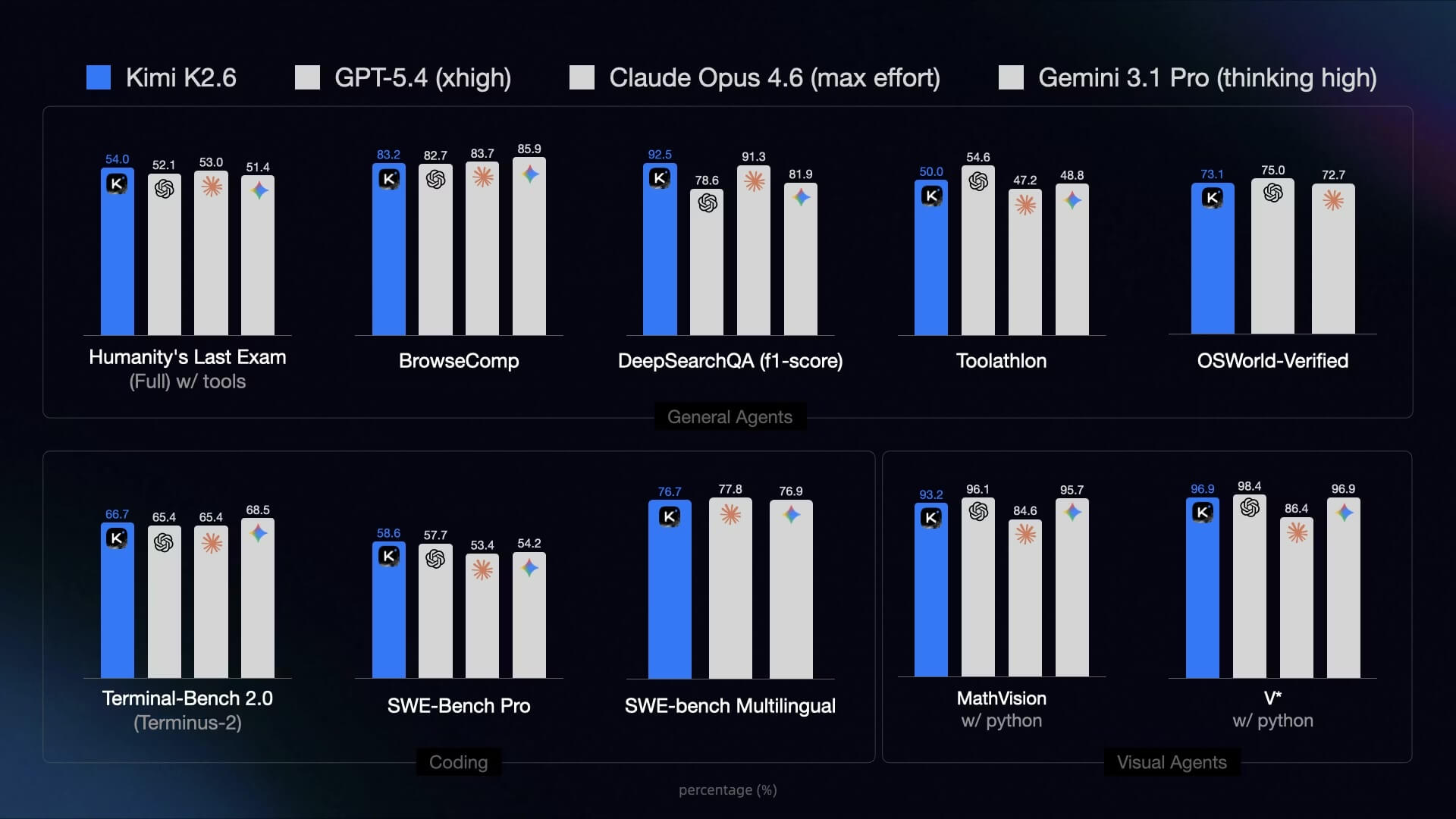
Here’s where the real benchmark war plays out. Let me show you the numbers, because they tell a more interesting story than you’d think:
| Benchmark | Kimi K2.6 | GPT-5.4 | Winner |
|---|---|---|---|
| SWE-Bench Pro | 58.6 | 57.7 | Kimi (slightly) |
| Terminal-Bench 2.0 | 66.7 | 65.4 | Kimi (slightly) |
| HLE-Full w/ tools | 54.0 | 52.1 | Kimi |
| DeepSearchQA (accuracy) | 83.0 | 63.7 | Kimi (big margin) |
| OSWorld-Verified | 73.1 | 75.0 | GPT-5 |
| SciCode | 52.2 | 56.6 | GPT-5 |
| Toolathlon | 50.0 | 54.6 | GPT-5 |
Here’s the thing. On practical coding and agentic work, Kimi K2.6 is actually slightly ahead of GPT-5 on several benchmarks. That’s a wild sentence to type, but the numbers back it up. On agentic search with deep reasoning, Kimi’s lead is substantial.
But on scientific coding (SciCode), tool orchestration (Toolathlon), and computer use (OSWorld), GPT-5 keeps its edge. And in real-world usage, GPT-5 tends to be more reliable — it gets stuck less often, overthinks less, and generally “just works” on messy production tasks.
Bottom line for coders:
- Quick scripts, debugging, explaining code? Tie. Both are excellent.
- Huge codebases or multi-file refactors? Kimi, because of its 256K context and agent swarm.
- Mission-critical production code where reliability matters? ChatGPT, especially GPT-5 Pro.
- High-volume automated coding (think CI/CD auto-fixes, bulk refactoring)? Kimi, because the cost math is just way better.
Writing & Content Creation: ChatGPT (Usually)
I’ll say it straight — for English writing, ChatGPT is still the better writer. Not by a massive margin, but by enough that you’ll notice it if you write for a living.
ChatGPT’s prose flows better. It understands tone and register more consistently. It handles idioms, cultural references, and subtle humor in ways Kimi still doesn’t quite nail. For blog posts, marketing copy, social media, and anything where the feel of the writing matters, ChatGPT wins.
That said, here’s where it gets interesting. Kimi K2.6 has a small but passionate following among creative writers who swear it produces better long-form fiction and more surprising creative output (Reddit discussion). The theory is that because Kimi isn’t as heavily RLHF’d for corporate-friendly tone, it takes creative risks that ChatGPT shies away from.
In my experience, that’s partly true. Kimi will give you a weirder, more interesting first draft. ChatGPT will give you a more polished one. Depending on what you’re writing, either can be what you want.
Writing verdict:
- Blog posts & SEO articles? ChatGPT
- Marketing copy & ad copy? ChatGPT (slight edge)
- Creative fiction & experimental writing? Kimi (surprisingly)
- Technical documentation? Tie
- Social media captions? ChatGPT
Research & Long Documents: Kimi Wins. Not Close.
If you’re feeding AI entire research papers, contracts, books, or massive datasets — this is Kimi’s home turf. And it’s not even close.
Kimi K2.6 handles 256K tokens natively, and earlier Kimi versions have pushed context up to 2M tokens. GPT-5 handles 400K via API but only 128K on the consumer ChatGPT Plus tier. In practical terms, Kimi can swallow an entire 400-page book in one prompt. ChatGPT Plus chokes at around 200 pages.
And here’s where it really shines DeepSearchQA accuracy of 83.0 vs GPT-5’s 63.7. That’s a 20-point gap on tasks that test how well the model extracts correct answers from long, dense research material. It’s one of the largest gaps in any benchmark between these two models.
Research verdict:
- Summarizing long PDFs? Kimi
- Analyzing multi-source research? Kimi
- Legal contract review? Kimi (context window matters a lot)
- Multi-step research with web browsing? Tie, leaning Kimi
- Quick factual lookups? ChatGPT (faster, better web integration)
Math & Reasoning: ChatGPT Still Has the Edge
Here’s where GPT-5 reasserts itself. On pure math and reasoning benchmarks, it’s ahead:
| Benchmark | Kimi K2.6 | GPT-5.4 | Winner |
|---|---|---|---|
| AIME 2026 | 96.4 | 99.2 | GPT-5 |
| HMMT 2026 | 92.7 | 97.7 | GPT-5 |
| IMO-AnswerBench | 86.0 | 91.4 | GPT-5 |
| GPQA-Diamond | 90.5 | 92.8 | GPT-5 |
Not massive gaps. But consistent. If your work is pure mathematical reasoning, contest-style problem solving, or PhD-level science, GPT-5 is the safer bet.
That said, we’re talking about scores in the 86-99% range here. Both models are absurdly good at math. Unless you’re genuinely doing olympiad-level stuff, you probably won’t notice the difference day-to-day.
Chinese Language & Multilingual: Kimi Dominates
This one’s easy. Kimi is natively trained in Chinese. It’s not even a contest.
For Chinese writing, Chinese business content, translation between English and Chinese, or anything involving Chinese cultural context, Kimi blows ChatGPT out of the water. Rated 10/10 for Chinese content vs ChatGPT’s 7/10 in head-to-head tests.
For Japanese and Korean, Kimi’s also noticeably better. For French, Spanish, German, and most European languages, ChatGPT wins, because its training data weighted those languages more heavily.
Multilingual verdict:
- Chinese, Japanese, Korean? Kimi
- European languages? ChatGPT
- Rare languages? ChatGPT (broader coverage)
Multimodal & Creative Tasks: ChatGPT, By a Mile
This isn’t even close. ChatGPT can:
- Generate images via GPT-Image-2
- Handle voice conversations
- Analyze videos
- Execute code in sandboxed environments
- Generate audio
- Integrate with DALL-E, Sora, and Operator
Kimi K2.6 accepts text and images as input, outputs text, and… that’s it. No image generation, no voice mode, no video generation.
If you’re a content creator who needs illustrations, voiceovers, thumbnails, or any kind of mixed-media output — ChatGPT is the only real choice. Kimi is a text machine. A very good text machine, but a text machine.
Customer Support & Business Automation: Kimi (Because of the Math)
Here’s a scenario that plays out at thousands of companies:
You’re building a customer support chatbot. It’ll handle ~8 million tokens per month. Which one do you use?
ChatGPT API: ~$720/month
Kimi K2.6 API: ~$24.80/month
That’s not a typo. It’s roughly 30x cheaper.
Scale that to a million-ticket-per-year enterprise operation and you’re comparing $90,000/year (GPT-5) to $3,100/year (Kimi). For business automation, bulk processing, high-volume customer support, or any task where you’re making lots of API calls, Kimi’s cost advantage is genuinely transformative.
Quality-wise, Kimi is absolutely good enough for most support workflows. You’re not going to get meaningfully worse customer outcomes. You’re just going to save a lot of money.
The Cost Comparison That Might Actually Decide It for You
Let’s be blunt about this. Here’s the real-world cost breakdown for different user types:
| User Type | Monthly Usage | ChatGPT Cost | Kimi Cost | Monthly Savings |
|---|---|---|---|---|
| Casual user | <1M tokens | $20 (Plus) | $0-5 | ~$15 |
| Solo developer | 10M tokens | $137 (API) | $31 | $106 |
| Small startup | 50M tokens | $687 | $155 | $532 |
| Growing business | 200M tokens | $2,750 | $620 | $2,130 |
| Enterprise scale | 1B tokens | $13,750 | $3,100 | $10,650 |
For casual users, the difference is negligible — a few bucks a month. For developers and businesses scaling up, the gap compounds fast. At enterprise scale, we’re talking six figures a year in differential spend. That’s serious money.
And here’s the hidden thing most comparisons miss: you can use Kimi via OpenRouter or self-host the open-weight version. No vendor lock-in. No subscription hostage situation. That flexibility has real value beyond the raw price.
Speed, Reliability & User Experience
Benchmarks don’t tell you how the models feel to use. Here’s the reality:
ChatGPT is faster. Response times are noticeably snappier, especially on the consumer web app. It’s had years of infrastructure optimization behind it and it shows.
ChatGPT is more reliable. It rarely hangs, rarely produces broken output, rarely fails on edge cases. Kimi has more “huh, that’s weird” moments — not a lot, but more.
ChatGPT has a more polished UI. The web app is genuinely slick. Voice mode works beautifully. Custom GPTs, memory, project folders — it’s a mature product.
Kimi’s UI is functional but less refined. It works. It doesn’t dazzle. For power users who just want a fast text box and a smart model, that’s fine. For your non-technical mom, it’s not as friendly.
Kimi is weirdly more decisive. This is subjective, but Kimi tends to just do the thing you asked without as much preamble. ChatGPT can be chatty and hedgy. Whether that’s a feature or a bug depends on your mood.
Privacy & Safety: The Part You Can’t Skip
Look, this matters. Kimi is made by a Chinese company. That triggers reactions — some reasonable, some overblown — and you need to think about it honestly.
The reasonable part: Moonshot is subject to Chinese law, specifically Article 7 of the National Intelligence Law, which can compel data disclosure to Chinese authorities. Your prompts, uploaded files, and generated content may be retained and potentially accessible under that legal framework. This is a real concern if you’re handling sensitive corporate data, classified material, or information under regulatory protection (HIPAA, GDPR, etc.).
The less reasonable part: Kimi isn’t “spyware.” It’s not watching your webcam. For a student summarizing a textbook or a freelancer drafting a blog post, the practical risk is minimal. For an enterprise handling customer PII, it’s a compliance concern.
ChatGPT’s privacy story: OpenAI is subject to U.S. law and has clearer enterprise data handling. By default, it may use your data for training, but you can opt out. Enterprise tier has stronger no-retention guarantees. There have been incidents (the 2023 leak, some data exposure events), but the legal framework is friendlier to Western users.
If privacy is a top-three concern for you, default to ChatGPT for sensitive work. If you really love Kimi’s capabilities, you can self-host the open-weight version — which is arguably the most private option available, since nothing ever leaves your machine.
Common Mistakes People Make Comparing These Two
I’ve seen these mistakes over and over, and they lead people to wrong conclusions.
Mistake #1: Comparing benchmark headlines without reading the fine print. “Kimi beats GPT-5 on SWE-Bench Pro!” is technically true (58.6 vs 57.7). It’s also a 0.9-point gap that’s within measurement noise. Don’t change your whole stack over a 1% benchmark difference.
Mistake #2: Assuming “more capable = better for me.” ChatGPT does image generation and voice chat. Great. If you never use those features, they’re irrelevant to your decision.
Mistake #3: Ignoring the tokenizer difference. Kimi and ChatGPT count tokens differently. A prompt that’s 1,000 tokens in ChatGPT might be 1,100 in Kimi or vice versa. Run a real cost estimate with your actual workload before switching.
Mistake #4: Thinking you have to pick one. You don’t. The smartest users run both and route each task to whichever model handles it better. More on that in a second.
Mistake #5: Assuming ChatGPT will always be better because it’s “the original.” OpenAI has a head start, but Moonshot is iterating aggressively. A year ago, Kimi wasn’t in this conversation. Today it’s genuinely competitive. In a year, who knows.
Mistake #6: Ignoring the privacy angle entirely. Even if you’re not paranoid, knowing where your data flows matters. Make an informed choice, not a reflexive one.
What Actually Works: Real Workflow Tips
Here’s how I’ve seen smart users set up their AI stack in 2026.
The “Router Setup”: Use a tool like OpenRouter that lets you hit both models through one API. Route simple, high-volume tasks to Kimi. Route hard, quality-critical tasks to ChatGPT. Watch your costs drop 60-80% without sacrificing quality.
The “Document Pipeline”: Dump long documents into Kimi for initial summarization and extraction. Feed Kimi’s output into ChatGPT for polish, creative rewriting, or formatting. Best of both worlds.
The “Chinese + English Stack”: If you work in both languages, use Kimi for Chinese and ChatGPT for English. Don’t try to force one model to be great at both when they’re natively better at different things.
The “Draft with Kimi, Polish with ChatGPT”: For writers, this one’s gold. Kimi generates weirder, more interesting first drafts. ChatGPT’s better at polishing prose. Stack them for content that’s both creative and refined.
The “Research Then Create” Flow: Use Kimi to ingest 50 sources and produce a structured summary. Use ChatGPT to turn that summary into a polished article, report, or presentation.
The “Self-Host Kimi for Privacy”: If you’re a tech-savvy team with sensitive data, running Kimi K2.6 on your own infrastructure gets you most of the capability without any data leaving your network. ChatGPT can’t offer that.
So… Is Kimi Actually Better Than ChatGPT?
Depends who’s asking. If you’re a casual user who just wants one AI that does everything like writing, images, voice, quick questions ChatGPT is better. Not because it’s technically superior on every benchmark, but because the overall experience is more polished, the ecosystem is richer, and you don’t have to think about whether it’ll work on whatever random thing you throw at it.
If you’re a developer building agentic applications, processing huge documents, or running high-volume AI workflows, Kimi is probably better. The cost advantage alone makes it worth using, and the agent swarm architecture genuinely enables things ChatGPT can’t match as easily.
If you work in Chinese, Kimi, full stop.
If you need multimodal creativity (images, voice, video). ChatGPT, full stop.
If you’re privacy-conscious with sensitive data, ChatGPT for enterprise use cases, or self-host Kimi’s open weights for the strongest privacy posture.
If you’re price-sensitive at any meaningful scale — Kimi.
If you want the safest, most mainstream, “nobody got fired for buying it” option — ChatGPT.
Final Thought
Here’s the thing nobody wants to say out loud: this isn’t a rivalry where one model crushes the other. It’s a market where two really capable tools are optimizing for different priorities. OpenAI is building the most polished, broadly-useful AI product on the planet. Moonshot is building the most cost-effective, open-weight alternative with a focus on long-context work and agentic workflows.
Both are succeeding at what they’re trying to do. Picking a “winner” is kind of missing the point.
The smartest move, honestly, is to stop treating this like a binary. Use ChatGPT where it’s strong. Use Kimi where it’s strong. Save money where you can. Spend it where it counts. The people who figured this out a year ago are already shipping better products than everyone still stuck in the “which one is better?” argument.
And if this whole comparison has you exhausted and you just want someone to pick one for you? Default to ChatGPT Plus at $20/month if you’re a general user, and Kimi K2.6 via API if you’re a developer watching the budget. Those two defaults will serve 90% of people well.
The other 10% will figure out on their own that the real answer was “both.”
You May Also Like
 AI Tool Reviews
How to Use ChatGPT for Beginners: The Complete Step-by-Step Guide (2026)
 ChatGPT
How to Use ChatGPT at Work: Productivity Tips That Actually Save You Hours
 ChatGPT
How to Use ChatGPT Best Prompts
 AI Models
Which Claude Model Is the Best Right Now? An Honest 2026 Breakdown
 AI Models
Is DeepSeek Accurate? An Honest, Practical Answer
 AI Tool Reviews