
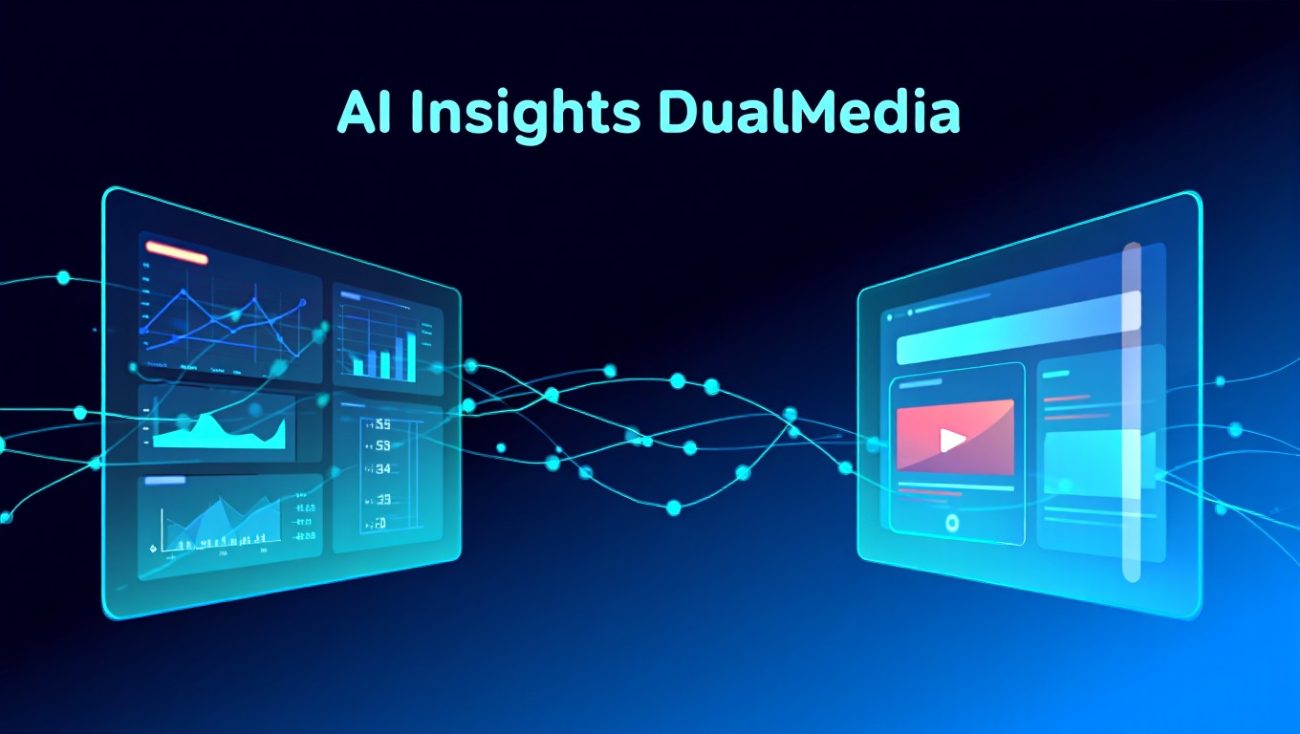
Let’s be honest, the AI space has gotten loud. Every other day, there’s a new tool promising to change everything, and most of them quietly fade away within a quarter. So when something like AI Insights DualMedia keeps surfacing in my feeds, search results, and Slack conversations with marketers, I figured it deserved a real look. Not a fluff piece. Not a lazy press-release rewrite. An honest breakdown of what it actually is, how it works, and whether it’s worth your time.
If you’ve been searching for a clear, no-nonsense explanation of AI Insights DualMedia — what it is, how the technology behind it functions, and where it fits into the bigger AI ecosystem, you’re in the right place. I’ll walk you through what I’ve gathered from real users, the official site, and a few brutally honest reviews floating around. Including the parts most blogs gloss over.
What Is AI Insights DualMedia, Really?
Here’s the thing — the name throws people off. “AI Insights DualMedia” sounds like a single product, but it’s actually two related things wrapped under the same brand.
First, AI Insights is the dedicated AI section of DualMedia Innovation News — a tech publication that’s been covering AI, crypto, cybersecurity, and emerging tech since 2000. It’s basically a content hub built to track how artificial intelligence is reshaping industries, with real analysis instead of recycled press releases.
Second, when people talk about “AI Insights DualMedia” as a capability, they’re referring to a hybrid approach that blends AI-powered analytics with multi-channel (dual media) marketing with combining online and offline data, text and visuals, predictive analytics and human strategy. It’s an approach more than a single piece of software, and a few platforms have built tools around the concept.
So, depending on the context, AI Insights DualMedia could mean:
- The publishing platform at dualmedia.com that decodes AI news for everyday readers and pros
- The methodology of using AI to merge online + offline marketing insights
- The toolset sold by various vendors built around that methodology
What most people don’t realize is that all three feed into the same idea: using AI to make sense of multiple data and content streams at once, and turning that into smarter decisions.
Why Anyone Even Cares About DualMedia in the First Place
Okay, before we go deeper, let’s zoom out. Why is “dual media” anything?
From experience, single-channel thinking has always had a ceiling. A marketer who only watches Facebook ad metrics misses the bigger picture. A business owner who only tracks online sales ignores the foot traffic their billboard generates. A reader who only follows AI hype misses the practical, on-the-ground shifts.
DualMedia tries to fix that gap. The “dual” part is the whole point — you’re combining two worlds:
- Digital + physical marketing channels
- Text + visual content analysis
- Historical + predictive data
- Automated + human decision-making
When you blend those streams, you get context. And in AI, context is everything.
Marketers, this matters to you. Business owners, especially. If you’re still treating AI like a fancy autocomplete, you’re missing where things are heading.DualMedia-style insights are now used across marketing, media, education, and e-commerce and the appeal is the same in every industry: clearer decisions, less guesswork.
How AI Insights DualMedia Works (The Honest Breakdown)
Let’s get into the mechanics. This is where most articles get vague and start tossing around words like “synergy” and “next-generation.” I’ll keep it grounded.
The Core Concept: Two Streams, One Brain
At its heart, the DualMedia approach processes two different data streams through unified AI models. These streams typically pair like this:
| Stream 1 | Stream 2 | Real-World Use Case |
|---|---|---|
| Online ad data | Offline foot traffic / sales | True ROI of omnichannel campaigns |
| Text content | Visual creative | Knowing which ad images drive engagement |
| Historical performance | Real-time signals | Predictive budget reallocation |
| Customer behavior | Audience demographics | Real-time segmentation, not static personas |
| News & trend data | Industry-specific impact | AI Insights articles and analysis |
The magic happens in something called the embedding space, a mathematical “world” where words, pixels, and behaviors all get translated into the same kind of numerical fingerprint. Once the data is in that shared space, the AI can compare and reason across it.
Step by Step: What Actually Happens
Here’s a simplified flow of what’s going on under the hood when AI Insights DualMedia tools process your data:
- Ingestion. Your CRM data, ad platform metrics, creative assets, and any offline signals get pulled in.
- Cleaning and mapping. Each source is normalized so the system can compare apples to apples.
- Encoding. Text goes through transformer-based models. Images and video go through vision encoders. Numbers feed into structured ML models.
- Alignment. All these representations get aligned into a shared embedding space — this is the secret sauce.
- Fusion + reasoning. The aligned data feeds into predictive models that look at attribution, fatigue, audience patterns, and outcomes.
- Output. You get dashboards, alerts, predictions, and (sometimes) automated actions like pausing a tired ad or shifting budget.
Here’s where things get interesting: the quality of step 4 (alignment) is what separates a mediocre platform from a great one. According to a detailed BoostiGrow review, platforms in this space typically need around 90 days of active data flow before predictions stabilize. The AI is basically going to school on your business during that period — and if your data is messy, it learns your bad habits.
Predictive Analytics: The Real Power Move
Most analytics tools look backward. They tell you what already happened. That’s useful, but not game-changing.
DualMedia-style systems try to look forward. The forecasting engines look at historical ad fatigue, seasonal trends, current auction prices, and creative performance to flag when a specific asset is about to stop working — sometimes days before the cost-per-click actually spikes.
That kind of foresight, when it works, easily shaves 20% off wasted media spend by catching ad fatigue before it bleeds your budget.
Content Intelligence: Where Visuals Meet Numbers
This is the part I find genuinely fascinating. AI Insights DualMedia tools don’t just crunch numbers — they scan your actual creative assets.
It might tell you that videos featuring people looking directly at the camera perform 30% worse on Tuesdays. Or that warm color palettes outperform cool ones for your specific audience.
It’s weirdly specific. And usually accurate.
The catch? Algorithmic bias. If you’ve historically only run ads to one demographic, the AI assumes that demographic is all that matters and quietly ignores everyone else. You have to actively force the system to test new audiences, or you end up trapped in a highly optimized echo chamber.
What You’ll Actually Find on AI Insights DualMedia (the Publication)
Now switching gears to the content side, because this is what most people land on when they Google “AI Insights DualMedia.”
Based on the official AI Insights page, the publication covers an absurdly wide range of AI-related topics in 2026, including:
- AI in music tools and how to evaluate them honestly
- Google Gemini Notebooks going free for everyone
- AI agents in the workplace and what they’re actually replacing
- Conversational AI and roleplay platforms like Beta Character AI
- Medical AI — including pet dentistry tools like Nerovet
- Personalization vs. privacy debates
- LegalTech and AI contract automation
- EdTech and AI tutoring
- Wearables and health tech diagnostics
- Cybersecurity automation and threat detection
- NVIDIA’s DLSS 5 and RTX 50-series coverage
- Enterprise software shifts (Oracle, etc.)
- The supposed end of traditional programming
- AI in ecommerce and customer support
The audience is intentionally broad — students, freelancers, developers, small teams, brands, creators, legal pros, educators. Basically anyone trying to keep up with AI without drowning in jargon.
Real-Life Use Cases: Where DualMedia Actually Shows Up
Theory is fine, but let’s talk about where you’d actually run into this in practice.
1. Smarter Content Creation
Marketers, this is huge. The DualMedia approach lets you feed in a brand image and a tone-of-voice document, and get social posts that actually feel on-brand. Or upload a product video and get blog posts, captions, and email subject lines automatically aligned with your visual identity.
I’ve seen small teams ship a week’s worth of content in an afternoon using this stuff. It’s not magic — but it’s close.
2. Multi-Channel Attribution Without the Spreadsheet Hell
Trying to prove which touchpoint actually closed the sale is a nightmare. Was it the LinkedIn ad? The organic search? The newsletter?
DualMedia-style tools use fractional attribution models that don’t just credit the last click. They weigh every interaction based on algorithmic probability — forcing you to stop over-valuing bottom-of-the-funnel tactics and start respecting top-of-funnel awareness work.
Getting your CFO to actually trust these numbers, though? That’s a completely different battle.
3. Real-Time Audience Segmentation
Static personas are dying. According to Zulo AI’s analysis, one of the core ideas behind AI Insights DualMedia is real-time segmentation — where audiences shift and re-cluster based on actual behavior, not what some marketing manager guessed in 2019.
4. Automated Budget Reallocation
The automated rule engines can pause campaigns or shift budgets when ROAS thresholds get crossed. Powerful, but you don’t want this on full autopilot day one — the AI is overly aggressive when it’s young and might dump your entire budget into a single vanity metric.
5. Staying Informed Without Drowning
Honestly, the simplest use case for the publication side is just: stay caught up. The AI Insights section is built to help you keep up without reading 40 different newsletters.
Common Mistakes (Save Yourself the Pain)
Let me save you some headaches here. From what users actually report, these are the biggest traps people fall into:
1. Treating it as plug-and-play. Vendors love the phrase “instant integration with 50+ ad networks.” Reality? You’ll spend weeks chasing API keys, mapping custom fields, and begging IT to whitelist IP addresses.
2. Skipping the data cleanup. AI Insights DualMedia is like a high-performance sports car. Pour cheap, contaminated fuel into it and the engine knocks. If your CRM is full of duplicates and manual overrides, the AI just learns your bad habits and amplifies them.
3. Trusting predictions before the model is trained. Any forecast in the first 90 days should be treated with serious skepticism. The AI hasn’t seen enough of your business yet.
4. Letting the AI run fully autonomous on day one. Keep automated budget changes in manual-approval mode for the first few months. Trust me on this.
5. Ignoring the operational tax. This isn’t a “set it and forget it” tool. Someone on your team has to monitor pipelines, troubleshoot broken APIs, and re-authenticate tokens when ad platforms change their privacy policies. Without that human, the platform turns into a very expensive paperweight within three months.
6. Over-relying on AI insights without human review. Even Global Tech Council’s FAQ states it plainly — “human review is still important.” The AI is a brilliant assistant, not a replacement for judgment.
What Actually Works: Practical Tips
Here’s what I’d genuinely recommend if you’re going to dive in:
- Clean your house first. Spend a few weeks auditing and de-duping your CRM and ad data before you connect anything. Your future self will thank you.
- Budget for a data ops person. Even part-time. The platform claims to be plug-and-play, but you’ll need someone managing API limits and data flow.
- Use it to inform, not dictate. Let the AI surface patterns and predictions, but keep humans in the loop for final decisions — especially around creative direction.
- Force diversity testing. Manually push the system to test new audiences. Don’t let it optimize you into a tiny echo chamber.
- Read the AI Insights publication regularly. Even if you never buy the toolset, the content alone keeps you sharper than 90% of your competitors. Bookmark DualMedia and check in weekly.
- Match the tool to your scale. If you’re running basic Facebook and Google ads on a small budget, this is overkill. If you’re managing millions across five platforms with a broken attribution model, it’s worth the painful setup.
- Don’t over-rely on the dashboard. Pretty graphs feel productive. Real insights come from asking weird, specific questions and digging into the why.
What Most People Get Wrong About AI Insights DualMedia
Here’s where things get interesting — and a little uncomfortable.
Most people think AI Insights DualMedia is about automating marketing tasks. It’s not. It’s about automating decisions across realities — digital and physical, online and offline, predictive and reactive Zulo AI. That’s a fundamentally different value proposition.
The other big misconception? That the AI is magic. It’s not. It’s a powerful pattern-matcher with a lot of operational baggage. The companies that win with it are the ones that invest in the unglamorous parts — data hygiene, human oversight, slow training periods — instead of expecting the AI to fix a broken business overnight.
And let’s be real — there’s also vendor lock-in to think about. Once you’ve ingested three years of media data, built custom dashboards, and trained the AI on your specific business logic, leaving is a logistical nightmare. You’re not buying software. You’re entering a long-term marriage. So do your homework on the vendor’s roadmap before you sign anything.
A Quick Note on the AI News Side
If you’re more interested in the publication than the marketing tech, here’s the quick pitch: DualMedia’s AI Insights section is genuinely useful because it doesn’t just rewrite press releases. The pieces actually take positions — like a recent article on judging music AI tools more honestly, or a piece on the LA Times’ AI feature controversy, or a fascinating breakdown of how more data can sometimes mislead AI.
That last one is a good example of what makes the publication worth following — they’re willing to push back on the “more data is always better” mantra, which is rare in tech media.
Final Thoughts: Is AI Insights DualMedia Worth It?
So, where does this leave us?
AI Insights DualMedia — both as a methodology and as a publication — isn’t a magic wand. The toolset side is heavy, complicated machinery that pays off only if you respect what it actually demands: clean data, patient training, and ongoing human oversight. The publication side is one of the more honest AI news destinations on the web right now, especially if you’re tired of recycled hype.
If you take only one thing from this post, let it be this: the value of AI Insights DualMedia isn’t in the AI itself. It’s in what the AI forces your team to do — stop guessing, start measuring, and combine signals you used to ignore. The technology is just the catalyst.
And if all of that sounds like a lot of work, that’s because it is. Anyone selling you “effortless AI transformation” is selling you a fantasy. The folks getting real value from this stuff are the ones who showed up, did the boring setup work, and stuck around long enough for the AI to actually learn their business.
That’s the unglamorous truth. And honestly? That’s why it works.
You May Also Like
 AI Tool Reviews
How to Use ChatGPT for Beginners: The Complete Step-by-Step Guide (2026)
 AI Tool Reviews
GPTZero vs ZeroGPT: Which AI Detector Actually Holds Up in the Real World?
 AI Tool Reviews
Kimi vs ChatGPT: Is Kimi AI Actually Better Than ChatGPT?
 AI Models
Kimi K2.6 vs Claude Opus 4.7: Which AI Comes Out on Top?
 ChatGPT
Grok vs ChatGPT: Is Grok Actually Better Than ChatGPT?
 AI Tool Reviews
