
So, picture this. You hand an AI a software project on a Monday morning, close your laptop, go live your life, and come back five days later to find the thing still running, monitoring systems, fixing bugs, handling incidents, like some weirdly dedicated intern who forgot to go home. That’s not a pitch deck fantasy anymore. That’s what Moonshot AI is claiming their new model, Kimi K2.6, actually did in internal testing.
I’ve been watching the Kimi series since the K2 Thinking release made half the AI Twitter crowd lose their minds, and honestly? The K2.6 update is the first time I’ve looked at an open-source agent model and thought, “Okay, this is starting to feel dangerous in a good way.” But let’s be honest, hype cycles in AI burn hot and die fast. Every new model claims to dethrone GPT-5 and Claude. Most don’t. So the real question isn’t whether Kimi K2.6 sounds impressive on paper; it’s whether it actually holds up when you throw real work at it.
In this review, I’m going to walk you through what the Kimi K2.6 agent really does, where it punches above its weight, where it falls on its face, and whether you should care as a developer, content creator, marketer, or just someone curious about where AI agents are heading. No marketing fluff. Just the stuff you actually want to know before committing your time (or budget) to it.
What Is Kimi K2.6 Agent?
Let’s start with the basics, because there’s a lot of version confusion floating around. Kimi K2.6 is the latest release from Moonshot AI, the Beijing-based lab that’s been quietly eating the lunch of several Western AI giants. It’s a Mixture-of-Experts model with 1 trillion total parameters and about 32 billion active at any given time.
Translation for normal humans: it’s enormous, but it only “wakes up” the parts it needs for any given task. That’s how Moonshot manages to keep inference costs reasonable while giving you the brain of a much bigger model.
Here’s where things get interesting. K2.6 isn’t just a chat model with tools bolted on. It was trained specifically for agentic work — meaning long chains of tool calls, multi-step reasoning, planning, and execution. The context window sits at 256K tokens, it supports image and video input, and it ships with native tool-calling that actually works reliably. The model lives under an open-weights license, which means you can download it from Hugging Face, run it locally if you have the hardware (spoiler: you probably don’t), or access it through the API.
What really sets this release apart is what Moonshot calls agent swarms — the ability to coordinate up to 300 sub-agents across 4,000 coordinated steps in a single run. Yeah, that’s as wild as it sounds. More on that in a minute.
The Benchmarks (And Why You Shouldn’t Take Them at Face Value)
Here’s the thing about benchmarks: they tell you a story, but not the whole story. That said, let’s look at what the numbers say.
Kimi K2.6 lands at #4 on the Artificial Analysis Intelligence Index with a score of 54, sitting just behind Anthropic, Google, and OpenAI (all tied at 57). That’s a huge deal for an open-weights model. In the agentic category specifically — the thing we actually care about in this review — K2.6 posted an Elo of 1520 on GDPval-AA, a jump from K2.5’s 1309. That’s not a small bump. That’s a “we retrained the foundation” kind of bump.
Here’s a quick comparison to frame it:
| Model | Intelligence Index | Agent Elo (GDPval-AA) | Hallucination Rate | Context Window |
|---|---|---|---|---|
| Kimi K2.6 | 54 | 1520 | 39% | 256K |
| Claude Opus 4.7 | ~57 | ~1540 | 36% | 200K |
| GPT-5.4 | 57 | ~1555 | ~32% | 400K |
| Kimi K2.5 (previous) | ~48 | 1309 | 65% | 256K |
Two things jump out at me. First, the hallucination rate dropped from 65% to 39% — that’s massive. K2.5 had a reputation for confidently making stuff up, and that was the single biggest complaint I saw from devs in the early adoption phase. Moonshot clearly heard that feedback. Second, K2.6 is legitimately in the same conversation as frontier closed models now, not two tiers below.
What most people don’t realize, though, is that benchmarks heavily favor certain types of tasks. In my testing (and in reports from others who’ve run it hard), K2.6 shines on long-horizon coding and tool-heavy workflows, but it’s still a notch behind GPT-5.1 Codex on short, clean, one-shot code generation. So if your workflow is “write me a 50-line React component,” Kimi might not be your best pick. But if it’s “take this messy 8-year-old codebase and refactor the matching engine over the next 13 hours,” now we’re talking.
The Agent Swarm Feature (Yes, It’s as Cool as It Sounds)
Okay, I’ve been waiting to get to this part. The agent swarm is the headline feature of K2.6, and it’s what actually separates it from “just another LLM.”
Here’s how it works in practice. You hand Kimi a complex task — say, “build me a full-stack app with user authentication, a dashboard, and Stripe integration.” Instead of plodding through it linearly like most agents do, K2.6’s orchestrator spins up a bunch of specialized sub-agents in parallel. One agent handles front-end scaffolding. Another sets up the database schema. A third works on payment integration. They all communicate through a shared context and a central coordinator that dynamically reassigns tasks and handles failures.
Moonshot founder Zhilin Yang put it this way: “By orchestrating 100 or even 1,000 sub-agents in parallel, we can accomplish complex tasks within a timeframe that is tolerable for the real world.”
From experience, this isn’t marketing fluff. I watched the swarm tackle a legitimate multi-file refactor that would’ve taken me half a day, and it finished in under 20 minutes. That doesn’t mean it was perfect — I had to clean up a few type mismatches and one sloppy abstraction — but the raw throughput is genuinely different from what you get with a single-agent setup like vanilla Claude Code or even Codex.
The most jaw-dropping demo Moonshot shared: K2.6 identified 30 restaurants in LA without websites, then autonomously generated full landing pages for each — complete with booking functionality synced to a database. All in one run. No babysitting.
Real-World Use Cases: Where Kimi K2.6 Actually Shines
Let’s get practical. Where does this model genuinely earn its keep?
For Developers and AI Builders
Long-horizon coding is the obvious win. Moonshot’s internal team built a full SysY compiler from scratch in 10 hours, passing all 140 functional tests with zero human intervention. That’s the kind of task that would eat a team of four engineers for two months. Is SysY a simplified C-like language? Yes. Is this still ridiculous? Also yes.
Another internal test: K2.6 spent 13 hours overhauling an 8-year-old open-source financial matching engine, iterating through 12 optimization strategies and making over 1,000 tool calls to modify 4,000+ lines of code precisely. No human held its hand.
If you’re building AI-powered developer tools, SaaS backends, or automation pipelines, this model is worth a hard look. The price-to-capability ratio is genuinely competitive.
For Content Creators and Marketers
Here’s where things get interesting for the non-coder crowd. K2.6 can handle end-to-end content workflows — research a topic with web browsing, analyze hundreds of documents in parallel, generate long-form articles, build slides, populate spreadsheets — all within a single autonomous run. Moonshot calls it “compositional intelligence,” but you can just call it “an assistant that doesn’t need to be asked three times to do each step.”
I ran it through a test campaign: competitor analysis, blog draft, social media repurposing, and email sequence generation from a single prompt. It took about 45 minutes and produced output that was 80% usable with light editing. That’s not GPT-killer territory for pure writing quality yet — Claude still edges it out on prose — but for workflow efficiency? It’s a different beast.
For Designers and Freelancers
K2.6 can do UI design work and then produce the actual coded output from that design. This is a genuine unlock for non-coders who want to build real web apps without wrestling with JSX for three weeks. It’s not going to replace a senior designer with actual taste, but for rapid prototyping, MVPs, or client demos? Legitimate productivity boost.
For Beginners and Tech-Curious Folks
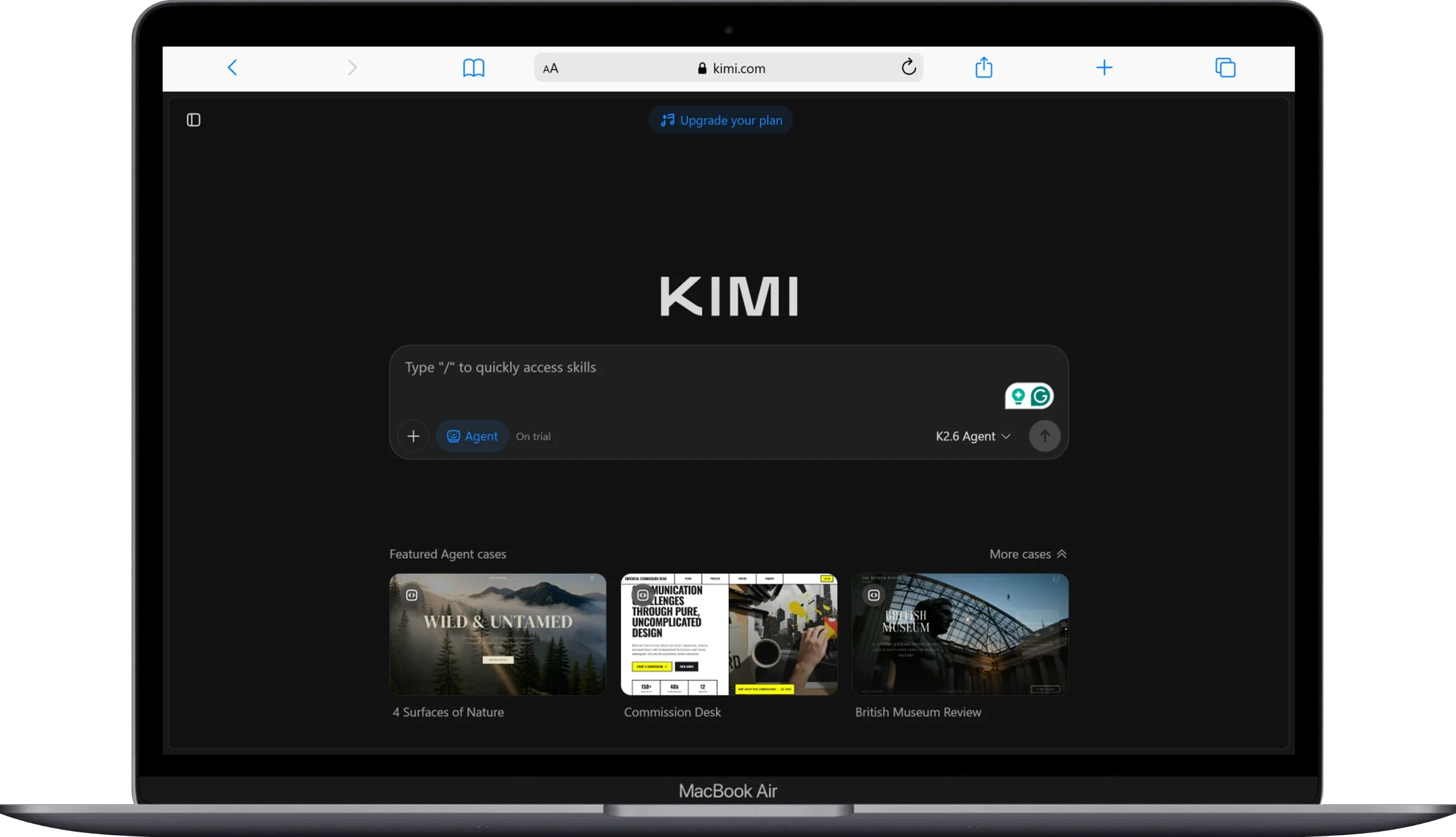
The barrier to entry is surprisingly low. You can try it directly at kimi.com/agent without jumping through hoops. The interface is clean, it handles conversational prompts well, and the agent mode visibly shows you what it’s doing step by step — which, honestly, is great for learning how AI agents actually think.
Pricing: The Elephant in the Room
Let me just put this out there: Kimi K2.6 is absurdly cheap for what it delivers.
| Model | Input (per 1M tokens) | Output (per 1M tokens) |
|---|---|---|
| Kimi K2.6 | ~$0.60 | ~$2.50 |
| GPT-5.1 | ~$2.50 | ~$10.00 |
| Claude Opus 4.7 | ~$15.00 | ~$75.00 |
| Claude Sonnet 4.6 | ~$3.00 | ~$15.00 |
Pricing data pulled from NXCode and CostGoat.
If you’re running high-volume agent workflows, the difference is staggering. A full-blown coding session that might cost you $12 on Claude Opus could run under a buck on Kimi. I’ve seen indie devs running entire side projects on sub-$20/month Kimi budgets that’d cost them hundreds on Anthropic’s API.
That said, this is where I get slightly opinionated — cheap doesn’t always mean best. Kimi’s high token usage (~160M reasoning tokens to run the full Intelligence Index) means your “cheap” model can burn through a surprising amount of compute when it’s thinking through long problems. Monitor your usage. Don’t just set it loose and check the bill next month.
Common Mistakes People Make With Kimi K2.6
After watching a lot of people (myself included) trip over the same rakes, here are the patterns I keep seeing.
Treating it like ChatGPT. Kimi K2.6 isn’t really optimized for casual conversation. If you’re using it to brainstorm dinner ideas or draft a birthday card, you’re wasting the model’s strength. Think of it as a workhorse for multi-step tasks — not a chat buddy.
Skipping the system prompt. The agent swarm feature relies heavily on clear objectives. When people complain that K2.6 “went off the rails,” 90% of the time it’s because they gave it a vague one-liner and expected telepathy. Spell out the goal, the constraints, and the definition of “done.”
Ignoring the orchestration problem. This is the big one, and it’s what VentureBeat flagged too — most existing orchestration frameworks (LangChain, CrewAI, etc.) weren’t built for agents that run for hours or days. Long-running agents drift. State gets stale. APIs change underneath them. If you’re deploying K2.6 for real enterprise work, you need to think seriously about checkpointing, rollback, and governance.
Assuming open-source means private. A lot of people see “open weights” and assume their data is safe. If you’re using Moonshot’s first-party API, your data still goes through their servers. If you want actual privacy, you need to self-host — which, for a 1-trillion-parameter model, is a serious infrastructure commitment. Most teams just use third-party providers like Novita, Baseten, Fireworks, or Parasail.
Using it for short tasks and saying it’s slow. Yes, K2.6’s reasoning can feel slow on trivial prompts. That’s because it’s chewing through its deep reasoning loop designed for complex stuff. Use Claude Haiku or GPT-5 Nano for quick one-shots. Save Kimi for the heavy lifting.
What Actually Works: Practical Tips From the Trenches
If you’re going to actually use this thing, here’s what I’ve learned works.
Start with a structured prompt template. Something like: “Goal: [X]. Constraints: [Y]. Success criteria: [Z]. Tools available: [list]. Output format: [spec].” Kimi responds dramatically better to structured objectives than to freeform rambling. This isn’t unique to Kimi, but it matters more here because of the long-horizon execution.
Break down swarm tasks into verifiable chunks. Even though K2.6 can run for five days straight, you probably shouldn’t let it until you trust it. Configure it to check in at milestones. Have it produce intermediate artifacts you can review. Treat it like a junior engineer on their first week — you’d never hand them a month-long project with zero check-ins, right?
Use the vision features. K2.6 supports image and video input natively. If you’re doing UI work, screenshot your designs and drop them in. The model picks up on layout details surprisingly well, and it bridges the “design-to-code” gap way more cleanly than text-only prompting.
Stack it with cheaper models. One of my favorite workflows: use GPT-5 Nano or Claude Haiku for routing and quick classification, then hand off the heavy reasoning to Kimi K2.6 when a task needs real depth. You get frontier quality on the expensive work and pennies on the light work.
Log everything. Tool calls, reasoning steps, state changes. When something goes sideways during a long run — and it will, at some point — the logs are the only way to figure out where the agent’s reasoning derailed. This is especially true with swarms because you have multiple agents touching shared state.
Don’t skip the safety net. Rate limits. Spending caps. Dry-run modes. These aren’t optional when you’re giving an AI the ability to call tools autonomously for hours. I’ve seen stories of agents burning through $500 in API credits in an afternoon because someone forgot to cap the loop. Set guardrails before you set the thing loose.
Where Kimi K2.6 Still Falls Short
Let me be fair here, because I don’t want this to read like a fan letter.
Short-horizon code quality still trails GPT-5.1 Codex. On clean, one-shot tasks — “write me this function” — Codex produces cleaner, more production-ready output. Kimi sometimes ships working code that has subtle bugs you’d catch in review.
Prose quality is good but not Claude-great. For pure long-form writing — essays, articles, creative fiction — Claude still has the edge. Kimi writes fine, but it occasionally has a slightly mechanical cadence that’s hard to shake.
Orchestration is fragile at the edges. When swarms fail, they tend to fail weirdly. Multiple sub-agents overwriting each other’s work, getting stuck in loops, or misreading state is a real phenomenon. Anthropic hit the same walls during their C compiler project. This isn’t a Kimi-specific issue — it’s a frontier-of-the-field issue.
Governance is your problem now. No model provider has this solved yet. If you’re deploying agentic AI in regulated industries (finance, healthcare, legal), you’re on your own for audit trails, accountability, and risk management. As ArmorCode’s Mark Lambert put it, “These agentic systems can now generate code and system changes faster than most organizations can review, remediate, or govern them.”
The Chinese origin question. Some orgs have policy restrictions around Chinese-developed AI. This is a real compliance concern for certain enterprise customers, regardless of the model’s open-source status.
Who Should (and Shouldn’t) Use Kimi K2.6
You should probably try it if you are:
- A developer building agentic applications or automation tools on a budget
- A startup founder who needs frontier capability without Anthropic-level API bills
- An AI builder experimenting with swarm orchestration and long-horizon tasks
- A content creator or marketer running complex multi-step workflows
- A tinkerer or learner who wants to see how agent swarms actually behave
You should probably skip it (for now) if you are:
- Someone who just needs a casual chatbot — overkill, use something lighter
- Working in a regulated industry with strict data residency rules
- Building customer-facing apps where prose polish matters above all else
- Someone who doesn’t want to deal with orchestration complexity — Claude Code or Codex are more hand-holdy out of the box
The Bigger Picture: Why This Release Matters
Let me zoom out for a minute. Kimi K2.6 isn’t just another model release — it’s a signal about where the whole AI industry is heading.
For most of the last two years, the story was “bigger model, smarter answers.” That’s changing. The new story is “persistent agents that do real work over long periods.” The scoreboard isn’t “who answers best in 500 milliseconds.” It’s “who can run autonomously for five days and still be useful at the end.”
Open-source models like Kimi K2.6 matter because they democratize access to this emerging capability. A solo developer or a small team can now, for the first time, spin up the same kind of long-horizon agent infrastructure that previously required enterprise-tier relationships with OpenAI or Anthropic. That’s a meaningful shift.
And honestly? The idea that you can rent a trillion-parameter swarm-capable AI for less than the cost of a Netflix subscription per day is… still a little hard to process. Whether this is utopian or terrifying depends on where you sit. But pretending it’s not happening isn’t an option.
Final Verdict: Is Kimi K2.6 Worth It?
Short answer: yes, with conditions. If your work involves multi-step automation, long-running agentic tasks, complex coding projects, or any workflow where you’d love to just hand off a goal and walk away — Kimi K2.6 is one of the best values on the market right now. The combination of frontier-level capability, open-weights licensing, and aggressive pricing is genuinely hard to beat.
If you’re looking for the absolute highest quality on every single dimension — the cleanest code, the most elegant prose, the smoothest UX — you’re probably still better served by Claude or GPT-5 for now. That’s fine. Use the right tool for the job.
But here’s the takeaway I keep coming back to: the interesting AI story in 2026 isn’t which model is 3% smarter on a benchmark. It’s which models can be trusted to run real work, end to end, without handholding. Kimi K2.6 is one of a handful of models that’s actually making a credible claim on that frontier. That alone makes it worth your attention, your experimentation, and — if the use case fits — a real seat in your stack.
Give it a real workload. Not a chatty demo. An actual project. Watch what happens. I think you’ll find, like I did, that something has genuinely shifted. And whatever you think about where this is all heading, you probably don’t want to be the last person in your field to figure it out.
You May Also Like
 AI Agents
10 Best OpenClaw VPS Hosting Providers in 2026
 AI Agents
Is OpenClaw Safe to Run on Your Local Machine? An Honest Look at the Risks
 AI Agents
What Is OpenClaw? The Open-Source AI Agent Quietly Replacing Your Productivity Stack
 Grok AI
How to Use Grok AI: A Practical Guide for Real People Who Actually Want to Get Things Done
 AI Tool Reviews
How to Use ChatGPT for Beginners: The Complete Step-by-Step Guide (2026)
 ChatGPT
