
Every few months, Moonshot drops a new Kimi model and the AI corner of the internet loses its mind. This time it’s Kimi K2.6, and honestly? The hype is mostly earned. Mostly. Because here’s the thing — if you just scroll through the Twitter threads and YouTube thumbnails screaming “KIMI DESTROYS CLAUDE,” you’d think K2.6 is some revolutionary leap. It isn’t.
What it is, though, is a surprisingly meaningful point release that fixes some of K2.5’s real weak spots and quietly introduces features that change how you’d actually use the model day-to-day. If you’ve been riding with K2.5 or you’re just Kimi-curious. This breakdown will save you from wading through a dozen breathless takes to figure out what actually changed.
Let me walk you through it the way I’d explain it to a friend over coffee. No marketing fluff. Just what’s new, what’s better, what’s the same, and whether you should bother upgrading.
Should You Upgrade from K2.5 to K2.6?
Yes. Almost certainly. Same price. Same architecture. Same API format. But better at basically everything that matters, especially long coding tasks, agent workflows, and multi-file projects. The migration is maybe two minutes of work (literally just changing the model name in your API calls), and there’s no scenario I’ve found where K2.5 beats K2.6 at anything.
So if you’re looking for permission to stop reading and just flip the switch, here it is. But stick around for the juicy stuff because why it got better is honestly more interesting than the fact that it did.
Kimi K2.5 vs K2.6: The Quick Spec Comparison
Before we get into the nuance, let’s get the raw numbers out of the way. Here’s how K2.5 and K2.6 stack up side by side:
| Feature | Kimi K2.5 | Kimi K2.6 |
|---|---|---|
| Total Parameters | 1T | 1T |
| Active Parameters | 32B | 32B |
| Architecture | MoE (384 experts) | MoE (384 experts) |
| Context Window | 256K tokens | 256K tokens |
| Multimodal | Yes (MoonViT) | Yes (MoonViT) |
| Native INT4 QAT | ❌ No | ✅ Yes |
| Agent Swarm Size | Up to 100 sub-agents | Up to 300 sub-agents |
| Max Agent Steps | ~1,000 | 4,000 |
| API Input Pricing | ~$0.60 / 1M tokens | ~$0.60 / 1M tokens |
| API Output Pricing | ~$3.00 / 1M tokens | ~$3.00 / 1M tokens |
Notice something? The foundation is identical. Moonshot didn’t rebuild the house – they remodeled the kitchen, rewired the electrical, and added a deck. The house itself? Still the same Mixture-of-Experts architecture with 32B active parameters. Same 256K context window. Same multimodal support.
What changed is everything around the core. And that turns out to matter more than you’d think.
What Actually Got Better (and By How Much)
Let’s be honest, most “version upgrade” blog posts are vague. They say things like “improved reasoning” or “enhanced capabilities” without giving you actual numbers. I find that annoying. Here’s what the benchmarks actually show, taken from Moonshot’s own reporting and independent evaluations (Aimadetools comparison):
| Benchmark | K2.5 | K2.6 | Improvement |
|---|---|---|---|
| SWE-Bench Verified | 76.8 | 80.2 | +3.4 pts |
| SWE-Bench Pro | 50.7 | 58.6 | +7.9 pts |
| Terminal-Bench 2.0 | 50.8 | 66.7 | +15.9 pts (31% relative) |
| LiveCodeBench v6 | 85.0 | 89.6 | +4.6 pts |
| HLE-Full w/tools | 50.2 | 54.0 | +3.8 pts |
| BrowseComp | 74.9 | 83.2 | +8.3 pts |
| BrowseComp Swarm | 78.4 | 86.3 | +7.9 pts |
| DeepSearchQA | 89.0 | 92.5 | +3.5 pts |
| AIME 2026 (math) | 95.8 | 96.4 | +0.6 pts |
| GPQA-Diamond | 87.6 | 90.5 | +2.9 pts |
Here’s where things get interesting. Look at Terminal-Bench 2.0 — that 15.9-point jump is massive. Terminal-Bench isn’t some academic exercise; it tests whether the model can actually do real work in a terminal, executing commands, navigating file systems, and recovering from errors. That’s the kind of task where K2.5 used to trip over its own shoelaces.
And SWE-Bench Pro? That’s the harder version of the SWE-Bench benchmark — the one that tests multi-file software engineering tasks with complex dependencies. Nearly eight points of improvement is no small thing.
Math and reasoning benchmarks went up too, but modestly. K2.5 was already crushing AIME 2026 at 95.8%, so there’s just not much headroom left.
The Real Story: Long-Horizon Coding
Okay, here’s where K2.6 gets genuinely exciting and where the marketing starts to catch up with reality.
Moonshot reports a 185% improvement in long-horizon coding tasks over K2.5. That’s a gigantic number, and it’s easy to be skeptical. But when you dig into what they mean, it starts to make sense.
“Long-horizon” is Moonshot’s term for coding work that takes many steps over extended periods. Think: not “write me a function that reverses a string” but “build a working SQL query optimizer from these specs.” The kind of stuff a junior engineer would spend two days on.
The benchmark case they shared is actually pretty wild. K2.6 built a full SysY compiler (a C-like teaching language) from scratch in 10 hours, passing 140 functional tests without any human oversight. Moonshot claims this is roughly the equivalent of four engineers working for two months.
Now, should you take that claim completely at face value? Probably not entirely. Anthropic had Claude Opus 4.6 build a real C compiler earlier in 2026 and ran into genuine issues when the complexity got high (agents overwriting each other’s work, getting stuck on the same bugs, etc.). SysY is a simpler, cut-down language, so Moonshot likely picked it partly to keep things tractable.
Still, even with that caveat, 10 hours of autonomous coding work that passes 140 tests is nothing. That’s a qualitative change in what you can trust an AI to do unattended.
Where Things Get Interesting: Agent Swarms
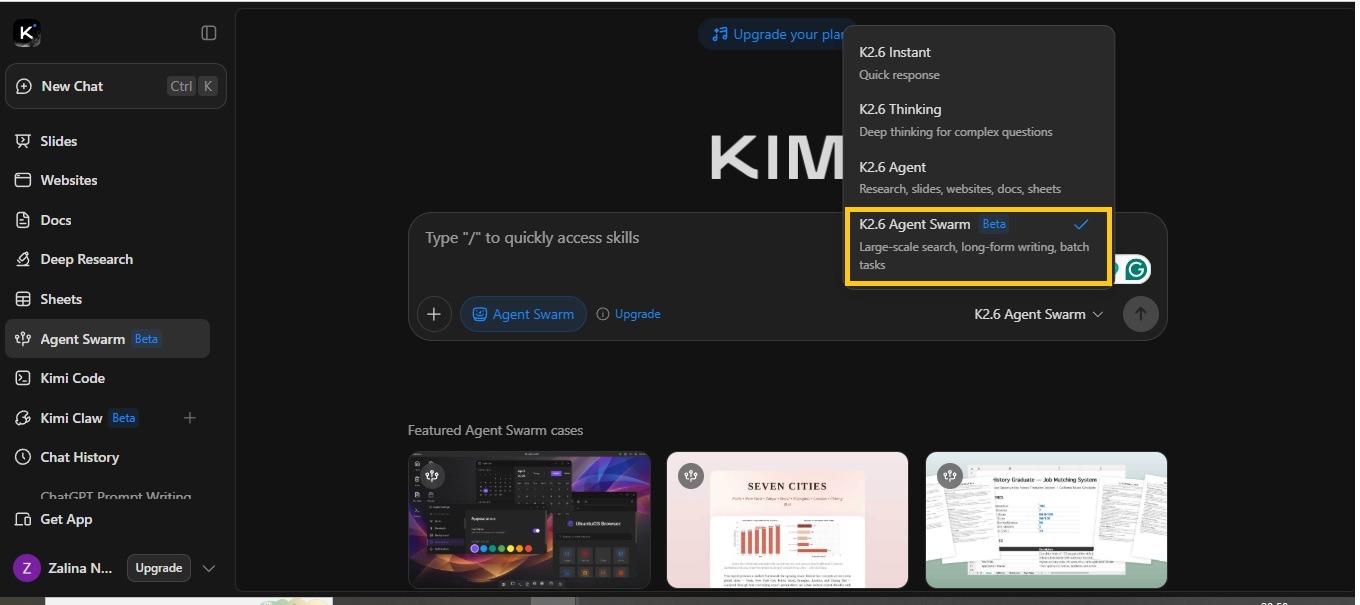
Here’s the feature that genuinely changes how you might use Kimi.
K2.5 introduced the concept of “agent swarms,” the ability to spin up multiple sub-agents that work on different parts of a problem in parallel. K2.5 supported up to 100 sub-agents. K2.6 triples that to 300 sub-agents, and extends the maximum step count from around 1,000 to 4,000.
That’s not just a bigger number for bragging rights. In practical terms, it means K2.6 can tackle the kind of fan-out-heavy tasks that used to choke earlier models. Moonshot demo’d it by having K2.6 automatically identify 30 Los Angeles restaurants without websites, then generate 30 custom landing pages with booking functionality for all of them in a single run.
Moonshot’s founder Zhilin Yang put it this way: “By orchestrating 100 or even 1,000 sub-agents in parallel, we can accomplish complex tasks within a timeframe that is tolerable for the real world.”
Translation: stuff that used to take all weekend can happen over lunch.
The “Claw Groups” feature
K2.6 also introduces something Moonshot calls Claw Groups, multiple OpenClaw-style agents running across different devices, collaborating with a shared context and a central coordinator. If one agent fails, the coordinator reassigns its task to another.
Honestly, this is cool and slightly unsettling in equal measure. One of the demos had a K2.6 agent run autonomously for five days, managing server monitoring, incident response, and system operations with no human intervention. Five. Days.
If you’re running a small DevOps team, that’s a fascinating possibility. If you’re a security-minded sysadmin, that might give you hives. Both reactions are valid.
Proactive Orchestration (the Subtle Win)
Here’s something that doesn’t get talked about enough: K2.6 introduces what Moonshot calls proactive orchestration.
In K2.5, if you asked the model to do a complex task, it would wait for step-by-step instructions. You’d say “do step one,” it would do it, report back, you’d say “okay now do step two,” and so on. K2.6 can anticipate what tools and sub-agents it’ll need and kick off parallel workflows on its own.
In practice? You give K2.6 a goal, and instead of one agent slowly working through a checklist, you get a bunch of mini-agents working in parallel from the jump. Less hand-holding, faster results, fewer round trips.
From experience with both versions, this is one of those changes that doesn’t sound like much on paper but feels substantial when you’re actually using the thing.
Native INT4 QAT: Why Local-Run Folks Care
Here’s a feature that’s going to fly completely under most people’s radar — but if you’re running Kimi on your own hardware, it’s a big deal.
K2.6 ships with native INT4 quantization-aware training (QAT). K2.5 didn’t have this. What it means in plain English: Moonshot trained K2.6 with the assumption that people will want to run it in lower-precision formats, so the quantized version actually performs closer to the full-precision version than K2.5’s did.
For people running Kimi locally through Unsloth, llama.cpp, vLLM, or KTransformers, this is the difference between “it technically runs” and “it runs well.” According to Unsloth’s documentation, dynamic 2-bit quantization gets K2.6 down to about 350GB on disk, compared to 610GB at full precision.
Still a monster. But a noticeably more manageable monster.
What’s Stayed the Same (And Why That’s Fine)
Not every release needs to reinvent the wheel. Here’s what didn’t change between K2.5 and K2.6:
- Context window. Still 256K tokens. Not the 2M-ish you might see quoted for some versions, but more than enough for most real work.
- Pricing. Same $0.60 input / $3.00 output per million tokens. Same tier, same bill.
- API format. Drop-in replacement. Change the model name in your code and you’re done.
- Deployment. Same vLLM, SGLang, and KTransformers configs work. No new dependencies.
- Multimodal support. Both handle text, images, and video through the MoonViT component.
The API compatibility is a huge quiet win. Anyone who’s lived through forced migrations between major ChatGPT versions knows how painful “upgrades” can be. Moonshot kept things civil here.
Best Tips When You’re Using K2.6
Here’s what I’ve found works best after using both versions in real projects.
Use the swarm for fan-out tasks, not everything. Agent swarms shine when your problem naturally parallelizes — researching multiple sources, generating multiple variants, processing many files independently. For linear, single-threaded problems, a swarm just adds overhead.
Lean on it harder for multi-file code changes. This is where K2.6 genuinely earns its keep. K2.5 could stumble on projects with lots of interdependencies between files — K2.6 is noticeably more coherent. If you’ve been avoiding big refactors because your AI kept making inconsistent changes, try K2.6 specifically for that.
Trust the proactive orchestration, but verify. The model will often kick off sub-tasks before you explicitly ask. Usually, that’s helpful. Occasionally, it goes off-script and does something you didn’t want. Keep an eye on the first few runs until you get a feel for what it’ll anticipate.
For long-horizon runs, start with a bounded scope. Don’t immediately hand K2.6 a five-day autonomous task because the marketing said it can do it. Start with a two-hour run. Then a four-hour run. Build up trust gradually. Long-horizon agents fail in interesting ways when things go wrong, and you want to catch those failure modes early.
Keep K2 Thinking in your back pocket. K2.6 is the general-purpose flagship, but if you have a hard reasoning task (complex math, multi-step logical puzzles), Moonshot’s separate Kimi K2 Thinking model is often still the better pick. They’re complementary, not replacements.
What Most People Get Wrong About K2.6
Here’s where I’ll push back on some of the louder takes I’ve seen.
The “K2.6 destroys Claude” framing is overblown. On certain coding benchmarks, K2.6 does beat Claude Opus 4.6. But on complex English-language instruction following, nuanced writing, and high-stakes reasoning tasks, Claude still has the edge. This isn’t a one-model-wins situation — it’s a “use the right tool for the job” situation.
On the flip side, the dismissive “it’s just a Chinese Claude clone at 1/8 the price” take misses how genuinely interesting the agent swarm architecture is. Nothing in the Western AI ecosystem right now handles 300 parallel sub-agents with 4,000-step budgets the way K2.6 does out of the box. That’s novel, not derivative.
And here’s the thing nobody wants to say clearly: the price-to-performance ratio is bonkers. At roughly 76% lower cost than Claude Opus 4.6 for comparable coding performance, K2.6 is genuinely changing the economics of AI-heavy projects. You can do things you couldn’t afford to do with a Western flagship model. That matters — even if you have legitimate concerns about the underlying provider.
Should You Use K2.6 or Stick with Something Else?
Let me lay it out bluntly by use case.
Building agentic coding tools? K2.6 is probably your best-value option right now. The combination of SWE-Bench Pro improvements, swarm capabilities, and low pricing is hard to beat.
Working on long-running autonomous workflows? K2.6 is genuinely ahead of most alternatives in this specific lane. The 4,000-step budget and proactive orchestration are meaningful.
Enterprise with sensitive data? The usual caveats apply. If you liked K2.5 enough to use it, K2.6 is strictly better. If you didn’t, K2.6 doesn’t change your calculus — the same data residency and privacy considerations remain.
Casual users doing writing, research, summaries? Honestly, the jump from K2.5 to K2.6 probably isn’t dramatic enough to feel for you. Upgrade if it’s free, but don’t expect fireworks.
Developers shopping for a Claude Opus 4.6 alternative? This is where K2.6 is most compelling. You’ll give up some polish on nuanced writing and get most of the coding capability at a fraction of the cost.
Final Take
K2.6 isn’t a revolution. It’s a solid, thoughtful iteration that fixes the things K2.5 was weakest at and doubles down on what it was already good at. The architecture is the same, the pricing is the same, and the deployment story is the same — but the model is just better at the stuff that matters in 2026: long coding tasks, multi-agent orchestration, and real autonomous work.
If you’re already on K2.5, upgrade. It’s a two-minute change for a meaningful quality bump.
If you’re new to Kimi, skip K2.5 entirely and start with K2.6 — there’s genuinely no reason to start with the older version.
And if you’re still on the fence because of privacy concerns, that conversation hasn’t changed. K2.6 is a better model, but it’s the same company making it. Make your decision on those terms, not on the benchmark numbers.
Moonshot’s clearly playing a long game here. Each release chips away at whatever gap is left between open-source Chinese models and the closed Western flagships. K2.6 narrows that gap further — and at the price they’re charging, it’s only going to keep getting harder for the big U.S. labs to justify their premiums.
Interesting times. Keep an eye on K2.7 when it drops, because based on the trajectory, it might be the release that actually catches up.
You May Also Like
 AI Models
Which Claude Model Is the Best Right Now? An Honest 2026 Breakdown
 AI Models
Is DeepSeek Accurate? An Honest, Practical Answer
 AI Models
Llama 4 Scout vs Llama 4 Maverick: Which One Actually Fits Your Workflow?
 AI for Coding
The Best AI Models for Developers in 2026: An Honest, Hands-On Look at What Actually Works
 AI Models
GPT-5.5 vs Claude Opus 4.7 vs Gemini 3.1 Pro: Real Benchmark Results Compared
 AI Models