
Four days. That’s how long the AI world got to enjoy Anthropic’s shiny new Claude Opus 4.7 before Moonshot dropped Kimi K2.6 and threw the whole conversation into chaos. Opus 4.7 arrived on April 16, K2.6 landed April 20, and suddenly every developer on Twitter was re-running their favorite benchmarks and arguing about which model to put their money on.
Here’s the honest truth that nobody’s saying clearly: these two models are not really playing the same game. They look like competitors on paper, but once you actually use them, you realize they’re optimized for pretty different things. And figuring out which one makes sense for your work has way more to do with your priorities than with raw scores.
Let me break it down the way I’d explain it to a friend who just had their Claude bill come due and is eyeing Kimi with a suspicious look. No sponsored fluff. Real numbers, real tradeoffs, and a few opinions.
Kimi K2.6 vs Claude Opus 4.7: Which One Actually Wins?
If you want me to save you 20 minutes of reading, here it is:
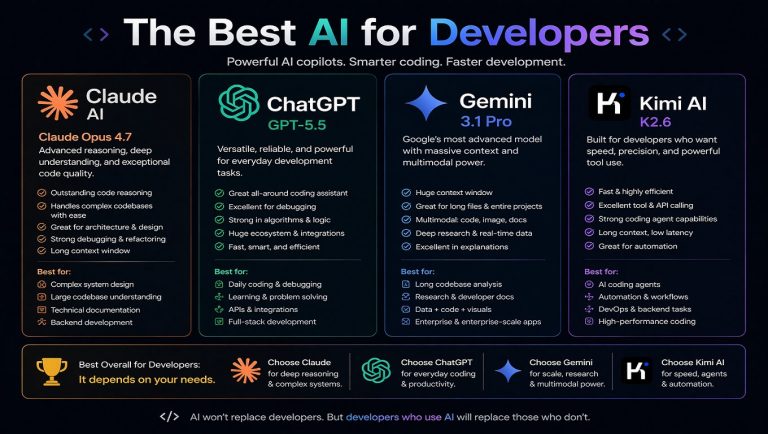
Pick Claude Opus 4.7 if you’re doing your hardest, most nuanced coding work, your team’s productivity matters more than your API bill, and you need best-in-class reliability on long-running agentic tasks. It’s the model you want in the chair when you hand off something critical.
Pick Kimi K2.6 if you’re running high-volume AI coding workloads, you care about open weights and self-hosting, or the cost difference matters to your business. For 80% of coding tasks, it’ll get you most of the way there at a fraction of the price.
Use both if you’re smart. They’re not mutually exclusive, and a lot of developers I’ve talked to are quietly running K2.6 for bulk work and saving Opus 4.7 for the hard stuff. More on that later.
Now let’s get into the why.
The Spec Sheet Nobody Reads But Everyone Needs
Before we dig into performance, here’s what you’re actually comparing:
| Feature | Kimi K2.6 | Claude Opus 4.7 |
|---|---|---|
| Release Date | April 20, 2026 | April 16, 2026 |
| Total Parameters | 1T (MoE) | Not disclosed (proprietary) |
| Active Parameters | 32B | Not disclosed |
| Context Window | 256K tokens | 1M tokens |
| Max Output | ~256K tokens | 128K tokens |
| Input Pricing | ~$0.60 / 1M tokens | $5.00 / 1M tokens |
| Output Pricing | ~$3.00 / 1M tokens | $25.00 / 1M tokens |
| Open Weights | ✅ Yes | ❌ No |
| Self-Hostable | ✅ Yes | ❌ No |
| Multimodal (text + vision + video) | ✅ Yes | ✅ Yes (higher resolution) |
| Agent Swarm Support | ✅ 300 sub-agents, 4,000 steps | ✅ Multi-agent coordination |
| Memory Across Sessions | Limited | ✅ File-system-based memory |
A few things jump out immediately. Opus 4.7 costs roughly 8.3x more on both input and output. That’s not a typo. Anthropic kept the same $5/$25 pricing as Opus 4.6, but between that and Kimi K2.6’s aggressive $0.60/$3.00 pricing, the gap is enormous.
On the flip side, Opus 4.7 has a 1M-token context window, which is nearly 4x Kimi’s 256K. If you routinely dump entire codebases or multi-hundred-page documents into a single prompt, that matters more than it might sound.
And here’s the footnote that will bite you: Opus 4.7 uses a new tokenizer that consumes roughly 1.35x more tokens than Opus 4.6 for the same text. So even though the sticker price didn’t change from 4.6 to 4.7, your actual bill probably will. Keep that in mind when you’re modeling costs.
The Benchmarks: Where Opus 4.7 Flexes
Let’s be honest — Opus 4.7 came out swinging, and the benchmarks show it. Here’s the head-to-head on the stuff that actually matters:
| Benchmark | Kimi K2.6 | Claude Opus 4.7 | Winner |
|---|---|---|---|
| SWE-Bench Verified | 80.2% | 87.6% | Opus 4.7 |
| SWE-Bench Pro | 58.6% | 64.3% | Opus 4.7 |
| Terminal-Bench 2.0 | 66.7% | 69.4% | Opus 4.7 (close) |
| LiveCodeBench v6 | 89.6% | Not officially reported | Kimi K2.6 |
| GPQA Diamond | 90.5% | 94.2% | Opus 4.7 |
| HLE w/ tools | 54.0% | 54.7% | Essentially tied |
| BrowseComp | 83.2% | 79.3% | Kimi K2.6 |
| MCP-Atlas (tool use) | Not reported | 77.3% | Opus 4.7 (best-in-class) |
| OSWorld-Verified | Not reported | 78.0% | Opus 4.7 |
| CursorBench | Not reported | ~70% | Opus 4.7 |
(Sources: Vellum’s Opus 4.7 benchmark breakdown, Aimadetools K2.6 vs K2.5)
Here’s what’s interesting. On SWE-Bench Verified — arguably the most watched coding benchmark — Opus 4.7 scores 87.6% versus Kimi K2.6’s 80.2%. That’s a 7.4-point gap. Not enormous, but not trivial either. On SWE-Bench Pro (the harder, more realistic version), Opus 4.7 pulls further ahead at 64.3% vs 58.6%.
And MCP-Atlas, which tests real-world tool-use orchestration? Opus 4.7 is the best-in-class model right now at 77.3%, ahead of GPT-5.4 (68.1%) and Gemini 3.1 Pro (73.9%). For agent developers, that’s a genuinely meaningful lead.
But look at BrowseComp — K2.6 actually beats Opus 4.7 there (83.2% vs 79.3%). Opus 4.7 actually regressed on BrowseComp from Opus 4.6, which Vellum flagged as “a slight step back” for research-heavy workloads. If your use case is “crawl the web and synthesize across 50 pages,” Kimi’s actually the stronger pick here.
The Real-World Test Nobody Expected
Benchmarks are one thing. What happens when you point both models at an actual bug in an actual codebase? Someone on r/LocalLLaMA ran exactly that experiment through OpenCode — and the results were… illuminating.
The task: a real bug in a Tanstack Start application. Not a toy problem. Real production code.
Here’s what happened (Reddit thread):
- Claude Opus 4.7: Found the root cause and the fix in 6 minutes, cost ~$2.
- Kimi K2.6: Worked for 10+ minutes, spent $2, got stuck in a loop of overthinking, never found the root cause. The tester killed the process.
- GPT-5.4 (high reasoning): Found the fix and spotted a separate missed bug in 3 minutes, cost ~$0.50.
Ouch.
Now, is this one test? Yes. Is it representative? Not entirely. But it illustrates something you won’t see in benchmark tables: Kimi K2.6 has a tendency to “overthink” on hard debugging problems, churning through reasoning loops without making progress. Opus 4.7, on the same kind of task, just… gets on with it.
From experience using both, this matches what I’ve seen. K2.6 is a capable model, but when it hits its limit, it doesn’t always know it’s hit its limit. It just keeps thinking. Opus 4.7 is more decisive — either it solves the thing or it tells you it’s stuck, and the failure mode is usually cleaner.
Where Kimi K2.6 Actually Wins
Let’s not turn this into a one-sided love letter to Anthropic. K2.6 has real advantages that matter:
Open weights. This is enormous and criminally underrated. K2.6 is open-source. You can download it, host it yourself, audit its behavior, and never send a single byte to an external server. For enterprises with compliance concerns — or anyone who just doesn’t trust the cloud — this is a feature Opus 4.7 literally cannot match.
The price. At roughly 1/8th the cost of Opus 4.7, K2.6 enables workflows that are economically impossible with Claude. If your agent needs to process 10 million tokens a day, the math gets brutal on Opus. You’re looking at $50+ per day just in input costs, versus $6 for K2.6.
Agent swarm capacity. K2.6 can orchestrate up to 300 sub-agents with 4,000-step budgets out of the box. Opus 4.7 also has multi-agent coordination, but Kimi’s swarm architecture is purpose-built for massive parallelization at a low unit cost. For fan-out-heavy work (generating 50 variants, researching 100 sources simultaneously, processing thousands of files), K2.6 is legitimately a better fit.
Agentic browsing. As noted above, K2.6 actually beats Opus 4.7 on BrowseComp. If your workload is research-heavy and web-centric, Kimi’s the surprise winner.
Aggressive iteration speed. Moonshot ships constantly. Between K2.5, K2.6, and whatever comes next, you’re getting meaningful improvements every few weeks. Anthropic’s release cadence is much slower, though arguably more polished.
Where Opus 4.7 Is Hard to Beat
That said, there are real areas where Opus 4.7 earns its premium:
Advanced software engineering. On the hardest coding tasks — not “write me a function” but “debug this weird race condition across six files” — Opus 4.7 is noticeably more reliable. Anthropic reports a 13% lift in resolution on their 93-task coding benchmark over Opus 4.6 (Anthropic). That tracks with what I’ve seen in practice.
Best-in-class tool use. MCP-Atlas at 77.3% is the headline number, but it translates to something real: when Opus 4.7 is orchestrating tools, it makes fewer weird mistakes. For production agents where reliability matters, this is the selling point.
Vision capabilities. Opus 4.7 processes images up to 3.75 megapixels (roughly 3x the resolution of Opus 4.6). On CharXiv with tools, it scores 91.0%. If you’re parsing charts, diagrams, or high-detail visual content, Opus 4.7 is ahead.
Memory across sessions. The file-system-based memory that Anthropic added in 4.7 is quietly one of its best features. It remembers notes across long multi-session work and carries context forward without needing to re-prompt. For genuinely long-running projects, this is a real productivity unlock.
Self-verification. Opus 4.7 is trained to verify its own outputs before reporting back — and it shows. Fewer hallucinations. Fewer “I did it!” moments where it didn’t actually do it. Less double-checking is required from you.
The “xhigh” effort level. Opus 4.7 introduces a new “xhigh” effort tier between high and max, giving you more granular control over how hard the model thinks. For complex tasks where you want deep reasoning without the full max-effort price tag, this is a practical win.
Cost Math That’ll Change Your Mind
Let’s put actual numbers on the cost difference, because this is where the decision often gets made.
Say you run a coding agent that consumes 2M input tokens and 500K output tokens per day a reasonable load for a small dev team.
| Model | Daily Cost | Monthly Cost | Annual Cost |
|---|---|---|---|
| Kimi K2.6 | ~$2.70 | ~$81 | ~$985 |
| Claude Opus 4.7 | ~$22.50 | ~$675 | ~$8,200 |
| Difference | ~$19.80/day | ~$594/month | ~$7,215/year |
And that’s for a modest workload. Scale it up to enterprise levels and you’re talking tens of thousands of dollars in annual difference. For a small team, that’s potentially a new hire. For a solo developer, it’s the difference between “this is sustainable” and “I’m subsidizing Anthropic with my retirement fund.”
Now, is Opus 4.7 worth that premium? For some work, absolutely. For most work, honestly, no.
Common Mistakes People Make Comparing These Two
After watching dozens of threads and comparison videos, here are the mistakes that keep cropping up.
Looking only at benchmarks. Benchmarks are useful, but they don’t capture failure modes. Kimi K2.6 can hit 80.2% on SWE-Bench but still gets stuck overthinking in a real debugging session. Opus 4.7 might score lower on some specific benchmark but fail more gracefully in production. The “which number is bigger” approach misses this entirely.
Ignoring the tokenizer issue. Opus 4.7’s new tokenizer consumes roughly 35% more tokens than Opus 4.6 for the same text. So when Anthropic says “pricing is the same” it’s technically true, but your bills won’t be. Model this in before you decide.
Assuming “open weights” means “use it anywhere.” Kimi K2.6 is open-weight, yes. But the full-precision model needs 610GB of disk space. Even the 2-bit quantized version is ~350GB. “Run it locally” is technically possible, but practically requires serious hardware. Most people still end up using it through an API, which means your data still goes to someone — just maybe not to Anthropic.
Trusting the Chinese provider marketing without reading the privacy policy. Kimi’s made by Moonshot AI, a Beijing-based company subject to Chinese law. If that matters to your compliance story, it matters. Don’t just look at the benchmark numbers and ignore where your data is going.
Defaulting to whichever one you used first. A lot of developers picked a camp 18 months ago and haven’t revisited it. Both models have improved dramatically. Whatever you decided about Claude 3 or Kimi K1 doesn’t necessarily apply to these versions.
What Actually Works: Real-World Usage Patterns
Here’s what I’ve seen working well in practice, based on dev teams I’ve talked to and my own experimentation.
Pattern 1: The “Tiered Routing” setup. Route easy requests (code formatting, simple refactors, docstring generation) to K2.6. Route hard requests (architectural decisions, complex debugging, security-critical code) to Opus 4.7. Tools like OpenRouter make this almost trivial to implement with a smart router.
Pattern 2: The “Draft and Polish” workflow. Use K2.6 to generate the first draft of something — a function, a migration, a plan. Then use Opus 4.7 to review and refine. You get the cost savings on the bulk work and the quality check where it matters.
Pattern 3: “Self-host K2.6, API Opus 4.7.” For teams that care about data privacy, run K2.6 on your own hardware for 80% of the work and hit Opus 4.7’s API for the hardest 20%. Your sensitive code stays internal; you only send external what absolutely needs the premium model.
Pattern 4: “Swarm and Supervise.” Use K2.6’s 300-agent swarm capability to fan out across a huge task, then have a single Opus 4.7 instance synthesize and verify the swarm’s outputs. Best of both worlds — parallelization is cheap, verification is premium.
What People Often Get Wrong
Here’s the opinion that’ll probably get me roasted online: this isn’t a “which one wins” situation.
The discourse around these models has gotten weirdly tribal. On one side you’ve got the “Kimi destroys Claude” crowd pointing at price and open weights. On the other side you’ve got the “you get what you pay for” crowd pointing at SWE-Bench and reliability. Both camps are missing the actual answer.
The actual answer is: these are complementary tools, and anyone running a serious AI stack in 2026 should probably be using both.
Opus 4.7 is Anthropic trying to build the most capable coding model possible, full stop. Cost and accessibility are explicitly not priorities. It’s a premium product for premium use cases.
Kimi K2.6 is Moonshot, trying to democratize capable AI by making it cheap and open. Absolute peak performance isn’t the goal — “good enough for most things, affordable for everyone” is.
Both strategies are legitimate. Both products succeed at what they’re trying to do. Treating them as direct competitors is like asking whether a Toyota Camry or a Porsche 911 is “better.” It depends entirely on what you’re doing with it.
Should You Actually Use These Models?
A few scenarios where my recommendation is pretty clear:
- Solo developer or small team on a budget: Start with Kimi K2.6. It’ll cover 80% of your needs at a fraction of the cost. Keep an Opus 4.7 subscription in your back pocket for the occasional hard problem.
- Enterprise with sensitive code: Either self-host K2.6, or pay the Opus 4.7 tax for the peace of mind that comes with Anthropic’s data handling. Don’t use consumer-tier kimi.com for anything that can’t leak.
- Agent-heavy workflows with lots of parallel tasks: K2.6’s swarm architecture is purpose-built for this. Opus 4.7 can do it, but you’ll pay a fortune.
- Mission-critical, “must not fail” work: Opus 4.7. The cost premium is worth it. The failure modes are cleaner.
- Research and browsing-heavy agents: Surprisingly, K2.6 has a slight edge here. Use it.
- Multi-modal analysis with detailed images/charts: Opus 4.7’s 3x vision resolution matters. Pay the premium.
Final Take
Claude Opus 4.7 is the most capable coding model on the market right now, and Anthropic earns every dollar of its pricing — as long as your work actually needs what it’s selling. Best-in-class tool use, superior reliability on hard tasks, longer context, better vision, and memory across sessions make it a legitimately impressive engineering achievement.
But Kimi K2.6 is doing something different, and arguably more interesting — making genuinely capable AI accessible at prices that change what’s economically possible. The fact that it’s also open-weight means the ecosystem around it will keep growing in ways that Opus 4.7 simply can’t match.
If I had to bet on the long game, here’s my take: Opus 4.7 is probably the best model right now. But Kimi K2.6 represents the direction the market is heading. Open, cheap, and nearly as good. In 18 months, the gap narrows further. In 36 months, it might close entirely.
For now? Use both. Route smart. Save money where you can. Spend it where it counts. And don’t let anyone on Twitter convince you this is a binary choice — because it isn’t, and the people who already figured that out are the ones quietly building better stuff than everyone else.
You May Also Like
 AI Tool Reviews
How to Use ChatGPT for Beginners: The Complete Step-by-Step Guide (2026)
 AI Models
Which Claude Model Is the Best Right Now? An Honest 2026 Breakdown
 AI Models
Is DeepSeek Accurate? An Honest, Practical Answer
 AI Tool Reviews
GPTZero vs ZeroGPT: Which AI Detector Actually Holds Up in the Real World?
 AI Models
Llama 4 Scout vs Llama 4 Maverick: Which One Actually Fits Your Workflow?
 AI for Coding
