
ChatGPT prompts for email marketing are specific text instructions you type into ChatGPT to generate high-performing email copy, subject lines, sequences, and campaign strategies in minutes instead of hours. These prompts act as your on-demand writing assistant, helping you produce welcome emails, abandoned cart reminders, promotional campaigns, re-engagement sequences, and more. When you pair a well-structured prompt with your brand details and audience data, ChatGPT delivers drafts that improve open rates, click-through rates, and conversions across platforms like Mailchimp, Klaviyo, Brevo, ConvertKit, and ActiveCampaign.
Email marketing generates an average return of $36 for every $1 spent, making it one of the highest-ROI digital channels available today. Yet producing fresh, engaging email content week after week remains a real challenge. Writer’s block, inconsistent sending schedules, and generic messaging cause open rates to drop and subscribers to disengage. ChatGPT solves these 3 problems by giving you a starting point you can refine, personalize, and send. The secret is knowing which prompts produce the best results for each campaign type.
I have tested and refined dozens of ChatGPT email prompts for email marketing across real campaigns, including product launches, flash sales, drip sequences, B2B outreach, and customer win-back flows. The 20 prompts below come from that hands-on process. Each prompt targets a specific email marketing goal. You will learn exactly how to use it, why it works, and how to customize it for your brand voice and audience.
How To Make ChatGPT Prompts for Email Marketing Effective?
An effective ChatGPT prompt for email marketing includes 3 core components: a clear goal, detailed context, and an optional persona or role assignment. These 3 components guide ChatGPT to produce relevant, on-brand, and conversion-focused email content rather than vague, generic text.
The goal defines what you want the email to achieve. Are you promoting a flash sale? Re-engaging lapsed subscribers? Welcoming new leads? State this clearly using action verbs like “write,” “craft,” or “generate.”
Context provides the background details ChatGPT needs. This includes your target audience demographics, product or service details, brand tone, desired email length, and the specific call to action. Without context, the output reads like a template written for no one.
The persona component is optional but powerful. When you ask ChatGPT to “step into the shoes of an expert email copywriter” or “write as a direct-response marketing specialist,” the output shifts toward more strategic, persuasive language. Role-playing prompts produce noticeably better email copy than standard instructions.
Here are the 5 elements every strong email marketing prompt should contain:
- Audience details describe who receives the email, including demographics, pain points, and buying stage
- Offer or purpose specifies the product, discount, resource, or message
- Tone of voice sets the emotional register, such as conversational, professional, or urgent
- Word count or length controls the email’s density and readability
- Call to action directs the reader toward one specific next step
What Are the 20 Best ChatGPT Prompts for Email Marketing?
The 20 best ChatGPT prompts for email marketing cover subject line generation, welcome sequences, cart abandonment, flash sales, re-engagement, lead nurturing, product launches, referral programs, testimonial campaigns, follow-up sequences, and post-purchase flows. Each prompt below includes the full text, an explanation of why it works, and customization tips.
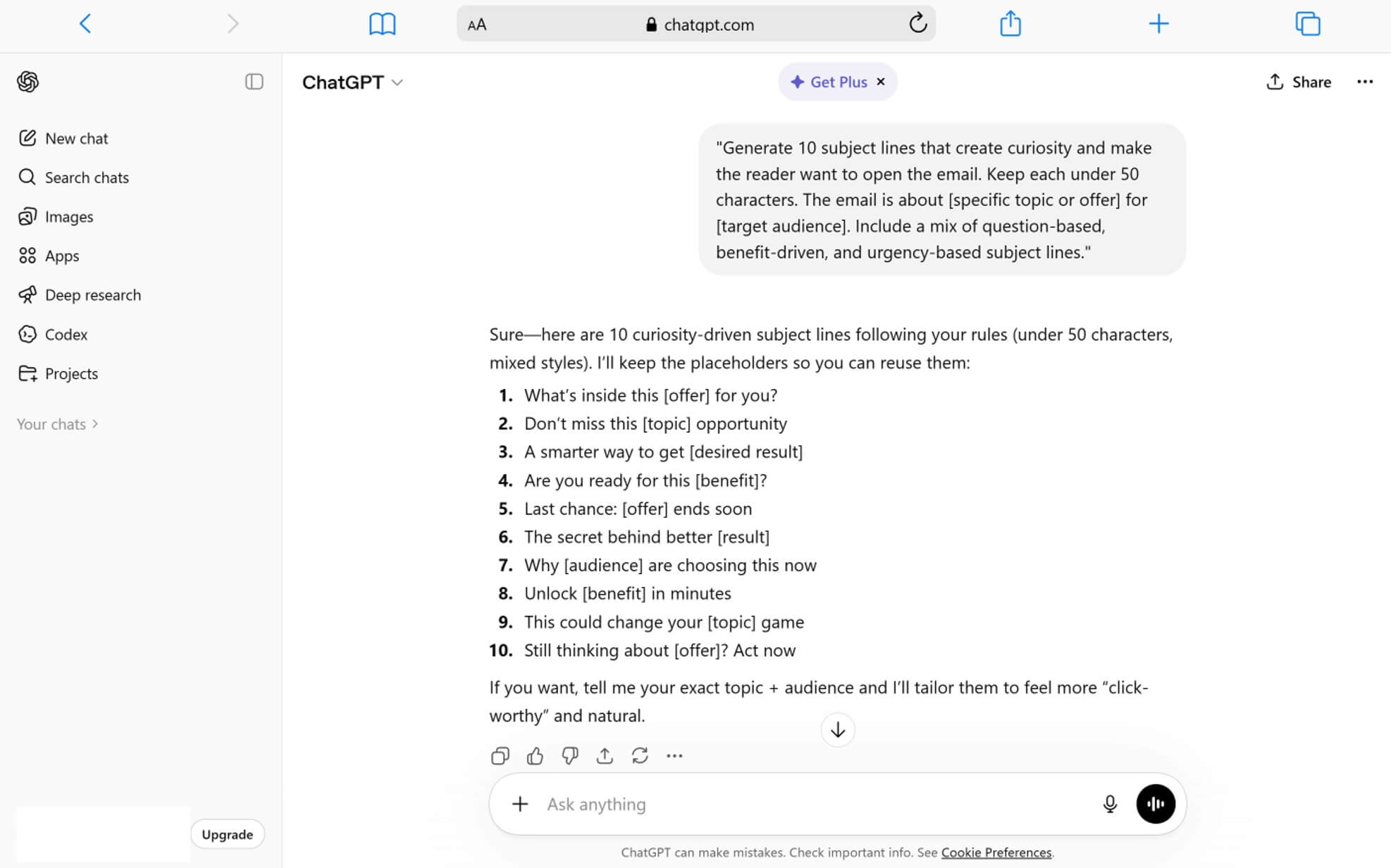
Prompt 1: Curiosity-Driven Subject Lines That Boost Open Rates
The prompt: “Generate 10 subject lines that create curiosity and make the reader want to open the email. Keep each under 50 characters. The email is about [specific topic or offer] for [target audience]. Include a mix of question-based, benefit-driven, and urgency-based subject lines.”
Subject lines determine whether your email gets opened or ignored. Using AI to craft subject lines can increase open rates by up to 10%, according to email marketing benchmarks. This prompt gives you 10 options to A/B test. Pick the top 2 to 3 and split-test them inside your email platform to find the winner.
To customize, replace the brackets with your real offer and audience. Add your brand tone, like “keep the tone playful” or “use a professional voice.”
Prompt 2: Personalized Subject Lines With Urgency
The prompt: “Write 5 email subject lines that include the recipient’s first name and create urgency without sounding pushy. The email promotes [offer details] for [target audience]. Vary the approach: use one question-based, one stat-based, one benefit-focused, one scarcity-driven, and one curiosity-driven subject line.”
Personalized subject lines improve open rates because they signal relevance. Adding urgency drives action. This prompt blends both elements while keeping the tone respectful. You avoid sounding spammy by requesting a “non-pushy” approach directly in the prompt.
Prompt 3: Social Proof Subject Lines Using Statistics
The prompt: “Give me 5 subject lines that use social proof or statistics to boost credibility and open rates. The email is for [brand name] promoting [product/service] to [target audience]. Each subject line should reference a real-sounding data point or customer result.”
People trust numbers and real-world results. A subject line like “Join 10,000+ marketers using this tool” outperforms a generic “Check out our product.” This prompt ensures every subject line carries a credibility signal that encourages the reader to click.
Prompt 4: Welcome Email Sequence for New Subscribers
The prompt: “Write a 5-email welcome sequence for new subscribers of [brand name], a [industry] company. Email 1: Thank the subscriber, deliver the [lead magnet name], and introduce the brand mission. Email 2: Share the brand story and 1 key value the subscriber gains. Email 3: Highlight the top-selling product and its benefits. Email 4: Feature a customer testimonial showing real results. Email 5: Offer a first-purchase discount with a clear CTA. Tone should be [warm/professional/casual]. Each email should be under 200 words.”
Welcome emails have an average open rate of 50% or higher. A 5-email sequence nurtures the relationship over the first 2 weeks and moves the subscriber from awareness to purchase. This prompt structures each email around a specific purpose so no message feels repetitive.
Prompt 5: Abandoned Cart Recovery Email With Empathy
The prompt: “Write a 120-word abandoned cart email for [store name], an online [product category] store. Start by empathizing with the customer’s indecision. Then gently remind them of the item they left behind. Include 1 reason to complete the purchase, a [X%] discount code, and free shipping. End with a clear CTA to ‘Complete Your Order.’ Tone should be friendly and understanding, not pushy.”
Cart abandonment emails recover 3% to 14% of lost sales. This prompt stands out because it leads with empathy instead of pressure. Starting with understanding (“We know choosing can take time”) builds trust and makes the discount feel like a genuine gesture, not a desperate tactic.
Prompt 6: Flash Sale Announcement With Genuine Urgency
The prompt: “Draft a 150-word flash sale email for [brand name] announcing a [X-hour] sale on [product category]. Use high-energy but honest language. State the discount, the deadline, and 2 featured products with their key benefits. Include a CTA to ‘Shop the Sale.’ Avoid fake scarcity. The tone should be exciting and professional.”
Flash sale emails drive immediate revenue when they combine real urgency with clear value. This prompt avoids manipulative tactics like “Only 1 left!” by requiring honest language. Consumers recognize fake scarcity, and overusing it erodes brand trust. Genuine deadlines perform better long-term.
Prompt 7: Re-Engagement Email for Inactive Subscribers
The prompt: “Craft a 150-word re-engagement email for subscribers of [brand name] who haven’t opened an email in [X] days. Reference what they may have missed since their last interaction. Offer a [special incentive] to reconnect. Include a CTA to stay subscribed and an easy opt-out option. Tone should be warm and no-pressure.”
Inactive subscribers increase your email platform costs and lower deliverability scores. This prompt gives you a respectful way to reconnect. Including an opt-out option shows respect for the reader’s inbox and actually improves your list health. Clean email lists produce 15% to 25% higher engagement rates than bloated, unmanaged ones.
Prompt 8: Lead Nurturing Email That Educates and Converts
The prompt: “Generate a 200-word email that nurtures leads by educating them on [topic relevant to your product]. Position [brand name] as a trusted authority while subtly encouraging action. Include 1 actionable tip, 1 data point or statistic, and a soft CTA to [next step, e.g., read the full guide, try the free tool, book a call]. Tone should be informative and conversational.”
Lead nurturing emails build trust before asking for a sale. This prompt follows the 80/20 rule: 80% of the email delivers genuine value, while 20% promotes the product. Educated leads convert at higher rates because they already understand the problem your product solves.
Prompt 9: Product Launch Email With Narrative Storytelling
The prompt: “You are a conversion-focused email copywriter. Write a 220-word product launch email for [new product name] by [brand name]. Tell a short story of a customer whose [specific problem] was solved by this product. Highlight 3 key features through the story rather than listing them. End with a CTA to [pre-order / shop / learn more]. Tone should be exciting but grounded in real benefits.”
Product launch emails perform best when they show the product in action rather than listing features. This prompt uses narrative to create an emotional connection. Story-driven emails generate 2 to 3 times more engagement than feature-list emails because readers see themselves in the customer’s experience.
Prompt 10: Customer Testimonial Drip Campaign
The prompt: “Plan a 3-part drip campaign for [brand name] where each email features a different customer testimonial. Email 1: A customer who achieved [specific result] using [product]. Email 2: A customer who overcame [specific challenge] with [product]. Email 3: A customer who experienced [lifestyle improvement] through [product]. Include real-sounding quotes, emphasize emotional and practical benefits, and end each email with a CTA to [try the product / read more reviews]. Keep each email under 180 words.”
Social proof builds trust faster than brand-written claims. 92% of consumers read reviews before purchasing. A 3-part testimonial sequence reinforces credibility from multiple angles. Each email tells a different story, which keeps the series fresh and reduces unsubscribe risk.
Prompt 11: Referral Program Email With Clear Incentive Structure
The prompt: “Write a 170-word email promoting the referral program of [brand name]. Explain the program clearly: the referrer receives [reward A], and the referred friend receives [reward B]. Use playful but professional language. Include a CTA to share the unique referral link. Mention that [X number] of customers have already joined the program.”
Referral emails turn your customers into a growth channel. Referred customers have a 16% higher lifetime value than customers acquired through paid ads. This prompt adds social proof (“X customers already joined”) to increase participation.
Prompt 12: Seasonal Promotional Email With Authentic Exclusivity
The prompt: “As an expert email copywriter, create a 200-word seasonal promotional email for [holiday name] for [brand name]. Announce a limited-time offer on [product category], available only to existing subscribers. The tone should be exclusive and appreciative, making the recipient feel valued. Include the offer details, a clear deadline, and a CTA to [shop the sale / claim the offer]. Avoid generic holiday clichés.”
Seasonal emails tap into existing buying intent. This prompt differentiates itself by making the offer feel exclusive to subscribers rather than blasting the same deal everywhere. Exclusive subscriber-only offers increase click-through rates by 14% compared to generic promotions.
Prompt 13: Post-Purchase Thank-You Email With Follow-Up Action
The prompt: “Write a 130-word post-purchase thank-you email for a customer who bought [product name] from [brand name]. Express gratitude. Reinforce the value of their purchase with 1 usage tip. Then encourage a follow-up action: [leave a review / refer a friend / explore related products]. Tone should be warm and appreciative.”
Post-purchase emails strengthen the customer relationship at the moment of highest satisfaction. Customers who receive a post-purchase email have a 15% higher repeat purchase rate. This prompt goes beyond a simple “thank you” by adding a usage tip and a next-step CTA that keeps the customer engaged.
Prompt 14: Behind-the-Scenes Brand Story Email
The prompt: “Draft a 200-word email for [brand name] that gives subscribers a behind-the-scenes look at how [product name] was created. Include details about the team’s process, customer feedback that shaped the product, and 1 surprising fact about its development. End with a CTA to [try the product / read the full story]. Tone should be authentic and conversational.”
Behind-the-scenes emails humanize your brand. They show the real people and process behind the product. This type of email builds emotional connection and differentiates your brand from competitors who only send promotional messages.
Prompt 15: Win-Back Email With Before-and-After Narrative
The prompt: “Write a 160-word win-back email for customers of [brand name] who haven’t purchased in [X] months. Share a brief before-and-after story of a customer who returned and experienced [specific benefit]. Offer a [special deal] to encourage a return purchase. Use a warm, welcoming tone and include a CTA to [shop / explore new arrivals].”
Win-back emails re-activate past buyers. Acquiring a new customer costs 5 to 7 times more than retaining an existing one. This prompt uses a before-and-after narrative to show lapsed customers what they are missing, which is more persuasive than a generic “we miss you” message.
Prompt 16: Weekly Newsletter With Value-First Structure
The prompt: “Write a 250-word weekly newsletter for [brand name] subscribers. The topic this week is [specific topic]. Structure the email as: 1 actionable insight or tip (80% of the content), followed by 1 product or content mention (20% of the content). Include a CTA to [read the full article / try the product / reply with feedback]. Audience: [describe demographics and interests]. Tone: conversational and informative.”
Newsletters maintain ongoing engagement. This prompt enforces the 80/20 value-to-promotion ratio, which keeps subscribers opening your emails week after week. Consistent value-first newsletters improve subscriber retention by up to 40% over 6 months.
Prompt 17: Cold B2B Outreach Email With Specific Pain Point
The prompt: “Write a 100-word cold outreach email from [your name] at [brand name] to [target recipient type, e.g., marketing directors at mid-size SaaS companies]. Mention 1 specific pain point you solve: [describe pain point]. Include 1 data point showing the result your product delivers. End with a low-pressure CTA to [schedule a 15-minute call / reply with questions]. Tone: professional, concise, and helpful.”
Cold outreach emails need to be short and value-dense. Emails between 50 and 125 words have the highest response rates. This prompt forces brevity while including a pain point and proof, the 2 elements that make a cold email worth reading.
Prompt 18: Feedback Request Email With Incentive
The prompt: “Create a 140-word email asking customers of [brand name] to complete a short survey about their recent [purchase / experience]. State that the survey takes [X] minutes. Offer [incentive, e.g., 10% off next order or entry into a gift card drawing] for completing it. Tone should be respectful and appreciative. Include a CTA to start the survey.”
Feedback emails generate data you can use to improve products, messaging, and future campaigns. Offering an incentive increases survey completion rates by up to 30%. This prompt keeps the ask simple and respectful.
Prompt 19: VIP Loyalty Member Exclusive Offer
The prompt: “Write a 160-word email for VIP loyalty members of [brand name]. Announce an exclusive [early access / bonus reward / members-only discount] available before the general public. Make the recipient feel appreciated for their loyalty. Use a premium, warm tone. Include a CTA to [redeem the offer / access the exclusive deal]. Mention how many members already claimed the offer.”
VIP emails reward your highest-value customers and increase retention. Loyalty program members spend 12% to 18% more per transaction than non-members. Adding a participation count (“327 members already claimed theirs”) creates social proof within your community.
Prompt 20: End-of-Year Recap and Forward-Looking Email
The prompt: “Write a 200-word end-of-year recap email from [brand name]. Thank subscribers for their support. Include 3 specific brand milestones from the past year, such as [number of customers served, products launched, or community growth]. Then share a 1-sentence sneak peek of plans for the coming year. End with a CTA to [share feedback / shop the year-end sale / stay tuned]. Tone should be grateful and energizing.”
Milestone emails build community and emotional connection. Sharing specific numbers, such as “we served 15,000 customers” or “launched 4 new products,” makes the recap tangible. This prompt turns a retrospective into an engagement opportunity that strengthens long-term subscriber loyalty.
ChatGPT Email Marketing Prompts: Quick Reference Table
| Prompt Number | Email Type | Primary Goal | Best For |
|---|---|---|---|
| 1 | Curiosity subject lines | Improve open rates | All email campaigns |
| 2 | Personalized urgent subject lines | Boost opens with urgency | Sales and promotions |
| 3 | Social proof subject lines | Build credibility | Product and service emails |
| 4 | Welcome sequence (5 emails) | Nurture new subscribers | List building |
| 5 | Abandoned cart with empathy | Recover lost sales | E-commerce stores |
| 6 | Flash sale announcement | Drive immediate revenue | Time-sensitive offers |
| 7 | Re-engagement email | Win back inactive subscribers | List maintenance |
| 8 | Lead nurturing educational | Build trust and authority | B2B and SaaS |
| 9 | Product launch with story | Generate buzz and pre-orders | New product releases |
| 10 | Testimonial drip campaign | Build social proof | All industries |
| 11 | Referral program | Acquire new customers | Growth campaigns |
| 12 | Seasonal promotional | Capture seasonal demand | Holiday periods |
| 13 | Post-purchase thank-you | Strengthen loyalty | E-commerce and SaaS |
| 14 | Behind-the-scenes | Humanize your brand | Brand storytelling |
| 15 | Win-back with narrative | Re-activate lapsed buyers | Customer retention |
| 16 | Weekly newsletter | Maintain engagement | Ongoing content |
| 17 | Cold B2B outreach | Book meetings | Lead generation |
| 18 | Feedback request | Gather customer data | Product improvement |
| 19 | VIP loyalty exclusive | Reward top customers | Retention campaigns |
| 20 | Year-end recap | Strengthen community | Brand building |
How Do You Customize These Prompts for Your Brand Voice?
You customize these prompts by replacing all bracketed placeholders with your real brand data, adding your tone-of-voice guidelines, and including specific product names, prices, and audience details. The more context you provide, the more relevant and usable the output becomes.
Here are 6 steps to customize any email marketing prompt:
- Replace every bracket placeholder with your actual brand information
- Add a tone-of-voice instruction, such as “friendly and casual” or “premium and confident”
- Include specific product names, prices, and feature details
- Mention your audience’s top pain point or desire
- Specify the word count you need for your email template
- Ask ChatGPT to “feel free to ask clarifying questions” if your prompt needs more detail
Teaching ChatGPT your brand voice takes about 5 minutes. Paste your best-performing email into the chat and say: “Study the tone, structure, and word choices in this email. Use this style for all future emails I ask you to write.” If you use the paid version of ChatGPT, it remembers this style across sessions. On the free version, paste a short brand-voice description into each new prompt.
What Are the 7 Biggest Mistakes When Using ChatGPT for Email?
The 7 biggest mistakes when using ChatGPT for email marketing are sending unedited AI output, writing vague prompts, ignoring brand voice, skipping A/B tests, using fake scarcity, neglecting compliance, and treating ChatGPT as a replacement for strategy. Each mistake reduces campaign performance and subscriber trust.
ChatGPT generates drafts, not final copies. Every output requires human review for factual accuracy, brand alignment, personalization, and legal compliance with regulations like CAN-SPAM and GDPR. Unedited AI-generated email copy sounds generic. Adding your personal insights, customer stories, and brand-specific phrases transforms the draft into something your audience connects with.
Vague prompts like “write a marketing email” produce vague results. Specific prompts with all 5 elements (audience, offer, tone, length, CTA) produce emails that convert. The extra 2 minutes you spend writing a detailed prompt saves 20 minutes of editing later.
Fake scarcity damages trust. Phrases like “Only 2 left!” when your inventory shows 500 units trains subscribers to ignore your urgency cues. Use genuine deadlines and honest stock information instead.
How Do You Measure the Performance of ChatGPT-Generated Emails?
You measure performance by tracking 6 key metrics: open rate, click-through rate, conversion rate, unsubscribe rate, revenue per email, and click-to-open rate. These 6 metrics reveal whether your prompts and emails deliver results or need adjustment.
| Metric | Benchmark Range | What It Reveals |
|---|---|---|
| Open Rate | 20% to 30% | Subject line quality |
| Click-Through Rate (CTR) | 2% to 5% | Body copy and CTA strength |
| Click-to-Open Rate (CTOR) | 10% to 15% | Relevance of content to openers |
| Conversion Rate | 1% to 3% | Offer and landing page alignment |
| Unsubscribe Rate | Below 0.5% | Content relevance and frequency |
| Revenue Per Email | Varies by industry | Direct financial impact |
Track these metrics inside your email platform after each send. Compare ChatGPT-drafted emails against your previous manually written emails. In most cases, well-prompted AI-generated emails match or exceed manual performance, especially for subject lines, abandoned cart flows, and welcome sequences.
Review your prompts alongside your campaign data. If click-through rates drop, refine the CTA instruction in your prompt. If open rates dip, adjust the subject line prompt to test new angles. Prompt optimization and campaign optimization work together as one continuous process.
My Final Words
The 20 ChatGPT prompts for email marketing in this guide give you a complete system for every stage of the email marketing lifecycle. From curiosity-driven subject lines to end-of-year recap emails, each prompt targets a specific campaign goal, audience need, and conversion objective. The prompts save you hours of writing time while producing consistent, high-quality email drafts across every campaign type.
Your next step is to pick 1 to 3 prompts that match your most pressing email marketing need. Replace the brackets with your brand details. Generate the drafts. Edit for tone, accuracy, and brand voice. Send. Track the results. Refine the prompts based on what your data reveals.
The real power of ChatGPT for email marketing comes not from copying and pasting generic output, but from building a library of customized prompts that reflect your brand, your audience, and your goals. The prompts in this article are your starting framework. Adapt them, test them, and improve them over time. Every email you send teaches you something about what your audience responds to. Combine that insight with well-crafted prompts, and you build an email marketing system that produces results month after month.
You May Also Like
 AI Tool Reviews
How to Use ChatGPT for Beginners: The Complete Step-by-Step Guide (2026)
 ChatGPT
How to Use ChatGPT at Work: Productivity Tips That Actually Save You Hours
 ChatGPT
How to Use ChatGPT Best Prompts
 AI Models
GPT-5.5 vs Claude Opus 4.7 vs Gemini 3.1 Pro: Real Benchmark Results Compared
 ChatGPT
ChatGPT 5.5 Is Here: Benchmarks, What’s New, What’s Different, and Is It Actually Worth the Hype?
 ChatGPT