
You are not here for another recycled list. You are here because you want business ideas that feel usable. You want something you can picture, explain, and maybe even test this week without spinning in circles.
That is exactly how I think about it. I do not use ChatGPT to dump random ideas on me. I use it to help me notice patterns, sharpen questions, and turn fuzzy thoughts into real options. The difference matters. More ideas do not automatically mean better ideas. In fact, too many weak ideas usually slow you down.
In this guide, I will give you 30 original ChatGPT prompts for business ideas, but I will also give you the missing part: how to use them with judgment. You will learn how to move from vague brainstorming to a clear business angle, a real customer problem, and a simple testable offer. I will keep the language plain, but I will not water the advice down.
Why do most prompts for business ideas lead nowhere?
Most prompts fail because they ask for business ideas before they ask for business problems.
That is the mistake I see again and again. Someone types, “Give me ten business ideas,” and gets the usual answers. Start a coaching business. Launch a digital product. Build a course. Start a marketing agency. Sell templates. Try dropshipping. None of those ideas are wrong, but they are not helpful unless they connect to a real person with a real pain point.
A stronger business idea starts with pressure. Something is taking too long. Something is too expensive. Something feels confusing, annoying, risky, or stressful. If your prompt does not uncover that tension, the answer usually stays generic.
Another problem is missing context. If you do not tell ChatGPT what you know, what you can afford, how much time you have, or what kind of business you actually want, it fills in the blanks with broad assumptions. That gives you ideas that sound possible but do not match your life.
So, before you ask for business ideas, ask yourself a better question: Who am I trying to help, and what is making that person’s life harder than it should be?
What makes a ChatGPT prompt strong enough to give you better ideas?
A strong prompt gives ChatGPT a customer, a problem, a constraint, and a clear output.
That is the foundation. If you want better thinking from the tool, you have to give it better structure. I like simple prompts, but I do not like empty prompts. There is a difference.
Here is the framework I use when I want a prompt to produce real business value.
| Prompt part | What it adds | Simple example |
|---|---|---|
| Customer | Defines who the idea serves | Independent real estate agents |
| Problem | Focuses on pain, not trends | Missed follow-up and lost leads |
| Constraint | Keeps the answer realistic | One-person business, low startup cost |
| Business type | Shapes the model | Service, digital product, subscription |
| Output | Makes ideas easier to compare | Rank by ease, demand, and repeat revenue |
If you remember only one thing from this article, remember this: the clearer your prompt, the more useful your idea list becomes.
Why should you use ChatGPT like a thinking partner instead of a shortcut?
You should use ChatGPT like a thinking partner because business ideas still need human judgment.
This is where many people get stuck. They want the tool to choose for them. They want it to tell them what to build, who to target, how much to charge, and what will work. I understand the temptation. A blank page is uncomfortable. A neat AI answer feels comforting.
But business does not reward comfort. It rewards fit. That means customer fit, market fit, offer fit, and founder fit.
When I use ChatGPT for idea research, I treat it like a fast brainstorming partner. It helps me surface opportunities, compare angles, simplify messages, and pressure-test assumptions. What it does not do is prove demand. That part still belongs to you. You still need to listen to people, notice objections, test an offer, and learn what the market values.
That is not bad news. It is actually good news. It means you do not need a perfect idea before you start. You need a promising angle and a willingness to test it honestly.
How can you get better answers without writing giant complicated prompts?
You get better answers by making your prompt sharper, not longer.
You do not need a huge block of instructions every time. You need the right ingredients in the right order. I usually build prompts using four simple questions.
- Who is this for?
- What problem matters most?
- What limits do I need to respect?
- What kind of output do I want back?
Here is what that looks like in practice.
Weak prompt:
Give me business ideas.
Better prompt:
Give me ten low-cost business ideas for busy parents who want to save time at home. Focus on repeat problems, simple solutions, and models that one person can start without inventory. Rank each idea by ease of launch and monthly revenue potential.
The second version is still short. It just does more work for you.
How should you use these prompts so they do not turn into another idea graveyard?
You should use these prompts in stages, not all at once.
One of the easiest ways to waste energy is to collect too many ideas too fast. When every idea looks possible, none of them feels clear. I prefer to move through a simple sequence.
- Find problems. Start with pain points and messy situations.
- Find buyers. Ask who feels the pain strongly enough to pay.
- Shape the offer. Turn the idea into something easy to explain.
- Test the idea. Learn what people actually respond to.
That step-by-step rhythm matters because a business idea becomes stronger each time you narrow it. First, you find a space. Then you find the pressure inside that space. Then you build a clear promise around that pressure.
Which 30 ChatGPT prompts for business ideas would I actually use?
I would use these 30 prompts because they help you move from vague interest to a business idea you can test.
Which prompts help you uncover real customer problems?
These prompts help you find the friction that good businesses solve.
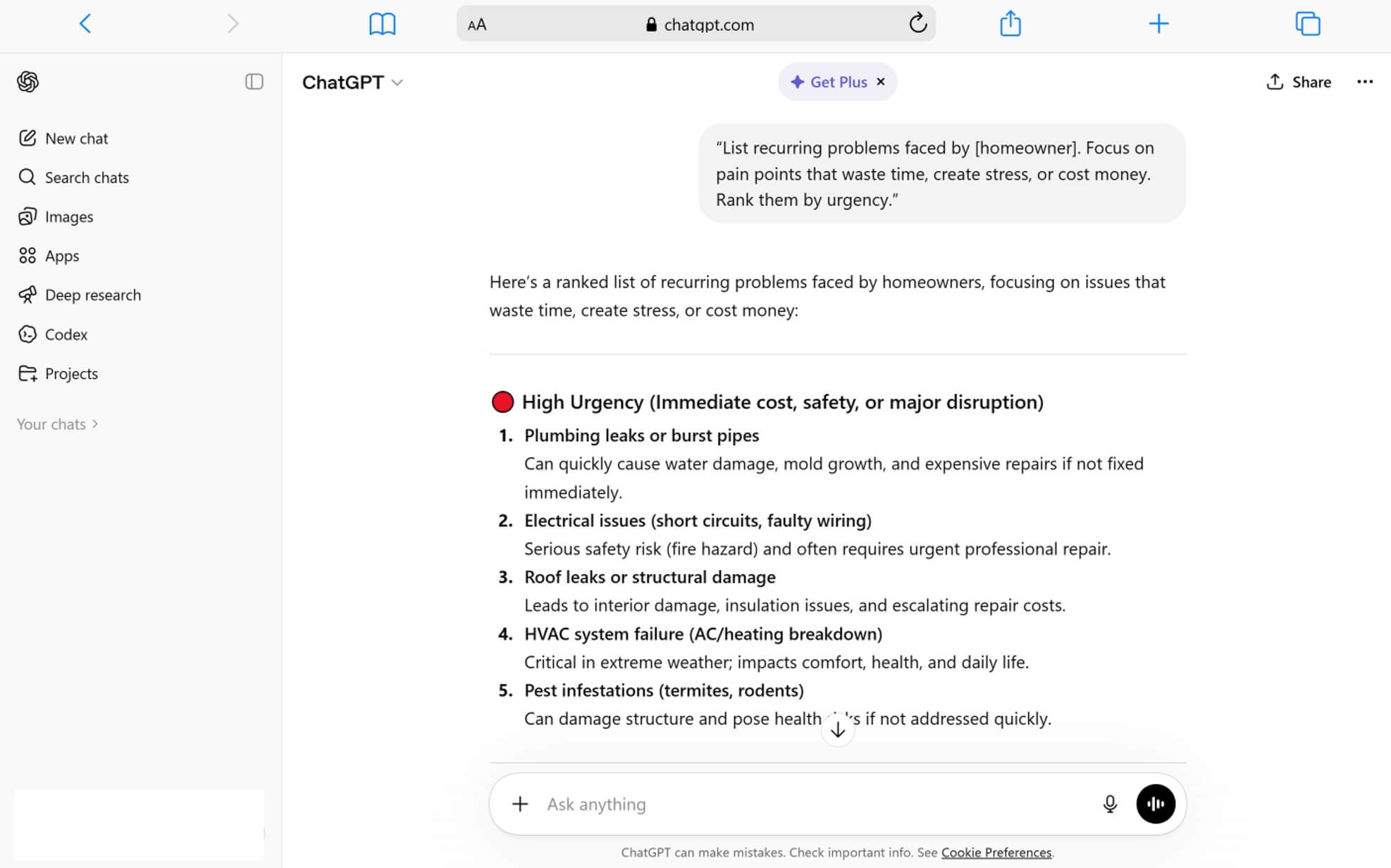
- “List recurring problems faced by [target audience]. Focus on pain points that waste time, create stress, or cost money. Rank them by urgency.”
This is where I usually start when I know the audience but not the offer. - “What tasks do [target audience] regularly avoid, delay, or complain about? Turn each one into a possible business opportunity.”
Avoided tasks often hide useful service ideas. - “Show me common situations where [target audience] still relies on manual work, messy notes, back-and-forth messages, or confusing steps.”
Mess usually signals opportunity. - “List the most frustrating mistakes people in [market] make. Suggest businesses that help prevent or reduce those mistakes.”
Prevention can be easier to sell than improvement. - “Find boring but important problems in [industry], especially around admin, scheduling, reporting, compliance, reminders, or follow-up.”
Boring markets often get overlooked, which can make them attractive. - “What problems do people in [target audience] deal with every week? Suggest business ideas built around those repeat frustrations.”
Repeat pain is usually better than occasional pain. - “Identify underserved customer groups in [city, niche, or industry] and explain what larger companies often fail to solve for them.”
This is useful when you want a narrower, more defendable niche. - “Find business opportunities based on emotional pain for [target audience], including stress, confusion, guilt, fear, embarrassment, or overload.”
Emotional pain often drives fast buying decisions.
Which prompts help you find buyers who can actually pay?
These prompts help you connect the problem to a customer with budget and urgency.
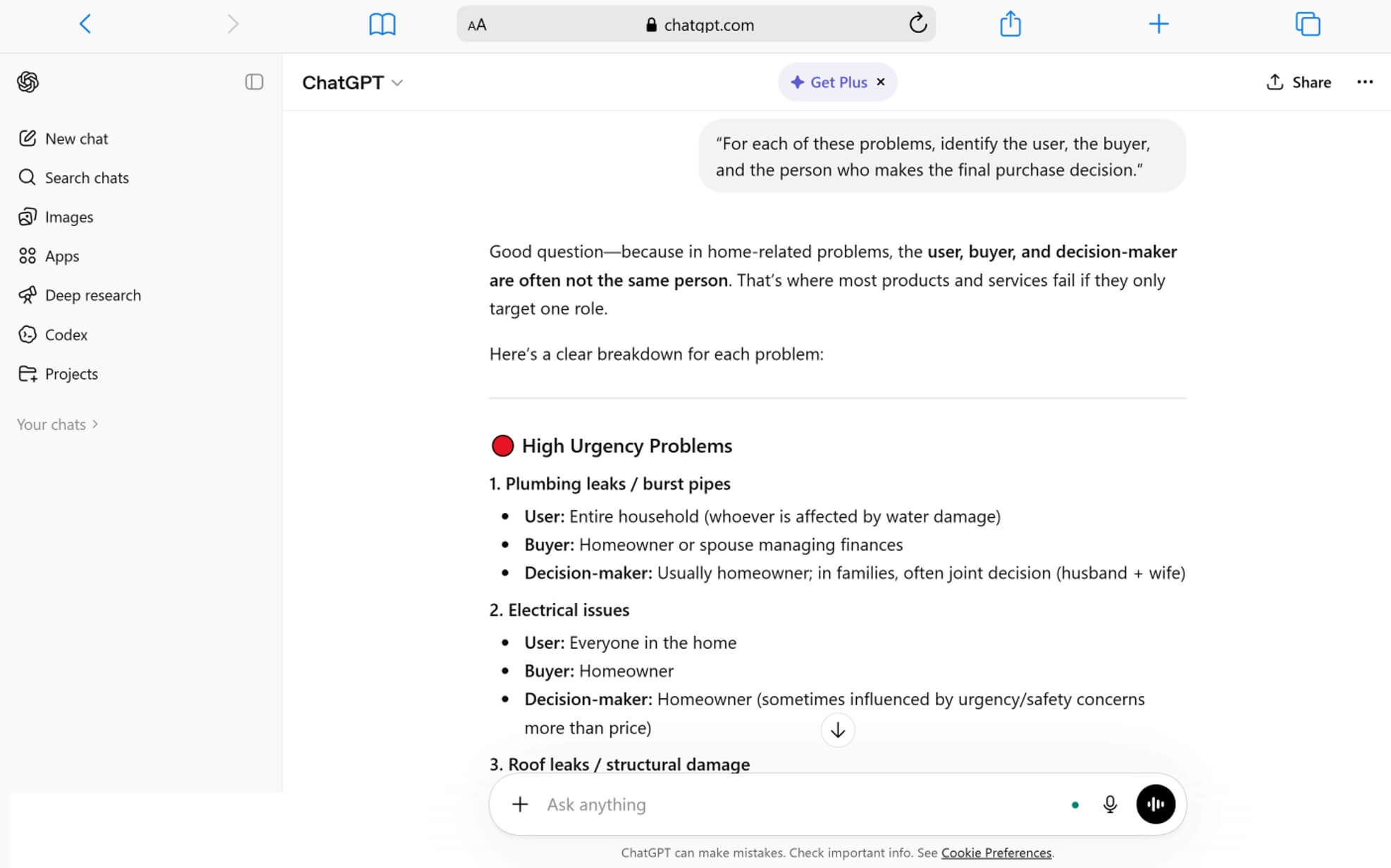
- “For each of these problems, identify the user, the buyer, and the person who makes the final purchase decision.”
This matters because the user and buyer are not always the same person. - “Which customer groups are most likely to pay for a solution to [problem]? Rank them by urgency, ease of reach, and likely willingness to spend.”
This helps you find a better starting market. - “Compare business opportunities for solving [problem] in B2B and B2C markets. Show differences in sales style, pricing, and repeat revenue.”
Sometimes the same problem becomes a better business in a different market. - “Suggest business ideas for [target audience] that begin as a service and can later become a product, membership, template pack, or software tool.”
I like this because service-first businesses teach you quickly. - “List business ideas for [problem] that could work as a local service and as an online business. Compare which model is easier to start.”
This is useful when you are deciding how you want to operate. - “Which ideas in [market] have repeat demand, low overhead, and room for simple premium pricing?”
Good ideas should not just sound nice; they should have business logic. - “Find business ideas created by complexity in [market], such as paperwork, setup, organization, communication gaps, or confusing decisions.”
Complexity often creates steady demand for help.
Which prompts help you shape the business idea into a clear offer?
These prompts help you turn an idea into something people can understand fast.
- “Turn this idea into a one-sentence value proposition for [target audience]. Keep it simple, direct, and specific.”
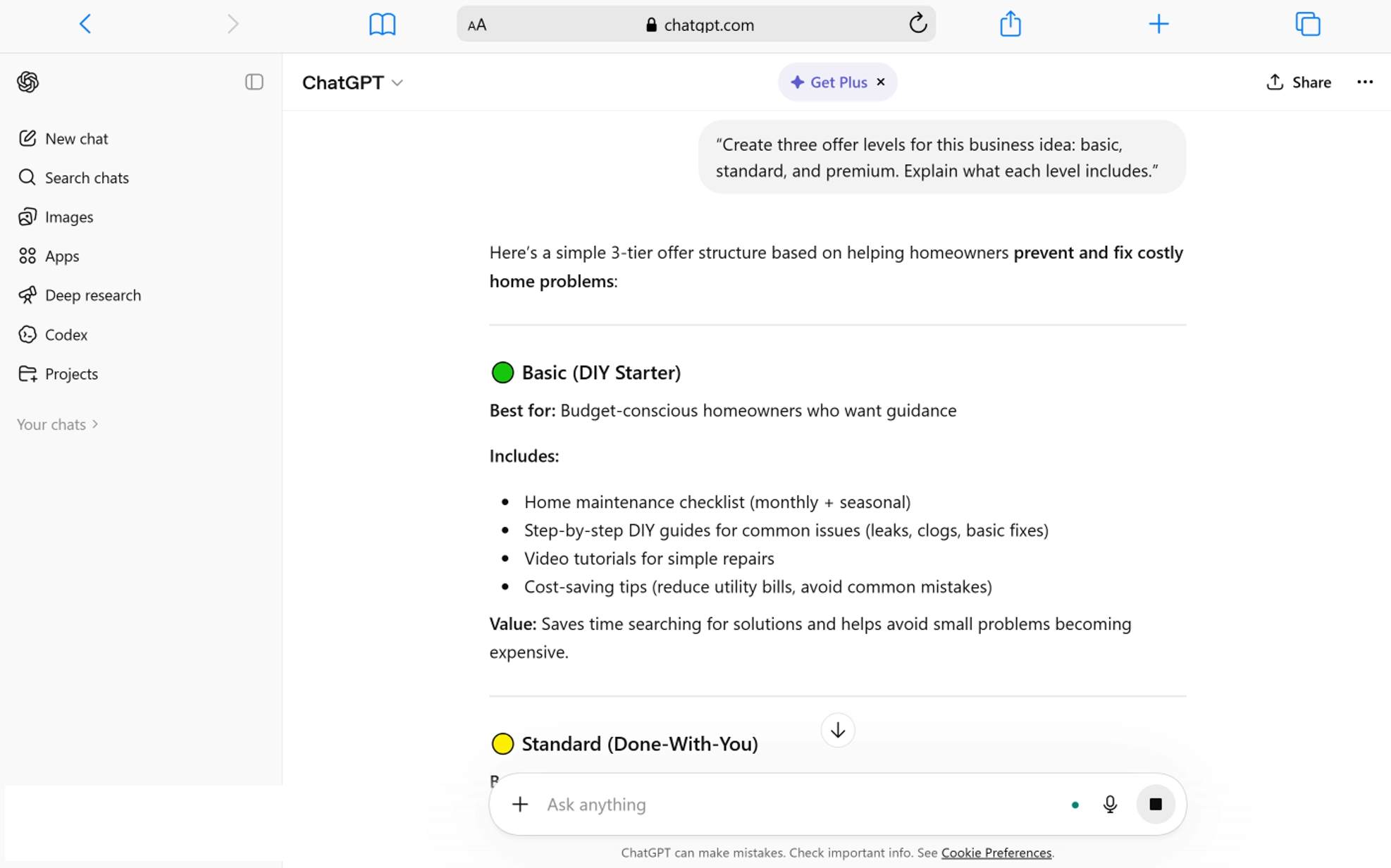
If your business is hard to explain, it is hard to sell. - “Create three offer levels for this business idea: basic, standard, and premium. Explain what each level includes.”
This gives shape to pricing and packaging. - “What result does the customer truly want from [idea]? Break it into practical, emotional, and convenience-based outcomes.”
People buy outcomes, not vague promises. - “Rewrite this business idea in plain language so a child could explain what it does and why someone would want it.”
This removes fluff fast. - “If I launched this business as a service first, what exact deliverables should I include in the first month?”
This moves the idea toward something real. - “Create a simple first offer for [target audience] that solves one painful problem quickly and clearly.”
Fast, narrow offers often sell better than broad ones. - “What proof, guarantee, example, or risk-reversal would make this offer easier to trust?”
Trust is part of the offer, not just the marketing.
Which prompts help you test demand before you build too much?
These prompts help you learn fast without overbuilding.
- “Give me five low-cost ways to test demand for [idea] in a small, practical way.”
I use this to avoid building too early. - “Write customer interview questions that help me learn whether [target audience] truly feels the problem [problem].”
Good questions reveal pain instead of fishing for praise. - “Create a landing page outline for [idea] that tests buying interest rather than casual curiosity.”
This helps you frame a stronger message. - “List the most likely objections someone would have before buying this offer, and explain how to reduce each one.”
Objections often tell you what your business is missing. - “What signs would suggest this idea is weak, moderate, or strong after an early test?”
You need warning signs, not just encouragement.
Which prompts help you choose the best idea instead of the most exciting one?
These prompts help you compare ideas with more discipline and less emotion.
- “Compare these business ideas using problem strength, buyer clarity, ease of launch, repeat revenue potential, and fit with my skills.”
This is one of the most practical prompts in the whole set. - “Score each idea from one to ten for demand, differentiation, simplicity, cost to start, and speed to first sale.”
A scorecard helps cut through emotional bias. - “If I had to choose one business idea to test first with limited time and limited budget, which one should I pick and why?”
Forced choices often reveal the strongest option.
How can you customize these prompts so they fit your life?
You can customize them by adding your strengths, limits, and preferred business model.
A business idea can look good on paper and still be wrong for you. That is why I do not separate market fit from founder fit. You have to respect both.
Here is what I would add to many of these prompts.
- Your skills: writing, design, teaching, organization, sales, coding, local relationships, operations
- Your limits: budget, time, energy, location, family schedule, risk tolerance
- Your preferred model: service business, productized service, digital product, subscription, local business, online business
- Your no-go list: inventory, travel, cold outreach, employees, paid ads, complex setup
Here is a quick before-and-after example.
Basic version:
Give me business ideas for accountants.
Better version:
Give me business ideas for accountants who want a one-person business with low startup cost, no inventory, and the option to earn repeat monthly revenue.
That small change improves the output because it makes the options more realistic.
What does a weak idea look like next to a stronger one?
A stronger idea is easier to explain, easier to test, and easier to sell.
| Weak idea | Why it feels weak | Stronger version |
|---|---|---|
| Start a marketing agency | Too broad and crowded | Offer review-response support for local dental practices |
| Sell templates online | No clear buyer or pain | Sell proposal templates for new freelance bookkeepers |
| Build an app for parents | Too vague and costly to test | Create a weekly meal planning membership for families with dietary restrictions |
| Start a cleaning company | Still too general | Offer turnover cleaning and restocking for short-term rental hosts |
The stronger versions are narrower, but that is a benefit. A narrow promise is often the first sign of a usable business.
Why should you validate the problem before building the full business?
You should validate the problem first because building too soon is one of the fastest ways to waste time.
I have seen people spend weeks naming a business, designing a site, and polishing an offer before confirming whether anyone truly cares. That feels productive, but it often delays the real work.
The real work is learning.
You do not need a finished company to start learning. You need a clear problem, a clear audience, and a simple way to test interest.
Here are the small validation moves I trust most.
- Talk to people who fit the market. Ask about their workflow, frustrations, and current workaround.
- Offer a small paid test. A small sale teaches you more than compliments.
- Write a one-page offer. Keep the promise narrow and practical.
- Try the service manually first. This shows you what customers actually value.
- Notice repeated language. The way buyers describe the pain helps shape your message.
When you validate the problem first, you stop guessing in the dark. You start learning in public.
Which mistakes quietly ruin otherwise good business ideas?
The biggest mistakes are vagueness, overbuilding, and ignoring what buyers actually care about.
This is where many decent ideas lose momentum. The founder is working hard, but the work is pointed in the wrong direction.
Here are the mistakes I would watch carefully.
- You ask for ideas without naming a clear customer.
That creates weak answers and weaker positioning. - You chase novelty instead of pain.
New does not always mean needed. - You confuse interest with buying intent.
“That sounds cool” is not the same as “I want this.” - You stay too broad for too long.
Broad ideas feel safe, but they are harder to sell. - You build before you test.
Early learning matters more than early polish. - You ignore distribution.
A good idea still needs a path to real customers.
If you can avoid those mistakes, your prompts become far more useful because they are tied to better business habits.
How can you turn ChatGPT output into a real business test quickly?
You can turn AI output into action by narrowing the idea and testing one promise with one audience.
This is the simple path I would follow.
- Choose one audience. Do not test three markets at once.
- Choose one painful problem. Look for something frequent and frustrating.
- Choose one offer. Keep it small and clear.
- Talk to a handful of potential buyers. Let their language shape your pitch.
- Run a basic test. A direct message, a short call, or a one-page offer can work.
- Refine the idea. Feed what you learn back into your prompts and improve the angle.
That last step is where ChatGPT becomes especially helpful. Your first prompt gives you possibilities. Your later prompts help you sharpen those possibilities into something more solid.
Why does prompt quality matter so much when you are building a business?
Prompt quality matters because better questions lead to better business decisions.
A weak prompt gives you generic output. Generic output creates generic thinking. Generic thinking creates broad offers, messy positioning, and slow progress.
A strong prompt does the opposite. It helps you identify the customer, clarify the problem, shape the offer, and notice trade-offs earlier. That speed matters. Not because speed is everything, but because fast learning helps you stop wasting effort.
I think of prompt writing as a business skill now. Not a writing trick. Not a novelty. A real skill. If you can ask better questions, you can usually make better decisions faster.
How should you score the ideas ChatGPT gives you?
You should score them against reality, not excitement.
A pretty idea is not the same as a workable idea. I like using a simple comparison table before I get attached to anything.
| Factor | What you are checking | Why it matters |
|---|---|---|
| Problem strength | How painful and frequent the issue is | Frequent pain creates stronger demand |
| Buyer clarity | Whether you can clearly name who pays | Clear buyers are easier to reach |
| Offer simplicity | Whether the promise is easy to explain | Simple offers are easier to sell |
| Ease of launch | Whether you can test it without heavy setup | Fast learning reduces risk |
| Repeat revenue | Whether the need returns often | Repeat demand supports stability |
| Fit with you | Whether your skills and limits match the model | Good execution depends on fit |
If an idea scores well across most of those factors, I pay attention. If it only looks exciting, I stay cautious.
What would I do after picking one idea from the list?
I would validate the pain, sharpen the offer, and ask for a small sale early.
That is the order that keeps you grounded.
- Interview potential buyers. Learn what makes the problem annoying, costly, or urgent.
- Write a clearer value proposition. Keep refining until it feels obvious.
- Package a simple first offer. One painful problem, one clear result.
- Test that offer in the real world. Do not wait for perfect branding.
- Use ChatGPT again after the test. Improve your angle based on what real people told you.
That cycle is more important than the first brainstorm. The first brainstorm gives you options. The feedback loop gives you traction.
What questions do people usually ask about ChatGPT prompts for business ideas?
Can ChatGPT give you a good business idea by itself?
No, ChatGPT cannot build a strong business idea by itself because it still needs your judgment, your context, and real market feedback. It can help you uncover possibilities, but you still need to test what buyers care about.
Should you ask for as many ideas as possible first?
No, asking for too many ideas too early usually creates clutter instead of clarity. You are better off asking for fewer ideas with stronger constraints and better context.
Can ChatGPT help you validate a business idea?
Yes, ChatGPT can help you validate a business idea by helping you write interview questions, compare objections, draft offers, and plan small tests. It supports the validation process, but it does not replace real conversations with buyers.
Is it smarter to start with a niche?
Yes, starting with a niche usually gives you a clearer customer, a clearer problem, and a clearer message. Broad markets often sound appealing, but narrow offers are usually easier to test and sell.
Should you build the whole product before testing demand?
No, building the whole product before testing demand often wastes time and money. A small offer, a pilot, or a manual version can teach you what matters much faster.
Can a service idea turn into a bigger business later?
Yes, a service idea can grow into a bigger business because service work often reveals what customers truly value. Many stronger products begin as simple manual services.
Do you need expert-level prompt skills to use ChatGPT for business ideas?
No, you do not need advanced prompt skills to get useful results. You mostly need clear thinking, a defined customer, and a willingness to refine the question after each round.
What should you remember before you use these 30 prompts?
You should remember that prompts do not create businesses on their own; clear thinking and honest testing do.
If you use ChatGPT like a random idea machine, you will probably get random idea results. If you use it to uncover pain points, compare business models, shape offers, and pressure-test your assumptions, it becomes much more valuable.
Start with people. Start with problems. Use the prompts to narrow your focus, not widen your confusion. Then choose one idea, test it simply, and learn from the market before you overbuild.
That is how I would use these prompts, and that is how I think you will get the most value from them too.
You May Also Like
 AI Tool Reviews
How to Use ChatGPT for Beginners: The Complete Step-by-Step Guide (2026)
 ChatGPT
How to Use ChatGPT at Work: Productivity Tips That Actually Save You Hours
 ChatGPT
How to Use ChatGPT Best Prompts
 AI Models
GPT-5.5 vs Claude Opus 4.7 vs Gemini 3.1 Pro: Real Benchmark Results Compared
 ChatGPT
 5.5 Is Here: Benchmarks, What’s New, What’s Different, and Is It Actually Worth the Hype?
 ChatGPT
