
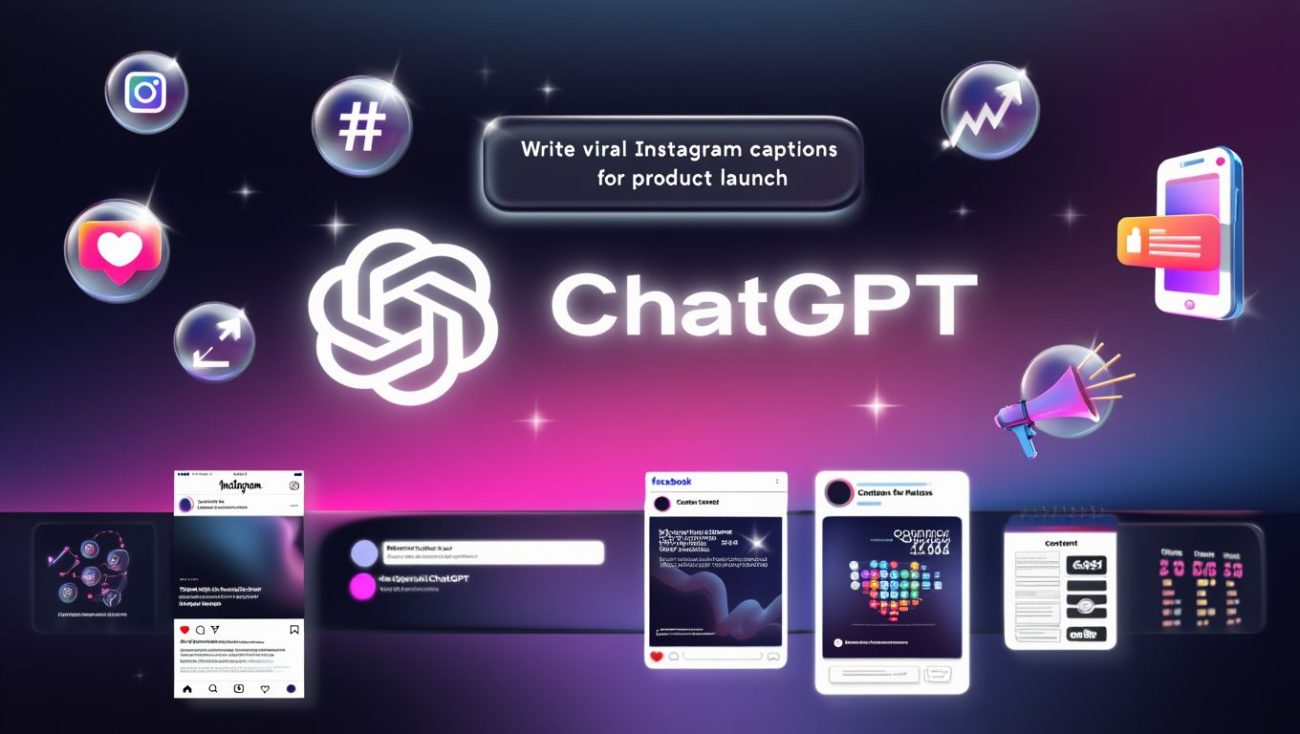
ChatGPT prompts for social media marketing help you create better content faster. They turn blank pages into engaging posts, catchy captions, and viral videos. You can use these prompts to write Instagram captions, LinkedIn articles, TikTok scripts, and Facebook ads in minutes. This guide shows you exactly how to do it.
I’ve spent months testing different prompts across platforms like Instagram, LinkedIn, and TikTok. Some worked great. Others fell flat. I’ll share what actually helps you grow your audience and save time. Whether you run a small business, manage social accounts for clients, or build your personal brand, these prompts will change how you create content.
What Are ChatGPT Prompts for Social Media Marketing?
ChatGPT prompts for social media marketing are specific instructions you give to AI tools like ChatGPT to generate content for your social platforms. You tell the AI what you need—like an Instagram caption or LinkedIn post—and it writes it for you. The better your prompt, the better the output.
Think of prompts as recipes. A bad recipe gives vague instructions: “Make something tasty.” A good recipe tells you exactly what ingredients to use and how to combine them. Good prompts include details about your brand voice, target audience, and goals. This helps ChatGPT create content that sounds like you and speaks to your followers.
Why Do You Need AI Prompts for Social Media?
You need AI prompts because creating daily content burns you out. Social media managers spend 6-8 hours per week just writing captions and posts. That time could go toward strategy, engagement, or growing your business. ChatGPT cuts that time in half when you use the right prompts.
AI also helps you stay consistent. Posting regularly grows your audience. But coming up with fresh ideas every day drains your creativity. Generative AI social media prompts give you endless content ideas without the mental fatigue. You can plan weeks ahead instead of scrambling for post ideas at midnight.
How ChatGPT Transforms Your Social Media Workflow
From Blank Page to Published Post in Minutes
You can create a full week of social media content in under 30 minutes using the right ChatGPT workflow for social media managers. Here’s how it works:
- Feed your strategy into ChatGPT. Tell it about your brand, audience, and goals.
- Generate content batches. Ask for 7 Instagram captions or 5 LinkedIn posts at once.
- Edit and personalize. Add your voice, tweak details, and insert emojis.
- Schedule and publish. Use tools like Hootsuite, Buffer, or Meta Ads Manager to post automatically.
This workflow beats staring at a blank screen, wondering what to write. Natural language generation for SMM means you spend less time writing and more time engaging with your community.
Building Your Brand Voice with AI
Your brand voice makes you recognizable. ChatGPT can mimic your style if you train it properly. Start by feeding it examples of your best posts. Tell it: “Write like this.” Include details about your tone—friendly, professional, sarcastic, or inspiring.
For example, if you run a fitness brand, you might say: “Write in an encouraging, energetic tone. Use short sentences. Include motivational phrases. Avoid complicated fitness jargon.” This prompt engineering for SMM ensures every post sounds like it came from you, not a robot.
Essential ChatGPT Prompts for Instagram Content
ChatGPT Prompts for Instagram Captions and Reels
Instagram rewards engaging captions and entertaining Reels. These prompts help you create both:
For Carousel Posts:
“Write 5 Instagram carousel captions for a [your niche] account. Each caption should hook readers in the first line, provide value in the middle, and include a call to action at the end. Use emojis naturally. Target audience: [describe your followers].”
For Reels Scripts:
“Create a 30-second Reels script about [topic]. Include a strong hook in the first 3 seconds, 3 quick tips in the middle, and an ending that encourages comments. Add suggested visual cues in brackets.”
For Story Engagement:
“Generate 10 Instagram Story ideas for a [business type]. Mix polls, questions, behind-the-scenes content, and educational tips. Make them interactive to boost engagement.”
AI-Powered Hashtag Research
Hashtags help new people find your content. But researching them takes forever. Use this prompt:
“Find 30 relevant hashtags for a post about [topic]. Split them into 3 groups: 10 broad hashtags (1M+ posts), 10 medium hashtags (100K-1M posts), and 10 niche hashtags (under 100K posts). Include a mix of popular and emerging tags.”
This prompt engineering for social media saves you from hashtag overwhelm. You get a balanced strategy that reaches big audiences while still ranking in smaller, active communities.
LinkedIn Content That Builds Authority
ChatGPT for LinkedIn Posts and Thought Leadership
LinkedIn rewards professional, value-packed content. Your posts need to educate, inspire, or start conversations. Here’s a prompt that works:
“Write a LinkedIn post about [industry topic]. Start with a personal story or surprising statistic. Include 3 actionable takeaways. End with a question to encourage comments. Keep paragraphs short (1-2 sentences). Use professional but conversational language.”
AI Prompts for LinkedIn Thought Leadership Posts
Thought leadership sets you apart as an expert. Use this prompt to establish credibility:
“Create a LinkedIn article outline about [complex topic in your industry]. Include: 1) A controversial or counterintuitive opening statement, 2) Personal experience or case study, 3) 3-5 lessons learned, 4) Practical advice for readers, 5) A forward-looking conclusion. Tone: confident but humble.”
ChatGPT for LinkedIn posts helps you maintain consistency without spending hours writing. You can batch-create a month’s content in one sitting, then focus on networking and engagement.
TikTok and Video Content Scripts
ChatGPT Prompts for Viral TikTok Videos
TikTok’s algorithm loves watch time and engagement. Your scripts need to hook viewers immediately. Try this:
“Write a 45-second TikTok script about [topic]. Structure: 0-3 seconds: Pattern interrupt or bold claim. 3-30 seconds: 3 quick, valuable tips with fast pacing. 30-45 seconds: Call to action (follow, comment, or check link). Include [text on screen] suggestions and [visual direction].”
YouTube Shorts and Long-Form Content
YouTube Shorts follow similar rules to TikTok. For long-form videos, use:
“Create a YouTube video script outline for ‘[your video title]’. Include: Hook (0-30 seconds), Introduction with value promise (30-60 seconds), 3 main sections with subpoints, Conclusion with call to subscribe, and 3 suggested timestamps.”
AI content creation social media tools like ChatGPT help you script faster. But remember: your personality makes videos viral, not just the script. Use AI for structure, then add your unique energy.
Facebook Ads and Promotional Content
Effective ChatGPT Prompts for Facebook Ad Copy
Facebook ads need to stop the scroll and drive action. Here’s a prompt that converts:
“Write 3 versions of Facebook ad copy for [product/service]. Version 1: Focus on pain points and solutions. Version 2: Use social proof and testimonials. Version 3: Create urgency with limited-time offer. Each should have a headline under 40 characters, primary text under 125 characters (before ‘see more’), and a clear call to action. Target audience: [demographics and interests].”
Promoting Without Being Pushy
Nobody likes feeling sold to. This prompt helps you balance promotion with value:
“Create 5 soft-sell social media posts for [product]. Each should provide standalone value (tip, insight, or entertainment) while subtly mentioning the product. Use storytelling and avoid aggressive sales language.”
Prompts for Facebook ads work best when you test multiple angles. ChatGPT generates variations fast, so you can A/B test and find what resonates with your audience.
Building Your Content Calendar with AI
How to Use ChatGPT for Social Media Content Calendar
Planning beats posting randomly. A content calendar keeps you consistent and strategic. Use this prompt:
“Create a 4-week social media content calendar for a [business type]. Include: 4 Instagram feed posts, 8 Instagram Stories, 4 LinkedIn articles, 2 TikTok videos, and 2 Facebook posts per week. Themes should rotate between educational, entertaining, promotional, and community-building content. Provide specific post ideas for each slot.”
Monthly and Quarterly Planning
Scale up with this advanced prompt:
“Develop a monthly social media content calendar for [brand]. Week 1: Focus on educational content. Week 2: User-generated content and community. Week 3: Behind-the-scenes and brand story. Week 4: Promotional and lead generation. Include daily post types, suggested captions, and hashtag groups for each platform.”
ChatGPT social media content calendars help you see the big picture. You spot gaps, ensure variety, and align posts with business goals like product launches or seasonal events.
Engagement and Community Management
AI Prompts for Comment Responses and DMs
Engagement builds relationships. But responding to every comment takes hours. These prompts help:
“Write 10 friendly, personalized responses to common comments like ‘Love this!’, ‘How much does it cost?’, and ‘Can you explain more?’ Match the tone of a [brand personality] brand. Keep responses under 50 words.”
“Create DM templates for: 1) New follower welcome, 2) Customer service inquiry, 3) Collaboration request, 4) Thank you for purchase. Make them warm and conversational, not robotic.”
Sparking Conversations with Questions
Questions boost your engagement rate. Use this prompt to generate conversation starters:
“Generate 20 engagement questions for [niche] social media posts. Mix professional questions (industry trends, career advice) with personal ones (work-life balance, productivity hacks). Avoid yes/no questions. Aim for questions that spark stories and opinions.”
Advanced Prompt Engineering Techniques
Semantic Content Optimization Prompts
Semantic SEO isn’t just for blogs. It helps social content too. Use this approach:
“Create a post about [topic]. Include related concepts like [concept 1], [concept 2], and [concept 3]. Use natural language that connects these ideas. Write for humans first, but include keywords that signal expertise to algorithms.”
Chain-of-Thought Prompting
Complex tasks need step-by-step thinking. Try this structure:
“Think step by step to create a social media campaign for [product launch]. Step 1: Identify the target audience’s biggest pain point. Step 2: Connect that pain point to our solution. Step 3: Draft 5 posts that tell this story across different platforms. Step 4: Suggest visuals for each post.”
Prompt engineering for social media gets better when you break big tasks into smaller steps. ChatGPT produces higher quality output when you guide its thinking process.
Platform-Specific Strategies
X (Twitter) and Threads Content
Twitter rewards brevity and wit. Use this prompt:
“Write 10 tweets about [topic]. Mix formats: 1) Single powerful statement, 2) Thread with 5 tweets telling a story, 3) Question to spark discussion, 4) Contrarian opinion with explanation, 5) Quick tip or hack. Keep under 280 characters. Include relevant hashtags.”
YouTube Community Posts
YouTube Community tabs boost channel engagement. Try:
“Generate 5 YouTube Community post ideas for a [channel niche]. Include: 1) Poll about next video topic, 2) Behind-the-scenes photo caption, 3) Question for comment discussion, 4) Celebration of subscriber milestone, 5) Teaser for upcoming content.”
Small Business and E-commerce Applications
Small Business Social Media ChatGPT Prompts
Small businesses need local engagement. Use this:
“Create social media content for a local [business type] in [city]. Include posts about: Community involvement, Customer spotlights, Local events, Behind-the-scenes of the business, and Special offers for followers. Emphasize local connection and personal service.”
E-commerce Instagram Prompts
Product-based businesses need visual, shoppable content. Try:
“Write 8 Instagram captions for an e-commerce brand selling [products]. Include: 1) Product benefit focus, 2) Lifestyle/aspirational angle, 3) User-generated content style, 4) Educational/how-to, 5) Limited-time offer, 6) Social proof/testimonial, 7) Behind-the-scenes creation, 8) Customer question answered. Add relevant hashtags and call-to-action for each.”
B2B and Professional Services
B2B LinkedIn AI Prompts
B2B content needs to demonstrate expertise. Use this:
“Create LinkedIn content for a [industry] B2B company. Focus on: Industry trends and insights, Case studies with results, Thought leadership on common challenges, Employee expertise and culture, and Practical guides for decision-makers. Tone: professional, data-driven, helpful.”
Digital Marketing Agency ChatGPT Tools
Agencies need to scale content creation. This prompt helps:
“Develop a content framework for [client industry] including: Brand voice guidelines, 20 reusable content templates, Hashtag strategy, Posting schedule recommendations, and Engagement response templates. Make it easy for junior team members to maintain quality.”
Measuring Success and Optimizing
Analytics Insights Prompts
Data tells you what works. Use AI to interpret it:
“Analyze these social media metrics [paste data]. Identify: Top performing post types, Best posting times, Audience growth patterns, and Engagement rate trends. Suggest 5 specific actions to improve performance next month.”
A/B Testing with AI
Test different approaches efficiently. Try:
“Create 2 versions of a post about [topic]. Version A: Focus on emotional storytelling. Version B: Focus on logical benefits and data. Both should fit [platform] best practices. Explain which might perform better for [specific audience] and why.”
FAQ: Common Questions About AI and Social Media Marketing
Can AI completely replace human social media managers?
No. AI handles repetitive tasks like writing first drafts and researching hashtags. But you need humans for strategy, community building, and crisis management. AI doesn’t understand cultural nuances or build genuine relationships. Use ChatGPT for efficiency, but keep the human touch for connection.
Is using ChatGPT for social media content considered cheating?
No. Using ChatGPT for social media content is a tool, not cheating. Professional writers, marketers, and businesses use AI to streamline workflows. The key is adding your unique perspective and editing AI output to match your voice. Original thought and strategy still come from you.
Will AI-generated content hurt my engagement rates?
Not if you do it right. Generic, unedited AI content performs poorly. But personalized, edited AI content often outperforms because it’s more consistent and strategic. The difference is in the prompting and editing. Spend time crafting good prompts and refining outputs.
How do I make AI content sound like me?
Train ChatGPT with examples. Feed it 10-20 of your best posts. Tell it: “Analyze my writing style and create new content matching this voice.” Include details about sentence length, vocabulary level, humor style, and common phrases you use. Edit outputs to add personal touches only you would know.
What’s the best AI for social media content: ChatGPT or Claude?
Both work well, but they differ. ChatGPT excels at creative, engaging copy and following specific formatting instructions. Claude often provides more nuanced, thoughtful analysis and longer-form content. Test both with your specific prompts to see which matches your needs. Many professionals use both for different tasks.
How often should I post AI-generated content?
Mix AI and original content. A good ratio is 70% AI-assisted (heavily edited) and 30% fully original. Or use AI for routine posts (tips, quotes, product features) and write personal stories and reactions yourself. Your audience follows you for your unique perspective, not generic content.
Can I use the same prompt for all platforms?
No. Each platform has different audiences, formats, and best practices. Instagram needs visual descriptions and emoji-rich captions. LinkedIn requires professional, paragraph-based posts. TikTok scripts need timing cues and visual directions. Customize prompts for each platform’s unique requirements.
How do I avoid sounding robotic with AI content?
Add human elements deliberately. Include personal anecdotes, specific details about your day, opinions on industry news, and casual language like “honestly” or “tbh.” Read outputs aloud—if it sounds weird when spoken, rewrite it. Break grammar rules occasionally for flow.
Your Action Plan: Getting Started Today
- Start small to build your ChatGPT workflow for social media managers. Pick one platform where you struggle most with content. Create 3-5 prompts tailored to that platform. Generate one week of content. Edit heavily. Post and measure results.
- Refine your prompts based on what performs well. Save successful prompts in a document or note-taking app. Build your own AI prompt library for SMM over time. Share prompts with your team to maintain consistency.
- Scale gradually. Once one platform runs smoothly, add another. Use social media AI tools like Hootsuite or Buffer to schedule everything. Spend your newfound time engaging with your community and analyzing what works.
Conclusion: The Future of AI in Social Media
ChatGPT prompts for social media marketing aren’t just a trend—they’re becoming essential. As platforms get more competitive and audiences demand more content, AI helps you keep up without burning out. But remember: tools amplify strategy, they don’t replace it.
Your unique voice, stories, and perspective still matter most. Use AI to handle the heavy lifting of drafting and research. Pour your energy into the parts that require human creativity: strategy, community building, and authentic connection.
You May Also Like
 AI Tool Reviews
How to Use ChatGPT for Beginners: The Complete Step-by-Step Guide (2026)
 ChatGPT
How to Use ChatGPT at Work: Productivity Tips That Actually Save You Hours
 ChatGPT
How to Use ChatGPT Best Prompts
 AI Models
GPT-5.5 vs Claude Opus 4.7 vs Gemini 3.1 Pro: Real Benchmark Results Compared
 ChatGPT
ChatGPT 5.5 Is Here: Benchmarks, What’s New, What’s Different, and Is It Actually Worth the Hype?
 ChatGPT